
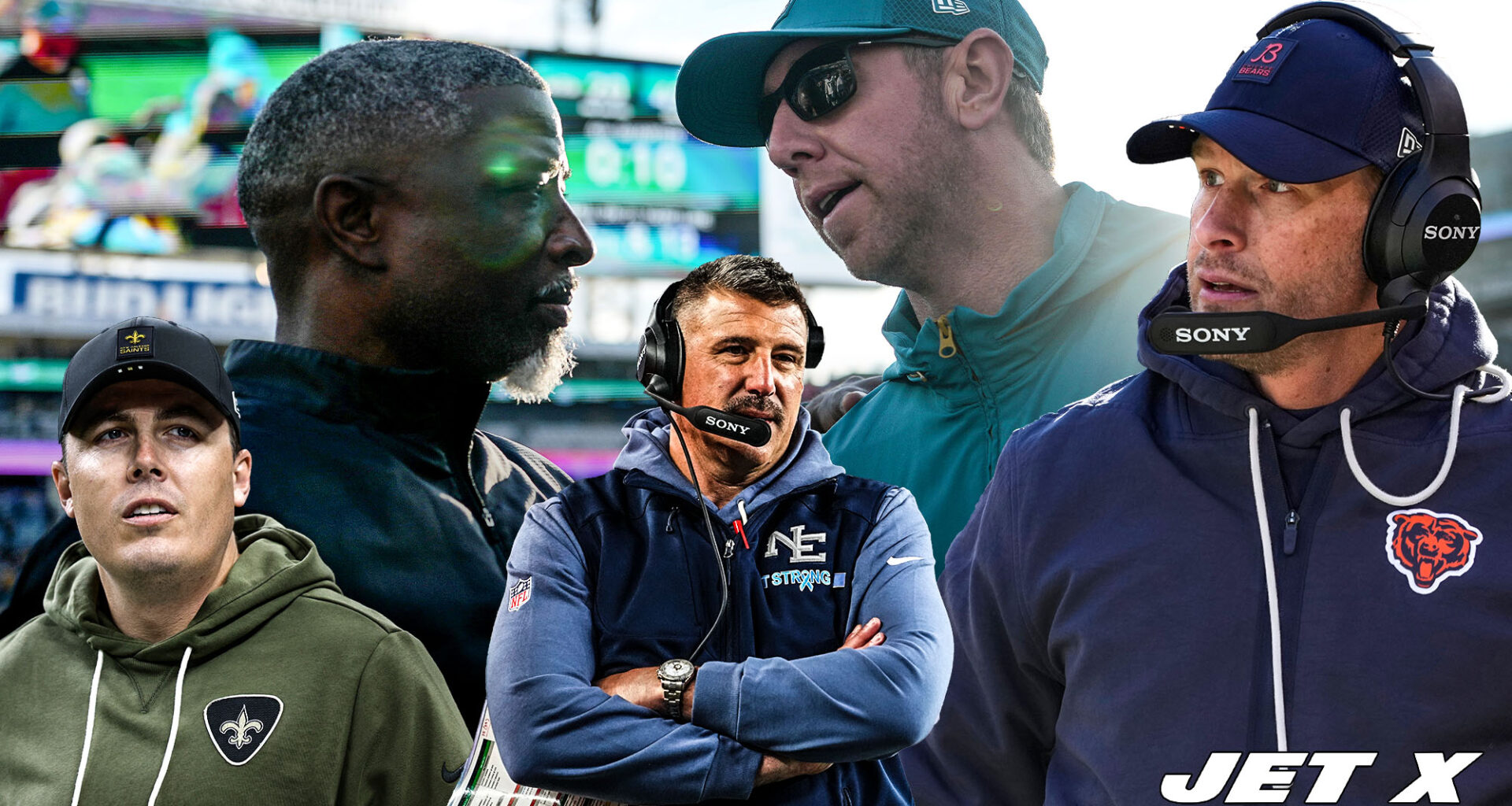
Hope is hampering the New York Jets. The idea of hope is what consistently leads them astray, off the beaten path that usually leads NFL teams to success in this fresh world.
A handful of teams can effectively lay claim as neighbors. Only the Jacksonville Jaguars (76-152) can lay claim to this isolated neighborhood’s captaincy, whereas the Cleveland Browns (77-150-1), New York Giants (82-145-1), Las Vegas Raiders (85-143), and Washington Commanders (93-133-2) are secure in its citizenship.
These NFL franchises live among the New York Jets, whose 77-151 record is the second-worst mark since the 2012 season. Just in case subtlety is drowning out the particulars, this is the neighborhood of the have-nots, those unfortunate organizations that cannot seem to get things right in the modern National Football League, where offensive efficiency rules the roost, and physicality is hard to spot.
In many ways, 2012 marks a clear line of demarcation.
The backdrop
Jets fans remember all too well: In 2011, Victor Cruz emphatically stamped the unofficial end of the Rex Ryan era. Rex’s physical, no-holds-barred, and ground-and-pound Jets teams qualified for the AFC championship game in each of the two previous seasons.
Yet, in 2011, New York disappointingly finished 8-8, missing the playoffs, ultimately leading to men named Tim Tebow and Tony Sparano, which then helped lead to a man named John Idzik.
In short, as the years progressed, Rex found it increasingly difficult to hit the quarterback. The more the offensive nerds perfected the three-step game, the less time there was to execute elaborate blitz packages.
Meanwhile, 2012 marked the rise of the zone-read offense. Kyle Shanahan’s Washington offense featured youngster Robert Griffin III, and Jim Harbaugh and Greg Roman’s San Francisco system was led by Colin Kaepernick. Suddenly, something was happening to the pro game that no old head could have ever dared dream was possible: college football principles invaded the NFL.
Nobody ever thought it was possible to risk a quarterback on the edge in this league. Maybe once a game, as a surprise, it could sneak by. That’s it. Running an actual offense that utilized the quarterback’s legs as a threat edge was akin to a guaranteed trip to the hospital.
By the 2012 season, that idea had gone kaput. It began with an accident—the Miami Dolphins’ desperate wildcat package some years earlier, which utilized east-west principles through motion—and the early read-option offenses in Washington and San Francisco ignited something.
In short, the sudden quarterback freedom came as a result of the NFL’s intense focus on player safety, or, more precisely, eliminating head injuries. Combine that with the similar hawkish attitude on cutting down on defensive coverage contact, and suddenly, football had changed irreversibly.
The current situation
Seriously, is it any coincidence that the Jets, an organization that has exclusively hired defensive-minded head coaches under this current ownership (save for Adam Gase), have experienced their worst run in franchise history—at the same time the league has drastically changed to favor offensive football and speed?
The current New York Jets, sporting a 3-13 record—having already broken the record for the worst December point differential in NFL history—find themselves in a familiar situation. Head coach Aaron Glenn continues to preach and sell hope to the fanbase.
Whether he’s uttering mantras related to “instant coffee” and “not letting go of the rope,” or he’s continuously harping on the overall talent level of the roster, the Jets’ action items seem to revolve around hope and belief.
Great job, getting this out there through the #Jets fans’ lens. For the most part, I agree with it—*hope* is the lone idea fans can cling to and rally around. In the effort to extend your angle, offering a contrasting, additional thought, I’ll say this …
Yes, hope is all Jets… https://t.co/FK0b14Rwiu
— Robby Sabo (@RobbySabo) December 31, 2025
Perhaps this is why Glenn’s insistence that “big ships turn slowly” is something that’s freely swallowed by many who listen. Then again, perhaps not. At the end of the day, I’m not quite sure.
That’s the point … uncertainty is the only appropriate feeling (when taking in all of his words in the last year).
I have no idea what Glenn is trying to sell, precisely. I have no idea what his genuine plans are. I have no idea what he’s talking about when he claims that a foundation has been laid behind the scenes, which none of us can see.
All I can do is live in the tangible, logical, and, most importantly, modern world of football. And it’s here where all the successful teams live, a neighborhood that the beaten path leads to.
It’s here where everybody understands that big ships do, indeed, turn quickly—if led by a modern vision.
Fluctuation reigns supreme
Decades ago, a franchise quarterback’s ascent was spotted from a mile away. He may have struggled a bit as a rookie (see Peyton Manning’s 1998 season), but he continued to improve gradually.
That incremental progress is rare in 2025.
How many so-called (or potential) “franchise quarterbacks” exist in this league? Could it be close to 20? What we’re looking for are guys who were once thought of as a potential franchise guy, and/or teams are still hoping can pan out as a franchise guy:
Drake Maye
Josh Allen
Lamar Jackson
Joe Burrow
C.J. Stroud
Trevor Lawrence
Bo Nix
Patrick Mahomes
Justin Herbert
Jalen Hurts
Dak Prescott
Jaxson Dart
Jayden Daniels
Caleb Williams
Jared Goff
Jordan Love
Bryce Young
Baker Mayfield
Tyler Shough
Matt Stafford
Brock Purdy
Sam Darnold
Twenty-two quarterbacks are listed; that’s a lot.
Aaron Rodgers was omitted (due to age), whereas players like Tua Tagovailoa and Kyler Murray, who were once considered sure-fire franchise quarterbacks, have also been left off the list. Michael Penix and Daniels Jones are two other names left off, due to uncertainty.
The details of who’s included and not do not matter. The point is simply this: The idea of what a “franchise quarterback” is in today’s league is largely skewed. While it’s wholly factual that quarterback production is the most valuable item in today’s sport, how the have-nots view the idea of a franchise quarterback leads to trouble.
The spectrum of who could potentially be a franchise quarterback is so insanely broad that we often lose sight of the actual position.
How many guys in this list of 22 are no-doubt-about-it franchise quarterbacks? Allen, Mahomes, Jackson (up until this season), Hurts, and Burrow? Who else? Stafford also belongs, regardless of how strong ageist views persist. That’s pretty much it.
Other than a handful of sure-fire franchise quarterbacks, the rest of the list is alarmingly inconsistent and blow incredibly hot and cold, year over year.
At this point last year, Jayden Daniels had already been crowned. Two years ago today, Sam Darnold had already been buried. During his rookie campaign, C.J. Stroud was the next coming. Meanwhile, that very same year, Bryce Young was a bust.
Shoot, even the generational talent himself, Trevor Lawrence, was hearing catcalls of “bust” before this season.
So, while all the rage in Jets land revolves around Fernando Mendoza and/or finding their franchise quarterback, in truth, it’s the entire idea of “franchise quarterback” that must fully be squared up by the organization first.
If a “franchise quarterback” truly boiled down to the individual human playing the position, there’s no way Brock Purdy (Mr. Irrelevant) would be considered a stud. There’s no way Sam Darnold would have struggled so badly before running into Kyle Shanahan and Kevin O’Connell. There’s no chance Drake Maye would not have been drafted No. 1 overall. There’s no form or fashion for which we currently view Bo Nix as a better quarterback than he actually is—mainly due to Sean Payton’s offensive brilliance.
The broad spectrum of opinions regarding a franchise quarterback is vast, and the differing views on these players, which number over 20, fluctuate strongly year over year.
What does that tell us?
Recognize the actual game being played
Attentively listening to other coaches around the league is a worthwhile exercise. For instance, one of the top teams in the NFL this season has taken the league by surprise.
Interestingly, it’s one of the teams that used to reside in the Jets’ off-the-beaten-path neighborhood, the Chicago Bears, with a record of 97-131 since 2012 (the eighth-worst in the league).
Bears rookie head coach Ben Johnson literally says the quiet part out loud during his introductory press conference.
Not only did Johnson fully admit that the quarterback was a significant aspect of why he chose to coach the Bears, but he literally painted the picture of what he thinks is most important to success.
“Having a quarterback helps,” Johnson said while smirking a bit. “Philosophically, what I believe is to make the same things look different, and the different things look the same. … The play-caller and the quarterback have to be integrated. The quarterback has to see the game through the play-caller’s eyes.”
In other words, Johnson understands that today’s game is all about deception on offense and realizes that the offensive play-caller is the most valuable man in the organization.
He also emphatically stated that quarterback efficiency has surpassed turnover ratio as the most significant indicator of a team’s success. However, unlike the teams that have not yet figured out this brave new world, he understands the concept of a “franchise quarterback,” recognizing that it’s not just about the individual player.
Not only that, but the have-nots continuously preach the wrong priorities, such as penalties, special teams production, and turnover ratio.
The Jets’ head coach firmly belongs to that have-not crowd, while preaching those things. Worse yet, he continues to harp on finding the right personnel to fit his vision for the team.
The QB conversation
“What about the quarterback position? It’s not Glenn’s fault when he’s working with subpar talent at the quarterback position!”
Yes, it is. In fact, it’s more of a damning indictment to unapologetically choose the wrong guy, an ill-fitting quarterback in this short-passing efficiency era, than it is to fail without any options at all.
In other words, had Glenn kept Aaron Rodgers, who, while old, commands the line of scrimmage in an extremely valuable way and fits today’s short-passing domination, it would have matched up with what wins in today’s league. Had he chosen Rodgers, only to see him go down via injury, and Glenn failed with an unknown UDFA quarterback, it would be understandable.
Instead, Glenn took on $49 million in dead cap to trade Rodgers for Justin Fields and $30 million in guarantees, with specific considerations in mind. He chose Fields for a reason, which was to fit his rush-first, physically dominant rushing-attack offense.
When asked to describe his brand of ball this past Monday, Glenn brought up an example from the Jacksonville game, when his offense physically ran the ball. That line of thinking couldn’t contrast more with the modern NFL than if Al Bundy were suddenly playing fullback for the Green Bay Packers.
“We want the ability to morph, whether it’s 50 runs in a game or 50 passes in a game; it does not matter,” Ben Johnson also said at his introductory presser. “Balance to me is throughout the entire season, not necessarily throughout the game. … It’s not going to look like it did in Detroit. We have a completely different personnel group (here) than we did in Detroit.”
This is a brandless league that’s currently dominated by offensive nerds—who bring original game plans to the table each week—mainly because these new-age rules give them that advantage. As opposed to constructing an offense and calling plays for max yards and points, they’re doing so for max yards and points while also thinking about efficiency (time of possession, conversions, which are intended to lift the defense and special teams).
Meanwhile, it feels as though the Jets still view offense, defense, and special teams on the same plane.
When asked what he envisioned his offense to look like, before the season, first-year Seattle Seahawks offensive coordinator Klint Kubiak provided a modern answer:
“It’s for us to be connected,” Kubiak said on Aug. 1, 2025. “It’s a big part of how we meet, and that we’re all on the same page. … This is something that we preach all the time: If it’s all looking the same, then we’ll be hard to defend. If we start giving tells (or hints) away, then we’re going to be in trouble.”
Despite the interview prodding him a bit, with the “chaotic” or “violence” descriptors, Kubiak opted for the thing that matters most in the modern NFL: deception. It’s just another quick example of a coach who fits this NFL like a glove, and who’s not afraid to say the quiet part out loud.
No mention of “violence.” No mention of “speed.” No mention of needing to “rush the ball with authority.” No mention of specific passing concepts.
It simply boils down, for modern coaches, to deploying a deceptive offense in a cookie-cutter league that favors offensive efficiency, which allows week-to-week game plans to be uniquely original.
Sure, Sam Darnold helps a guy like Kubiak, but does a quarterback like him provide an excuse for Jets apologists these days? Darnold was the Jets quarterback for a few years.
Again, what’s most important is the offensive architect, whose voice can be heard from the quarterback’s helmet. That’s how a “franchise quarterback” is born.
Aaron Glenn’s New York Jets had every opportunity to acquire an efficient quarterback for this season. Not only would Aaron Rodgers have sufficed for a year, but Jaxson Dart and Tyler Shough were certainly there for the taking.
However, when a firm preconceived notion of what a head coach wants their team to be is in place, as opposed to working it out in real-time, a limitless number of blind spots are created.
Final thoughts
At this point last year, the consensus was clear: The Jets had much more talent than the New England Patriots. Yet, here the Pats are, led by a defensive strategist in Mike Vrabel, as AFC East champs.
At this point last year, it was laughable to think the Jacksonville Jaguars would win the AFC South with a rookie head coach named “Liam.” Yet, here they are, just one game away from achieving just that.
Shoot, would anybody really be that surprised if Kellen Moore’s New Orleans Saints are NFC South contenders by October of next season?
No, big ships don’t turn slowly. In fact, they turn rather quickly in the NFL (just look at the Chicago Bears, Jacksonville Jaguars, and New England Patriots). It’s merely a matter of the football team’s leader deploying a vision and attitude that aligns with the landscape that features the ship.
For the New York Jets, the only thing worse than not recognizing how drastically the sport has changed is to convince themselves that this truly is a talent issue—at the heart of the matter.
It’s time to wake up, my New York Jets friends. Hope and belief don’t move the needle an inch—at least not the way it used to, not the way it did when the motivator head coach archetype could still butter his bread. This NFL world is about accepting reality, taking a deep breath, and adjusting accordingly to an already changed landscape.
It can easily be accomplished—if approached correctly.
Besides, if the New York Jets classify themselves as a “big ship,” what type of unholy category should the Jacksonville Jaguars—the former captains of loserville, with a 76-152 record since 2012—fall under?