
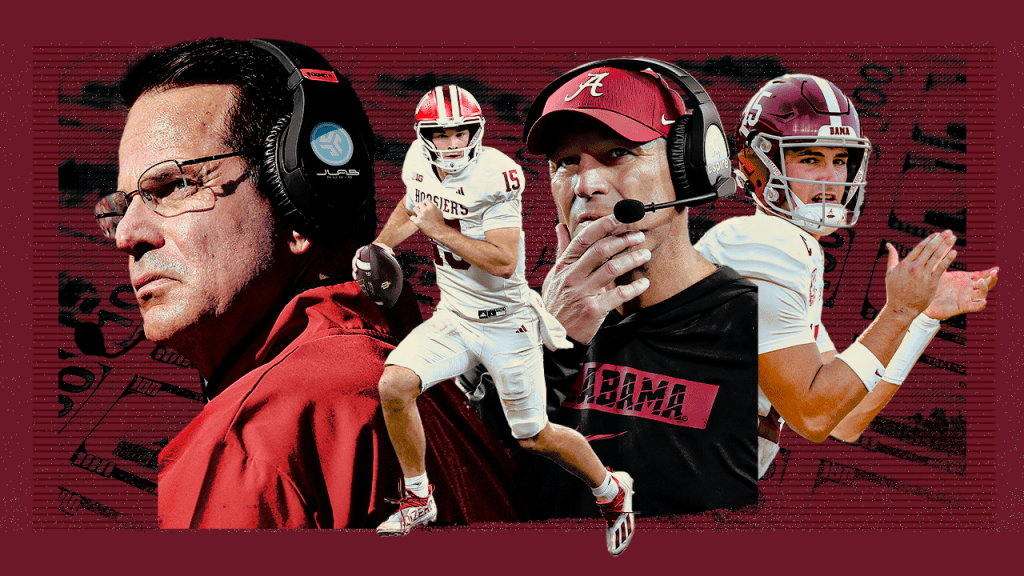
The Indiana Hoosiers are favored by more than a touchdown over the Alabama Crimson Tide in their Playoff quarterfinal game on Thursday. Such a scenario would have seemed impossible until recently given the two programs’ historic on-field results and financial profiles.
Alabama has won six national championships since 2009, all of them under former head coach Nick Saban. Indiana has not won a bowl game since 1991 and only this year got surpassed as the college football program with the most all-time losses. Even getting to a bowl game has been a rarity for the Hoosiers, who didn’t win at least 10 games in any season between 1887 and 2023 before they finally accomplished the feat the past two years. Meanwhile, Alabama ripped off 16 consecutive double-digit win seasons between 2008 and 2023.
Until recently, the two teams’ finances told a similar story. In the 2022-23 season, Alabama’s football budget of $83.3 million was nearly two-and-a-half times that of Indiana’s $34.2 million, according to Sportico’s College Sports Finances Database. The Crimson Tide’s expenses ranked first in the nation that season, as well as in six of the past seven seasons, while the Hoosiers spent the 38th-most among FBS public schools that year.
Indiana’s budget in 2023-24 jumped to $61.6 million and ranked 13th in the country, boosted by a $15.5 million buyout paid to fired head coach Tom Allen. Removing severance payments, though, the Hoosiers’ expenses that year would have still trailed 32 other public football programs. The team also won just three games.
In the past two seasons, however, Indiana has finished 11-2 and 13-0, respectively. Although college athletic departments have not yet reported financials from the 2024-25 and 2025-26 seasons, the Hoosiers’ turnaround from regular Big Ten cellar dweller to the No. 1 team in college football has clearly been driven at least partially by money.
Billionaire alumnus Mark Cuban donated to the athletic department for the first time last year and confirmed to CBS Sports that he gave a “big number.” The school also invested in its successful head coach Curt Cignetti this October by signing him to an extension through 2033 valued at $93 million. Cignetti’s new average annual salary of $11.6 million would be the third-highest compensation for a college football head coach this season, according to USA Today. That’s more than triple what Indiana was paying Allen ($3.7 million) just five years ago.
Under Cignetti, Indiana football has embraced the transfer portal and NIL. Last offseason, star quarterback Fernando Mendoza, who has the fifth-highest college football NIL valuation according to On3, transferred from California to Indiana. He lived up to the hype by winning the Heisman Trophy in 2025.
And after knocking off perennial financial and on-field powerhouse Ohio State last month for the Big Ten championship, the new era of Indiana football has a chance to make another statement against a heavyweight of the sport as it sets its sights on a national title.