
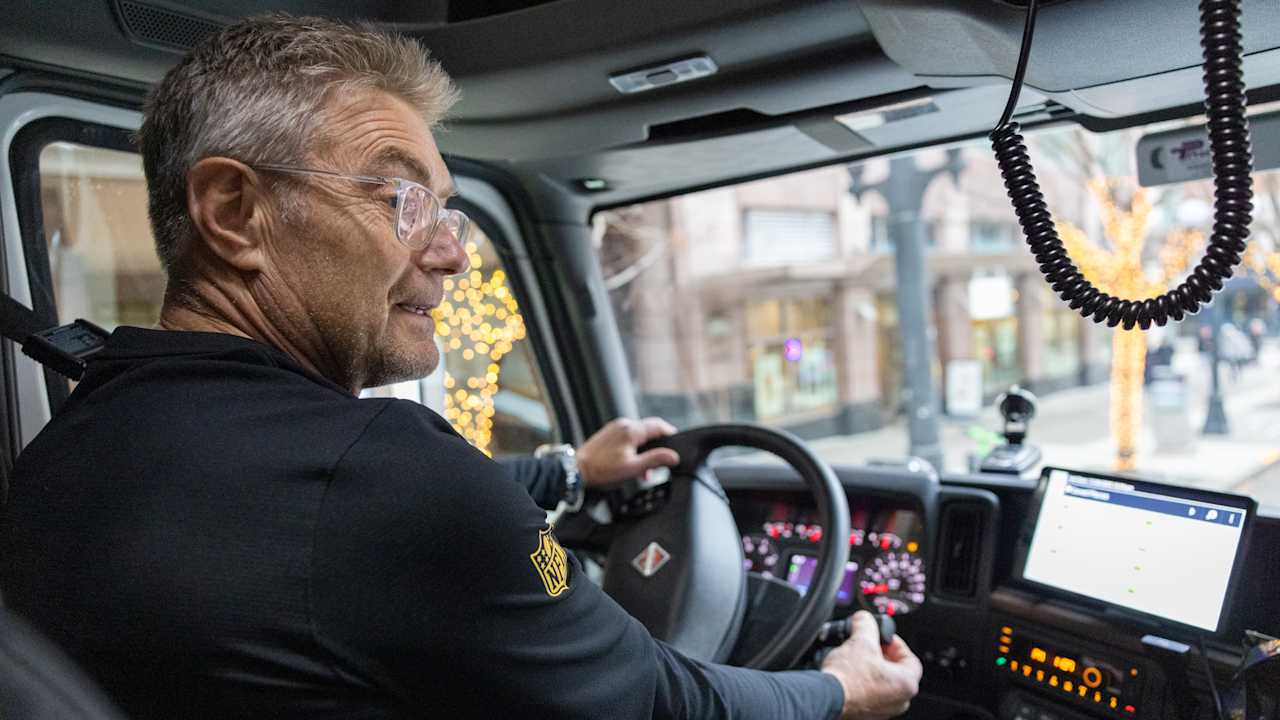
His NFL origin story is rooted in how many squads formerly held training camps in Wisconsin. In 1991, Terry made a connection with the Chiefs in River Falls, handling their gear from the airport to campus and from campus to a scrimmage with the Vikings at the Metrodome. Unbeknownst to Terry, he was being evaluated; and after impressing people, he was brought in to help with the Vikings.
The trucking of equipment stemmed from necessity: “All of a sudden, we stopped fitting on a plane. We couldn’t fit on a 757.”
Dennis asked if Terry was willing to drive to Chicago. Despite wearing a brace to help a torn biceps heal, Terry guided the automatic straight truck to Soldier Field, which had experienced a heavy snowfall. Hundreds were shoveling on the southwest shore of Lake Michigan. Staff there helped unload the truck and became dear friends.
“We get to know each other on a visceral level that is indescribable,” Terry says of the relationships, particularly within the division that are fostered through annual visits. “It all starts with integrity, like Ben back there. You won’t find a more straight-up guy in the world. He’s the healthiest human being, both mentally and physically.”
Now 65 in calendar years, Terry jokes he’s “mechanically put together.”
Two artificial hips, a recent shoulder surgery, having his biceps “put back on” and recovering from a torn pec will do that to a fella.
For some reason, I’m most interested in learning how the torn biceps occurred. Soon, I’m glad I asked.
Terry was helping the Lions unload at the Metrodome.
“They had this big rock they brought, and it said the most not-motivating thing I ever saw, “Not good enough yet.” I’m like, are you f-n’ kidding me?’ And the players were supposed to touch it, so I watched them go take the field and maybe three players touched it,” Terry recalls. “I wouldn’t touch that thing, either. It’s like bad luck. ‘Don’t worry, son, you’re not good enough yet, but you might get there,’ so when my biceps tore off, everyone said, ‘Was it the f-n’ rock?’ So everywhere I went, ‘Are you the guy that had the biceps tear on the rock?’
“It was a heavy trunk, and when you’re over 40, you can’t catch weight like this,” he explains with a gesture — sorry, I was still laughing about the rock and didn’t fully observe the demo. “You have to have your arm extended. I found that out.”
Space needs play a significant role, but so does the desire to shave minutes or an hour-plus from travel operations for the team.
Playing at San Francisco in December 2007, Dennis was interested in trimming time spent by the team on the tarmac.
The equipment staff hurriedly loaded one truck to leave for the airport 20 minutes after the game. A second truck would bring the rest, but the idea was that the first truck would be unloaded so that only a little bit remained by the time the team arrived at the airport.
The other logistical aspect is working with the former airline representative assigned to the Vikings to get the stuff on the plane. It proved to be quite a hurdle on that trip, but Terry was eventually able to execute his part of the plan.
“When you grow up poor, you’ve got one thing: your reputation,” Terry says. “You lose it, you’ve got nothing; and I fiercely hold onto to that.”
The reputation Terry has earned for reliability makes him the first call for visiting teams.
During Super Bowl LII, Terry was the first call for both teams.
“No one had ever done both [participating teams] because that’s 2,200. (Each team has 1,100 friends and family),” he explains. “You’ve got multiple flights. I got all my friends — 52 trucks, cube vans, anything I could get.
“The Patriots said, ‘It’s the first time in all the Super Bowls that every suitcase went to the right hotel,’ ” Terry continues. “I tell you what, there’s some luck involved there: 2,200 pieces of luggage going to 12 different hotels. Sometimes the plane would come in and have seven different hotels.
“The Eagles asked if I wanted to be on the sideline with them. It was kind of surreal,” he adds. “After the game, the locker room has the trophy, shirts, hats — what an immersive experience!”
It was a reward for withstanding subzero temperatures and being awake more than 30 straight hours while coordinating the logistics.
“Let’s eat,” Adam breaks in as he reaches into a brown paper care package with breakfast burritos and bacon, along with some nutritious snacks.
As Ben begins describing his “once upon a time go-to” McDonald’s order of “a Big Mac, a Quarter Pounder with Cheese, two McChickens, two McDoubles, three large fries and two large drinks,” Terry exclaims, “Show him the burger you ate!”
“There’s a picture — he got his name on the wall in Canton,” Terry says. “There’s 3 pounds of meat. Look at the fries back there. I have no idea how much weight that is. He ate that in 45 minutes.”
Ben adds with pride, “There’s a couple of milkshakes in there, too, vanilla and apple pie.”
George’s in Canton features Ben’s picture because he conquered the six-patty, three-bun behemoth while in town to celebrate his dad Dennis receiving an Award of Excellence from the Pro Football Hall of Fame in summer 2025.
Asked if he’s ever thought about competitive eating, Ben replies with classic Ryan-family humility, “I just like to eat. I don’t think I’d want to compete.”
During this time, Terry has had a strip of bacon, and I’ve been housing a burrito between jotting down notes.
“Hey Ben, they governed this truck to go faster than the other ones. I want to see how fast,” Terry says, soon finding out that the max is 77, which is 7 miles per hour faster, which will help across Montana on the way to and from Seattle.