
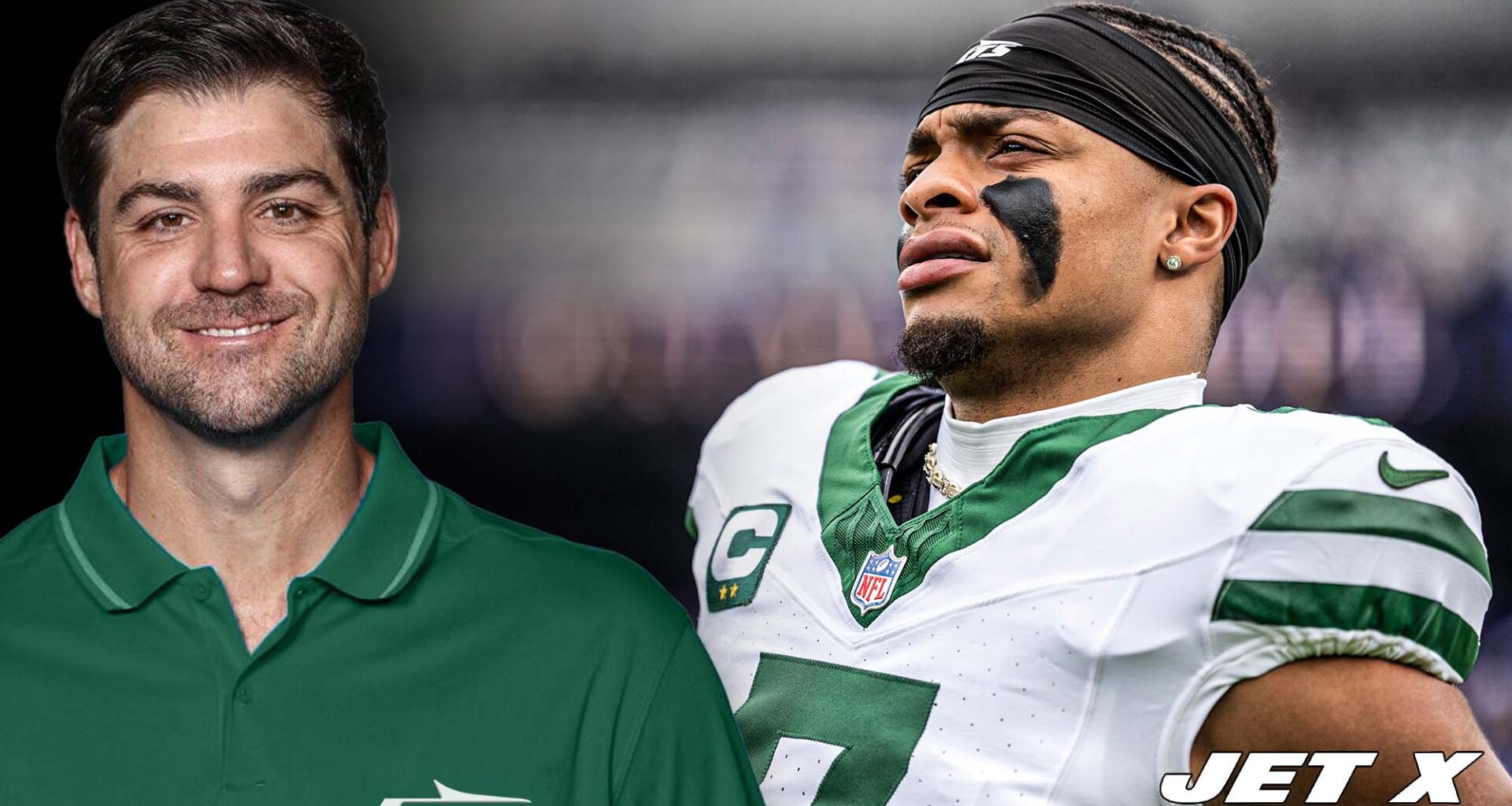
New York Jets offensive coordinator Tanner Engstrand is in a strange position.
The first-year OC oversaw one of the NFL’s worst offenses in his debut season. The Jets ranked 29th in points per drive, 26th on third down, 28th on fourth down, and 31st in the red zone.
Yet, calls for Engstrand’s job never got exceedingly loud throughout the year. And as we sit here on Jan. 8, it is clear that Engstrand will return in 2026.
This is contrary to defensive coordinator Steve Wilks, who fans were calling to be fired as early as October. Those calls were answered before the season even concluded.
Fans, analysts, and the Jets themselves have collectively decided to give Engstrand a pass for the 2025 season. Most of the criticism for New York’s historically bad campaign is being directed at head coach Aaron Glenn.
Glenn’s lightning-rod status is due to the Jets’ unprecedented ineptitude spanning both sides of the ball (with the defense, Glenn’s specialty, actually being worse), therefore prompting fans and media to direct their criticism at the head of the operation rather than spread it between the many smaller contributors underneath him.
It goes without saying that Glenn is not entirely responsible for the Jets’ struggles. The roster is severely lacking in talent. Both coordinators had their struggles, too.
Engstrand was not perfect. It’s impossible for a perfect OC to field an offense that ranks as poorly as the Jets’ did, no matter who is at quarterback or wide receiver.
With that said, Engstrand’s free pass is not due solely to his rookie status and the lack of talent underneath him. There is a reason that Glenn is receiving calls for his job, but the overseer of the Jets’ 29th-ranked offense is not.
It’s a difficult undertaking for fans and analysts, but coaches must be evaluated based on their performance in areas they have control over. And in that respect, Glenn has been a liability, whereas Engstrand has shown enough potential to justify sticking around.
In a few subtle ways, Engstrand showed legitimate upside as a play-caller and schemer.
You just have to dig a little bit deeper to see it.
Tanner Engstrand’s hidden signs of potential
When watching film of the Jets’ offense throughout the season, a consistent theme emerged: quarterbacks missing wide-open receivers.
On passes to receivers with 3+ yards of separation, the Jets had a completion percentage of 82.3%, per FTN Fantasy, ranking 29th in the NFL.
Examples of this stat are all over the tape.
AD Mitchell (bottom) missed for another potential TD
Play on route pacing, slowed drive phase off of the line slows the CB’s feet
Takes off vertically as he closes ground and had plenty of room for a walk in TD
Tyrod gets hit as Fashanu allows a hit
Fashanu’s pass pro punch… pic.twitter.com/VlGtendRft
— Joe Blewett (@Joerb31) November 25, 2025
Great play call from Engstrand vs man coverage
Rub from the #1 (bottom) with Mitchell running a stalk rail/wheel from the slot and is WIDE open because of the rub
Fields puts the ball short and behind Mitchell who DOES have the chance to catch it, harder said then done though… pic.twitter.com/bxzzNTe4sD
— Joe Blewett (@Joerb31) November 15, 2025
2nd-9, GW (top) most on a speed out vs a CB who is sitting high
Fields pulls the trigger but is behind Garrett
Put the damn ball ON him
Incomplete…. pic.twitter.com/BLRCDGpzHx
— Joe Blewett (@Joerb31) October 14, 2025
Simpson pressure allowed, late to pick up the TE stunt
Fields tries to get the ball to Garrett (top) but cant complete the pass with pressure in his face pic.twitter.com/K0LFEkw6mU
— Joe Blewett (@Joerb31) October 7, 2025
It’s not Engstrand’s fault that his quarterbacks can’t hit a wide-open pass anywhere close to nine times out of 10.
What Engstrand can control is how often he creates those wide-open passes. In that area, he did a pretty good job, at least in certain parts of the field.
Engstrand can still improve at cooking up open targets in the short (0-9 air yards) and deep (20+ air yards) parts of the field. According to NFL Pro, the Jets ranked 28th in average separation on short passes (3.7 yards) and 26th in average separation on deep passes (1.7 yards). Part of those rankings could be due to the Jets’ lack of route-running talent outside of Garrett Wilson, though.
Where Engstrand really shone was in the intermediate area (10-19 air yards). Here, he generated opportunities at a level similar to the league’s most respected play-callers.
The Jets ranked fourth-best in average separation on intermediate passes (2.9 yards). Check out the teams nearby them on the leaderboard:
Seahawks (3.1)
Bears (3.1)
Bills (3.0)
Jets (2.9)
Ravens (2.9)
Chiefs (2.9)
Rams (2.8)
Falcons (2.8)
Saints (2.7)
Eagles (2.7)
Just above the Jets are the Seahawks, Bears, and Bills, who each ranked top-10 in scoring this season. Klint Kubiak (Seattle OC), Ben Johnson (Chicago HC), and Joe Brady (Buffalo OC) are three of the hottest offensive minds in the league right now.
The rest of the top 10 is filled out by names like Todd Monken (Baltimore OC), Andy Reid (Kansas City HC), Sean McVay (Rams HC), and Nick Sirianni (Philadelphia HC).
Intermediate passes are the bread and butter of today’s NFL. Compared to yesteryear, teams have decreased their pursuit of deep passes, converting many of those attempts into intermediate shots, whether it’s on digs or crossers. These passes offer nearly as much yardage potential as vertical shots thanks to the increased YAC expectancy, yet their odds of being completed are higher than your typical go route along the sideline.
If you look at the top of the leaderboard in intermediate passing production this season, you will find many of the league’s best overall quarterbacks. Here are the nine quarterbacks who passed for over 1,000 yards on intermediate passes in 2025:
Jared Goff, DET (1,520)
Matthew Stafford, LAR (1,416)
Drake Maye, NE (1,364)
Trevor Lawrence, JAX (1,274)
Dak Prescott, DAL (1,221)
Sam Darnold, SEA (1,163)
Josh Allen, BUF (1,068)
Baker Mayfield, TB (1,042)
Patrick Mahomes, KC (1,002)
That’s a who’s who of the league’s hottest quarterbacks and strongest offensive systems.
The two MVP favorites, Stafford and Maye, rank top three. Lawrence is on fire under Liam Coen, who is cooking as the Jaguars’ offensive mastermind. Goff had a stellar season, despite the Lions’ underwhelming record, and the same can be said for Prescott in Dallas. Darnold became an efficiency wizard under Klint Kubiak, leading Seattle to the No. 1 seed. Allen is Allen, and Mahomes is Mahomes.
The intermediate area is home to a substantial portion of the explosive passing plays we see in today’s league. The Jets have a coordinator who created separation at a top-four level in this part of the field. That’s an exciting thing for the Jets to hang their hats on moving forward.
Unfortunately, the results weren’t there yet in 2025. Despite the top-four separation, the Jets ranked 30th with just 645 passing yards on intermediate completions.
As the film and data show, though, the lack of production had more to do with the Jets’ execution than the man drawing up the plays.
The Jets’ quarterbacks combined for a Pro Football Focus passing grade of 62.0 on intermediate passes, ranking 27th in the league. Every other team that ranked top 10 in average separation on intermediate passes had a better grade on those throws, indicating just how much meat the Jets left on the bone in this part of the field.
More damaging than the quarterbacks’ execution on intermediate passes was their inability to even attempt them. The Jets’ signal-callers lacked the confidence to rip the ball into the middle of the field. New York was tied with Cleveland for the second-fewest intermediate attempts with 79. Aaron Rodgers and the Steelers had the fewest (76).
Justin Fields was especially bad at this. Fields threw an intermediate pass on just 11.1% of his dropbacks, the lowest rate in the NFL (league average: 18.2%). Essentially, Fields threw an intermediate pass once every 9.0 dropbacks, while the average NFL quarterback did it once every 5.5 dropbacks.
This is why Fields threw just one interception but generated ghastly yardage numbers: because he was flat-out petrified to throw to the middle of the field.
But the separation was there. That’s a good sign for Engstrand and the Jets moving forward. Now they need a quarterback who can make that separation count.