
It’s time to accept reality.
Aaron Glenn will be the New York Jets’ head coach in 2026.
Glenn is a lightning rod for criticism in the New York media right now, including from yours truly and some of our other folks at Jets X-Factor. The first-year head coach undoubtedly had an indisputably poor debut campaign in the Big Apple (well, the swampy outskirts of it), so the flak is warranted.
Nonetheless, the Jets are running it back with Glenn. That is the fact of the matter. Thus, it’s time for fans and analysts to embrace the situation and start mapping out a road to success with Glenn at the center.
As we embark on this quest, it’s worthwhile to discuss Glenn’s skills as a game manager. What is his outlook in that department entering 2026?
A newly released chart features a fascinating revelation about Glenn’s game management in his rookie season as a head coach.
How Aaron Glenn handled fourth downs in 2025
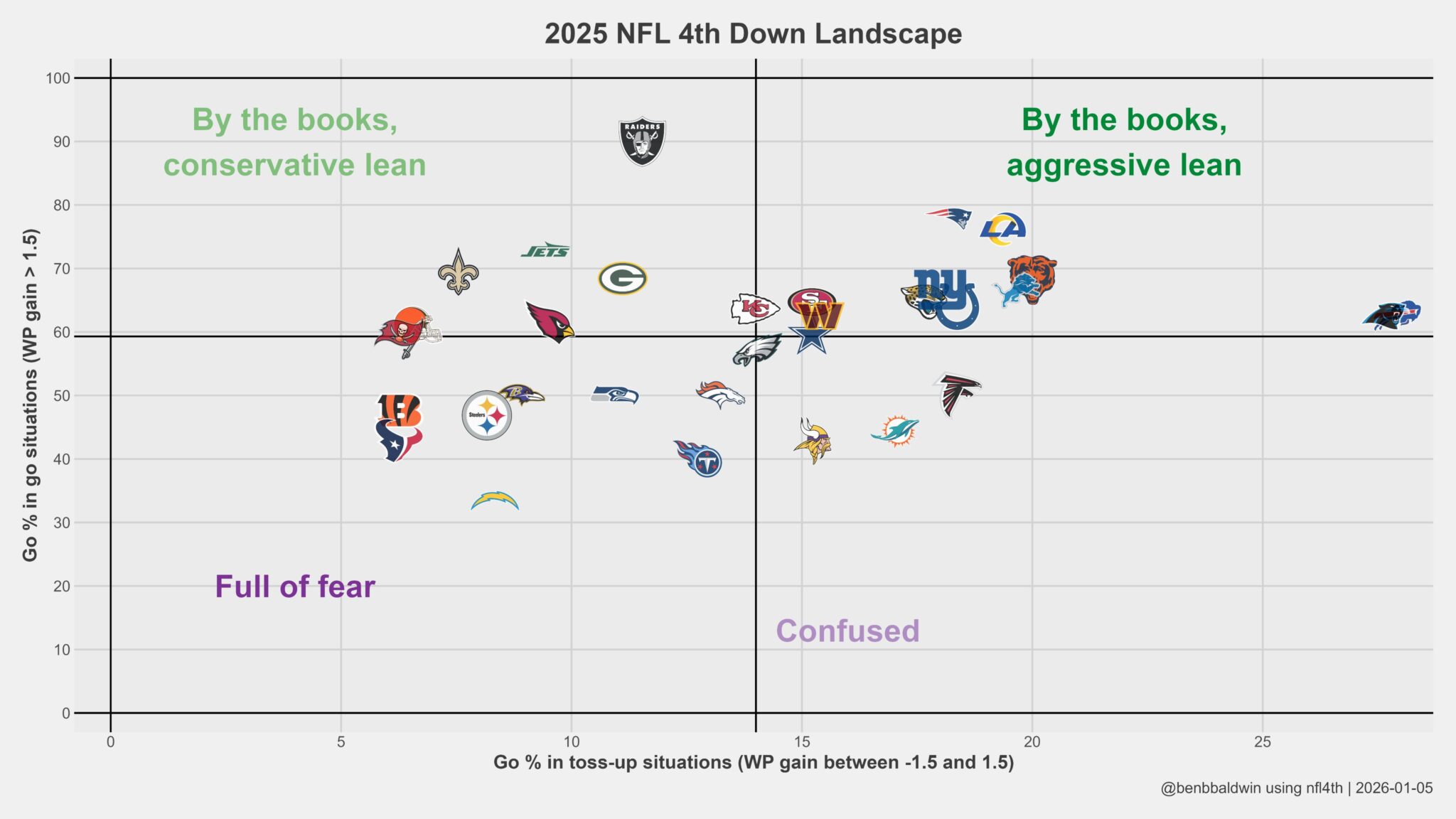
The following chart, shared by Ben Baldwin to his X/Twitter account (@benbbaldwin) on Jan. 25, displays how each NFL team handled fourth-down “go/kick” situations in the 2025 regular season, based on how strongly it was advised for the offense to go for it.
via Ben Baldwin (X/Twitter: @benbbaldwin)
The Y-axis displays a team’s go-for-it rate in situations where they clearly should have gone for it (expected win probability gain of at least 1.5%). The higher up vertically, the more often a team kept its offense on the field in fourth-down situations where going for it was strongly advised by analytical models.
Meanwhile, the X-axis displays a team’s go-for-it rate in situations where the choice was a toss-up (ranging from -1.5% to 1.5% in expected win probability). The further to the right, the more often a team went for it in situations where there was no clear recommendation from analytical models.
Combined, these two metrics give us a feel for each head coach’s approach to fourth-down decisions.
Glenn checks out with results that surprised me. They might surprise a lot of Jets fans, too.
Comfortably nestled in the top left, Glenn fell into Baldwin’s “By the books, conservative lean” quadrant. Essentially, Glenn was aggressive in situations where aggressiveness was advised, but he leaned toward conservative choices in situations where he could’ve gone either way.
Per Baldwin’s chart, the Jets had the fourth-highest go percentage in situations where they were projected to gain at least 1.5% in win probability by going for it instead of kicking (field goal or punt). This is a positive sign for Glenn. It means that he didn’t make many costly mistakes related to kicking field goals or punting in situations where going for it was preferable.
However, the Jets had the ninth-lowest go percentage in situations where the decision was a toss-up (ranging from -1.5% to 1.5% in expected win probability if they were to go for it). What this tells us is that Glenn rarely made uber-aggressive decisions that shocked even the analytical models, which are famously aggressive. If punting or kicking a field goal was a reasonable choice, Glenn typically took it.
What does it tell us about Glenn?
There are mixed takeaways for Glenn here.
The good news is that Glenn certainly isn’t a full-blown skeptic when it comes to aggressive fourth-down decisions. Some of the older coaches in the league, such as Mike Tomlin and Jim Harbaugh, are reluctant to attempt fourth downs in any situation.
(Yes, Tomlin and Harbaugh are obviously immensely better coaches than Glenn in every other area, but they are behind the times in this specific facet.)
As old-school as his philosophies are in many ways, Glenn’s mind is at least somewhat open to the advantages of being aggressive on fourth down. He likely absorbed some of this knowledge from his days in Detroit under Dan Campbell.
This exposure is a positive sign for the Jets moving forward. We saw signs of Glenn leaning into Campbell’s influence this year. Still, if Glenn is going to succeed as a head coach, he must tap even further into the game-management lessons he learned from Campbell.
Here’s the question, though: Does Glenn actually want to be aggressive? Or was his aggressiveness in 2025 a byproduct of the Jets constantly trailing by double digits?
As reported by ESPN’s Rich Cimini, the Jets trailed by double-digits on a shocking 53.1% of their offensive plays in 2025, the highest rate by any team in the 21st century. This is a critical piece of context when evaluating Glenn’s game-management decisions.
On most of the plays where Glenn went for it when going for it was advised, the Jets were trailing by multiple scores, making it easier for him to push through with those decisions. With nothing to lose, he was less likely to get criticized for being aggressive. It’s not hard to take “risks” when there is nothing to risk in the first place.
Thus, it isn’t entirely surprising that the Jets had a high go percentage in situations where going for it was advised. On most of those plays, it was flat-out obvious to go for it, since they were probably down by at least two touchdowns. Glenn had more to fear by not going for it, as he would be labeled as a coward in the media.
At the very least, Glenn deserves a smidgen of credit for mostly avoiding cowardly kicks in situations where they would have been inexcusable. However, Glenn’s go percentage in toss-up situations is a red flag that could rear its ugly head if the Jets ever become a respectable team under his watch.
When given opportunities to push the envelope, Glenn usually played it safe. Is this a sign of his true philosophy on fourth down?
If the Jets become a competitive team under Glenn, their “go situations” will become less obvious than the ones they faced in 2025. It’s one thing if the model says to go for it when you’re down 38-13 in the third quarter as a 3-11 team, but it’s completely different when the model says to go for it on 4th & 2 from the goal line when you’re up 24-21 with eight minutes left in the fourth quarter as a 9-7 team.
Both scenarios would be labeled as an obvious “go situation” by the analytical models, but we all know that mustering up the guts to go for it is a hell of a lot tougher in the latter scenario. Would Glenn go for it with all of that pressure on his shoulders?
Ultimately, it’s hard for us to say at the moment, because Glenn hasn’t faced any situations with those types of stakes. Most of the time, all Glenn really had to do was say “screw it” and keep the offense on the field in every situation. There was no fear of backlash because the Jets spent the whole season with an awful record and most of it in double-digit deficits, so who the heck would care if they failed to convert?
Glenn’s game-management philosophy remains a mystery entering his second season. On one hand, we cannot label him an abject failure as a fourth-down decision-maker just yet, as he was clearly far from the worst coach in that area. However, he was far from the best, and there are red flags that suggest he might lean too conservatively once/if the Jets get into high-pressure scenarios under his watch.
With a full offseason to study his tendencies and figure out where he can improve, it’s on Glenn to come back in 2026 as a new coach with a new approach.