
Scouting the NFL draft isn’t just an “inexact science.”
It’s essentially random.
Inexplicable outcomes occur in every draft. Josh Rosen went 22 spots ahead of Lamar Jackson. Kenny Pickett went 242 spots ahead of Brock Purdy.
These examples are focused on the quarterback position, but the unpredictability spans across every position on an NFL roster. Heck, even kickers are impossible to predict.
Roberto Aguayo stood out so much that the Tampa Bay Buccaneers chose him in the second round, and he couldn’t last more than one professional season. Yet, this year’s second-team All-Pro kicker, Brandon Aubrey, is a former soccer player who didn’t even play college football.
Simply put, scouting the draft is hard.
NFL teams invest millions of dollars into massive scouting staffs that research prospects in every conceivable way to try and predict their likelihood of succeeding in the pros. Whether it’s traveling across the country to watch them in person, interviewing their high school science teacher, or concocting complex algorithms, organizations are trying everything to get a leg up on draft weekend.
Ultimately, nothing really works. If there were an infallible formula by now, the whole league would know about it, and each year’s NFL draft would see a perfect correlation between draft slot and future NFL success. We don’t see anything close to that, though.
There is somewhat of a correlation between draft slot and future success (first-rounders do better than second-rounders, second-rounders better than third, and so on), which means teams are doing a decent job of stacking up the entire draft board. Nonetheless, each individual pick is a dice roll, no matter how much research is put into it.
At the end of the day, sports weren’t intended to be analyzed so meticulously. The unpredictability is what makes them so exciting. If sports could be easily predicted, they would not be nearly as popular with consumers, and we would not be talking about the NFL right now; a predictable entertainment product wouldn’t make any money.
That doesn’t stop NFL teams from doing everything in their power to increase their odds of selecting the right prospect by even the slightest percentage point.
And it’s not going to stop us, either.
As the New York Jets prepare to select a quarterback early in the 2026 NFL draft, I was curious to find out if there are any metrics from prospects’ collegiate profiles that have proven particularly effective at predicting their success in the NFL.
Here are the results.
Which metrics are the most relevant in scouting first-round quarterback prospects?
What we want to determine is whether there are specific metrics that can help us identify the quarterback(s) with the best chances of NFL success among those likely to be drafted in the first round.
As fans debate over Fernando Mendoza, Dante Moore, Trinidad Chambliss, and Ty Simpson, is there a particular stat that deserves the most attention? Is there something that fans should be less fixated on?
Methodology
I focused my analysis on first-round prospects. This allows us to compare prospects who possessed similar talent levels based on teams’ scouting evaluations.
Post-first-round quarterbacks typically have at least one fatal flaw that explains their drop (age, size, competition, injuries, etc.), despite most of them having similarly dominant college statistics to first-round quarterbacks. The vast majority of them do not become successful NFL starters, so including them would skew the data.
For these reasons, first-rounders are the focus.
Our analysis includes the 35 quarterbacks chosen in the first round from 2015 to 2024.
Before we can analyze how their college metrics correlate with their NFL success, we need to answer a simple question: How is “NFL success” defined?
I decided to generate a single rating by combining each quarterback’s career regular-season performance in three metrics: passer rating, adjusted EPA per play, and overall Pro Football Focus grade. This gives us a one-number overall rating to quantify the player’s NFL productivity. Using this rating, we can figure out the average correlation between it and various college metrics.
Here’s a look at the 35-player pool. The overall rating is calculated on a 0-100 scale based on the player’s performance relative to the group average across all three metrics.
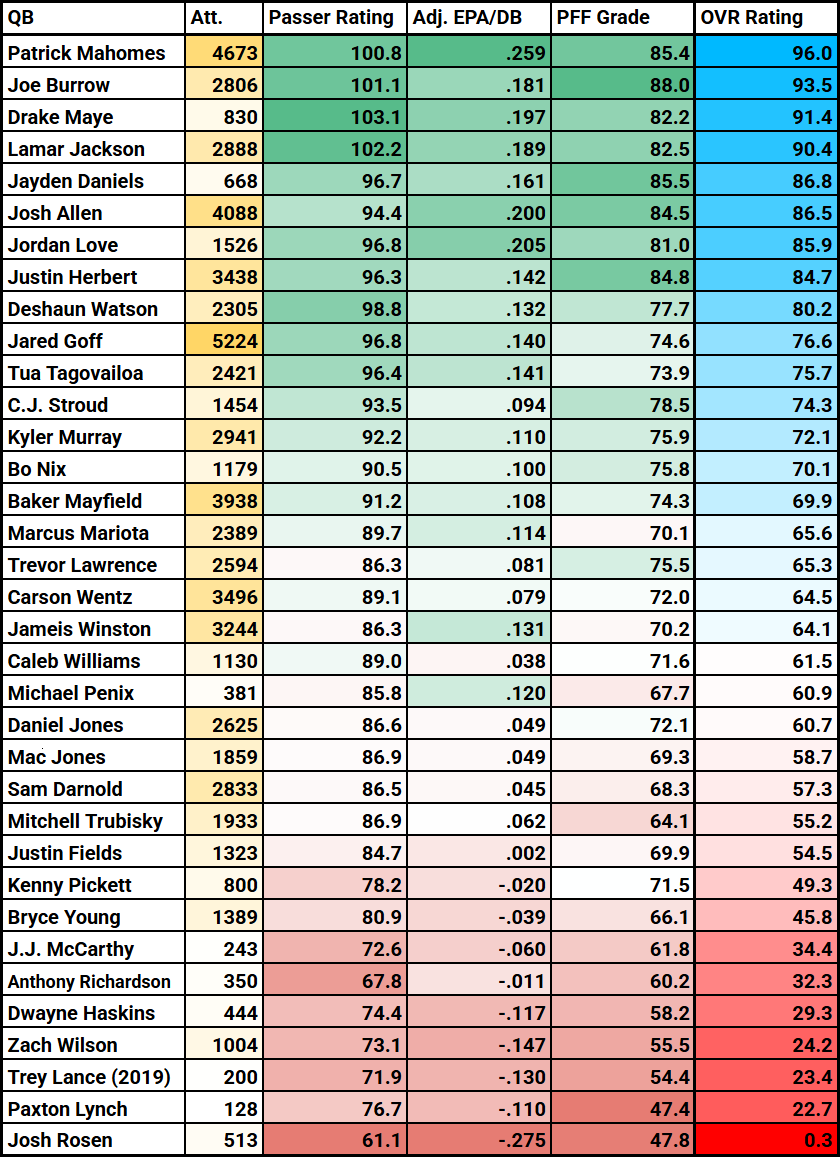
The average overall rating among these 35 players is 61.8.
Metrics analyzed
I combed through each player’s performance in their final college season, charting 21 different metrics.
Rather than focus on traditional metrics like passing touchdowns or completion percentage, I used PFF data to analyze metrics that are more directly tied to the quarterback’s efficiency and play style in specific aspects of the position, whether it’s their tendency to scramble, their ability to minimize turnover-worthy throws, or how often they allowed pressures to be converted into sacks.
Across the 35-player sample, I calculated the correlation between overall rating (our quantification of “NFL success”) and all 21 metrics.
Here are the results, ranked by the correlation coefficient (r). For perspective, the closer the number is to 0, the weaker the relationship. The closer the number is to -1.0 or 1.0, the stronger the relationship.
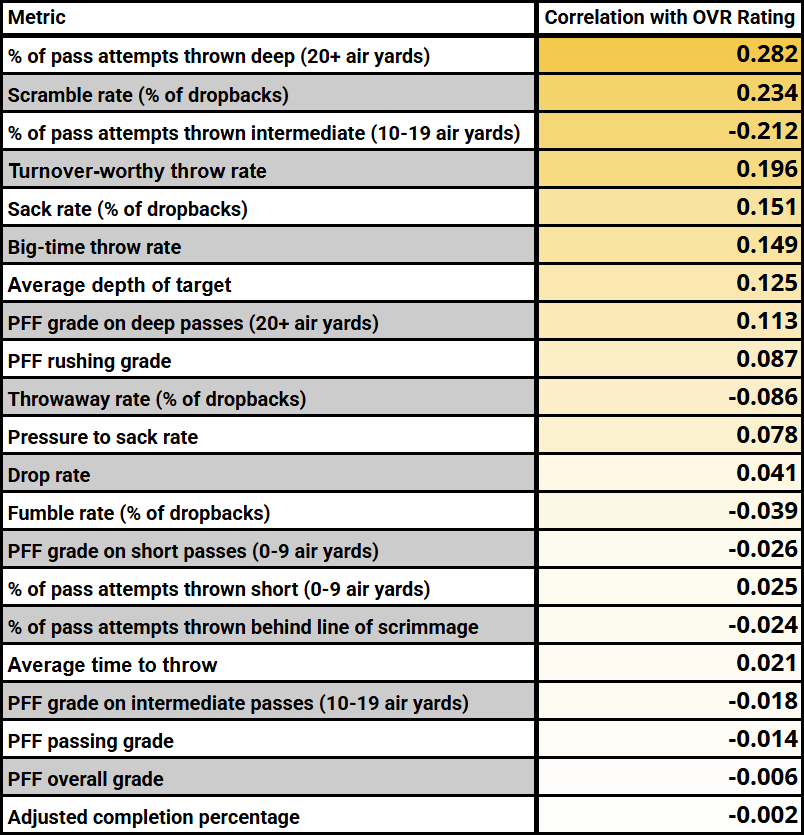
The main takeaway here is that none of these metrics offered a strong correlation. It highlights the randomness of NFL draft evaluation.
Generally speaking, a “strong” relationship is considered anything above 0.75. If the correlation coefficient ranges from 0.5 to 0.75, it is considered a “moderate” relationship. Anything from 0.25 to 0.5 is considered “weak,” and if it is below 0.25, there is essentially no meaningful relationship.
The greatest correlation we found was only 0.282, coming from deep pass attempt rate (i.e., the percentage of a prospect’s total pass attempts that were thrown at least 20 yards past the line of scrimmage).
While it isn’t predictive enough to be considered a secret sauce that can tell any prospect’s fortune, its relationship is far enough ahead of the rest of the pack to be considered a significantly more useful tool than any other metric.
The value of a prospect’s deep rate
When stacking the prospects up by their deep pass attempt rate, a glaring threshold stands out: 15%.
Prospects who threw deep on under 15% of their pass attempts were much less likely to succeed than those who reached the 15% benchmark.
There were 11 quarterbacks who threw deep on 14.2% of their deep pass attempts or fewer. The best among them is Bo Nix, whose 70.1 overall rating makes him just the 14th-best quarterback of the 35-man group. The average overall rating among these 11 players is just 46.0.
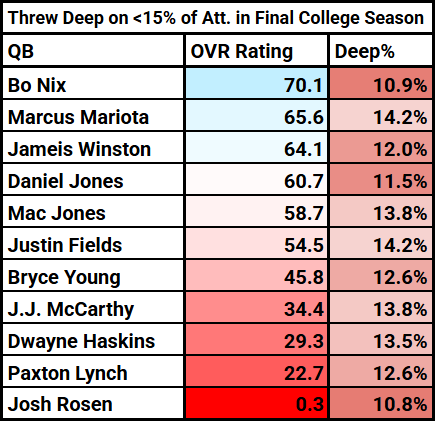
Comparatively, among the 24 quarterbacks who threw deep on at least 15% of their pass attempts, the average rating was 69.1, more than 23 points higher. Each of the 13 highest-rated overall quarterbacks threw deep on at least 15% of their attempts in their final college season.
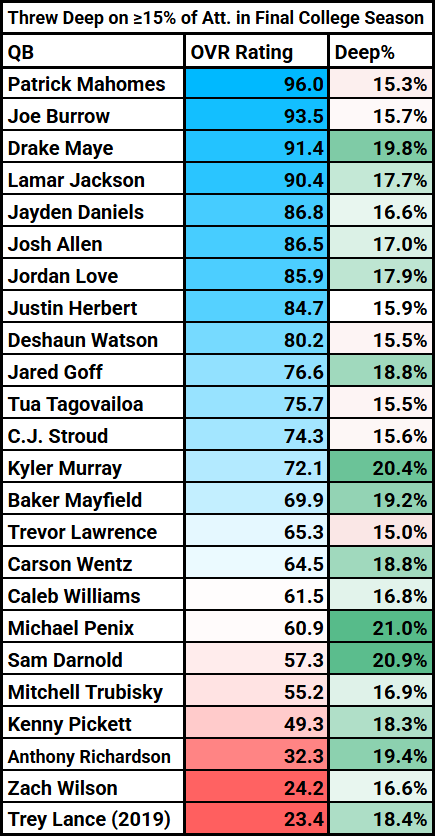
Ultimately, the correlation coefficient between deep rate and overall rating is not high enough to be considered strong (or even moderate); it’s not as if a higher deep rate guarantees your success (Zach Wilson is in there, after all). Still, this isn’t nothing. There is some value to be found here.
What does it all mean, though? Why is a prospect’s willingness to throw deep the most meaningful metric for predicting NFL success? It carries more predictive weight than many categories that most people would think are much more valuable, such as avoiding sacks, getting the ball out quickly, or throwing with accuracy.
It’s all theoretical, but a few explanations come to mind. For one, taking more deep shots could be a subtle indicator of a quarterback’s confidence. Regardless of whether those shots connect or not, the sheer fact that they are being taken could show that the prospect has the mental makeup required to succeed in the pros.
Another explanation is that it could show that the prospect played a more NFL-ready style. Many college offenses are extremely “gimmicky” compared to your typical NFL offense; there are a handful of prospects in this data sample who threw behind the line of scrimmage on more than a quarter of their pass attempts. This can make it difficult to project prospects to the NFL. Perhaps throwing a higher rate of deep passes is a sign that the prospect wasn’t just farming production from screen passes.
My third theory is that it signals the prospect’s ceiling as a true difference-maker in the NFL. In a league where teams are throwing the ball shorter and quicker every season, most coaches are adept at scheming open screens and short passes. The deep game is one facet of the sport where schematics will never be able to do all the work for a quarterback, and arm talent will always be the primary determinant of success.
So, if a quarterback threw deep more often in college, it could show that he has the potential to succeed in an area that can raise his impact ceiling beyond what is schemed up for him. Hence, all of the best overall quarterbacks had a deep rate higher than 15% in college. Hitting this threshold did not guarantee success—you still have busts in there, like Zach Wilson and Trey Lance—but it does guarantee a ceiling.
No first-round quarterback since 2015 with a sub-15% deep rate has gone on to become a star (yet), and that’s out of an 11-player sample. If a quarterback isn’t throwing deep passes often in college, it could show that he is the type of player who will be limited to the ceiling bestowed by his NFL scheme, and doesn’t have either the confidence or arm strength to add value with explosive plays over the top—the game-changing moments that separate really good game managers from franchise-carrying superstars.
When evaluating quarterbacks in this year’s draft class, keep a close eye on their willingness to throw deep. Don’t worry too much about whether those passes are completed; as long as the prospect is taking shots, it’s a good sign for their NFL future.
Other meaningful metrics
Deep rate is clearly the most predictive metric of the 21 that I analyzed, but two other metrics stood out with fascinating benchmarks: turnover-worthy throw rate and scramble rate.
Turnover-worthy throws = Good?
Turnover-worthy throw rate is PFF’s estimation of how often a quarterback throws a pass that is worthy of being intercepted. It is intended to be a better measure of ball security than raw interceptions, as it cuts quarterbacks slack for non-faulty interceptions and blames them for passes that should have been picked.
There was a somewhat decent correlation between collegiate turnover-worthy throw rate and NFL success. The correlation probably doesn’t work the way you think, though.
The higher the turnover-worthy throw rate, the better prospects have performed in the NFL.
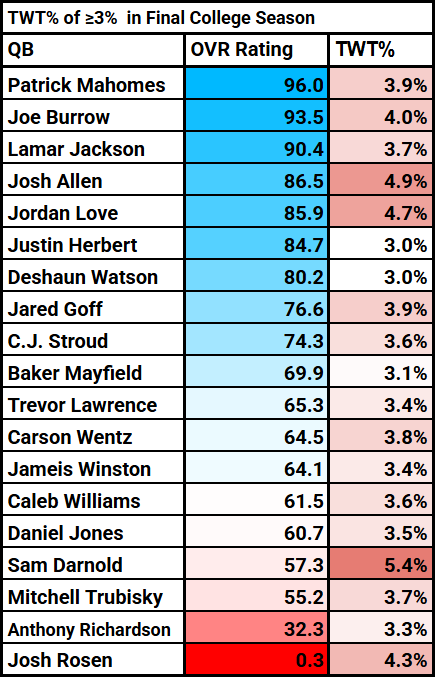
Of the 19 quarterbacks who had a turnover-worthy throw rate of at least 3%, the average overall rating was 68.4. Eight of the 10 highest-rated quarterbacks are in this group.
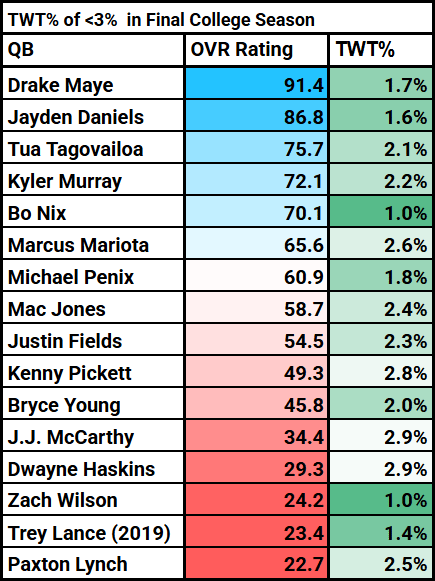
Of the 15 quarterbacks with a turnover-worthy throw rate below 3%, the average overall rating was 54.0, more than 14 points lower. Only two of the 10 highest-rated quarterbacks are in this group, Drake Maye and Jayden Daniels.
The inverse correlation we’re seeing here appears to align with our theories regarding the value of deep rate.
If a quarterback is throwing more turnover-worthy throws, it means he is probably taking more chances, whereas a quarterback with fewer turnover-worthy throws is probably playing with a more risk-averse style. Based on the trends we’re seeing, it actually seems preferable for the quarterback to put the ball in danger more often. Perhaps it suggests that the quarterback is displaying the confidence he will need to succeed in the NFL.
In a vacuum, throwing more turnover-worthy passes is a bad thing. It’s not as if you should applaud prospects when you see a bad interception on their tape; ball security is paramount in football. When evaluating college prospects, though, we shouldn’t be judging them based on their ability to produce wins for their college team. We should be looking for trends and traits that project to success in the NFL.
It seems that the positive value of the confidence involved in throwing risky passes outweighs the concern of putting the ball in danger. Conceivably, the issues that led to the negative result (whether related to accuracy or decision-making) can be fixed by coaching. What cannot be coached is confidence.
Confidence is one of those intangible traits that we can all agree is paramount for quarterback prospects (or any athlete), but is difficult to quantify. Perhaps, though, the quantification can be found in unexpected places, such as a higher turnover-worthy throw rate.
Scrambling is key
The third and final metric that featured a noticeable threshold was scramble rate. Simply put, this is the percentage of passing dropbacks in which the quarterback elected to tuck the ball and rush.
Scramble rate appears to be a critical metric for identifying prospects with an MVP-caliber ceiling. Each of the six highest-rated quarterbacks in the 35-man sample—Patrick Mahomes, Joe Burrow, Drake Maye, Lamar Jackson, Jayden Daniels, and Josh Allen—scrambled on at least 7% of their dropbacks in their final college seasons.
There were 13 players with a scramble rate of at least 7% in their final college season. The average overall rating was 68.3, and eight of the 13 players (62%) had an overall rating of 70+.
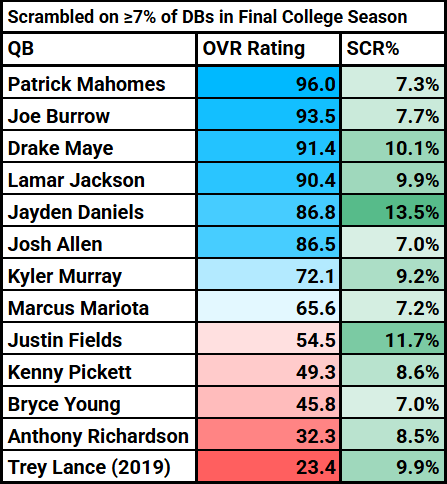
Among the 22 players with a scramble rate below 7% (the highest of those being 5.2%, a wide gap from the rest of the bunch), the average overall rating was 58.0, more than 10 points lower. Only seven of the 22 players (32%) had an overall rating of 70+.
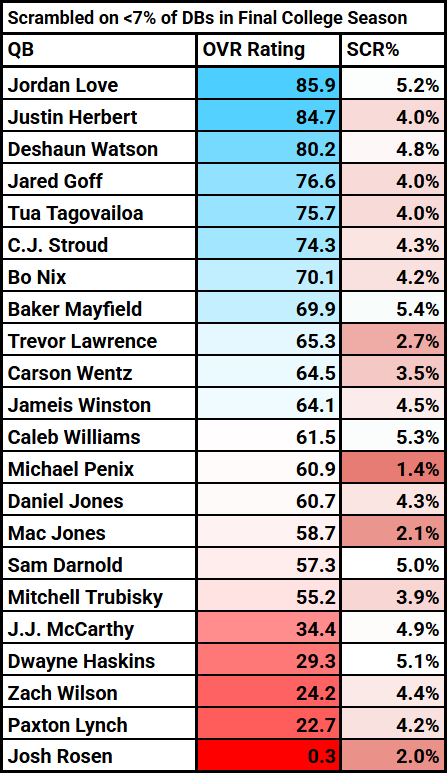
Once again, it is not as if this metric is a perfect way to predict a prospect’s success, as there are stars and busts on both ends of the spectrum. Still, the odds clearly appear to prefer prospects who scrambled more often in college, especially when it comes to the odds of fielding an MVP-caliber quarterback.
It speaks to the value of mobility in today’s NFL. And that’s not to say that every quarterback needs to run like Lamar Jackson; one of the quarterbacks in the high-scrambling group is Joe Burrow. Elite playmaking is not necessary to be a star quarterback in today’s league, but you do need to be capable of taking yards on your own when they are presented.
What did we learn?
The main thing we learned is that, no matter how deep we dive, there really isn’t a way to predict a quarterback’s odds of success with a high degree of certainty.
Across 21 metrics, most of which are very specific measures of quarterback play (as opposed to surface-level numbers like passing yards or win percentage), none came close to a correlation coefficient that would even be considered “moderate.”
There are no cheat codes in the draft.
However, we were able to identify three particular benchmarks that have carried noticeable weight among first-round quarterbacks over the last 10 years:
≥15% of pass attempts thrown deep (20+ air yards)
≥3% turnover-worthy throw rate
≥7% scramble rate
A quarterback is not guaranteed to succeed by hitting any of these benchmarks, nor is he guaranteed to fail if he misses them. However, recent history has shown that the odds of success have been noticeably better for quarterbacks who reached those numbers.
Stay tuned for a follow-up article, where we’ll analyze how some of the top quarterback prospects in the 2026 NFL draft performed in these metrics.