
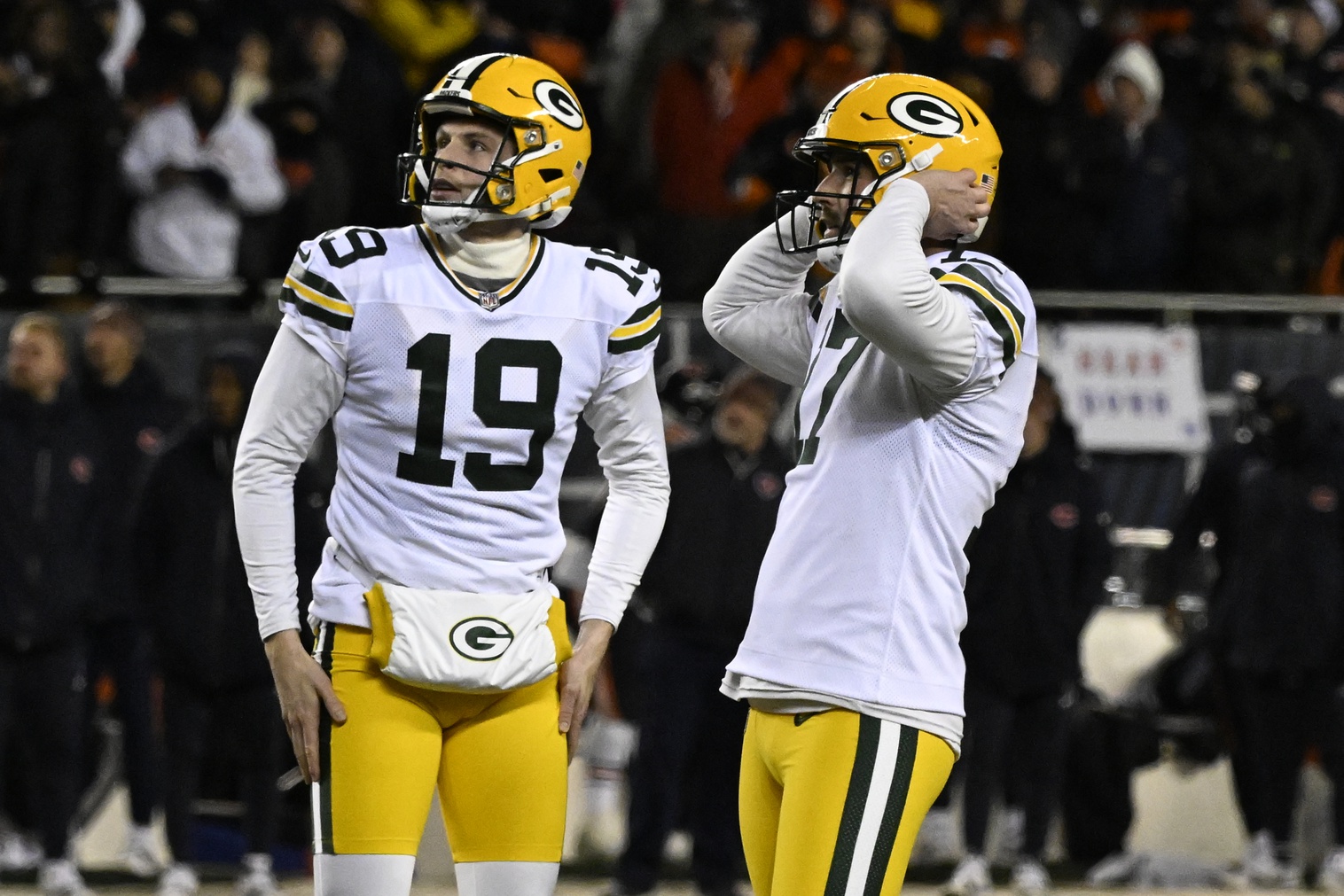
If I had written “Special teams once again cost the Green Bay Packers a trip to the Super Bowl” back in August, with no future knowledge of how Saturday’s Wild Card would turn out, I doubt there would have been much pushback.
Seared into the back of Packers fans’ eyelids, like staring directly into a solar eclipse, this fanbase is permanently scarred from special teams mistakes prematurely ending a Packer postseason run.
In this particular heartbreak, the loss didn’t come down to a single, definitive blunder, à la the losses in 2014 and 2021. In Saturday’s loss, every phase of the game was erroneous.
But the kicker missing seven points certainly doesn’t help. (The Packers lost by less than seven, btw.) Nor does giving up big punt returns or changing your own returner mid-game.
There was a lot going against the Packers as they entered the postseason, yet the first half squarely went their way. A team collapse and special teams errors prematurely ended another season. This has become almost an absolute for Green Bay. What will the fallout be for the 2025 version?
If you thought the failed onside kick recovery against the Bears in Week 16 would get the special teams mistakes out of the way, boy, were you wrong. (That is me, I am the “you” in that sentence.)
The Packers ended the first half of their third matchup with the Bears up 21-3, yet few fans were relaxed, especially after Brandon McManus missed a 55-yard attempt after the Bears successfully iced him.
It wasn’t a great snap, and it was the most forgivable of Brandon McManus‘ three misses. Still, it started the downfall of Green Bay’s chances of victory.
Fine giving McManus a pass on the 55-yarder. Bears iced him. The snap was low. He just missed. Certainly no gimmie in those conditions.
But the two kicks in the fourth quarter? You cannot miss those. Changes the entire complexion of the finish if he makes even one of the two.
— Zach Kruse (@zachkruse2) January 11, 2026
The veteran kicker would miss an extra point after Green Bay’s lone second-half touchdown and later missed a 44-yard field goal. If even one of those kicks is in, it’s an entirely different ball game. Green Bay had to drive for a touchdown on its final drive, rather than even attempt a field goal to force overtime.
Ultimately, the kicker missed seven points in a game the Packers lost by four.
McManus was fully accountable after the game, delivering a chillingly melancholy, “This is the biggest disappointment of my career — just an embarrassment of a performance.
“It’s disappointing that my role on the team is to make kicks, and these guys pour in thousands of plays over the course of the season, and I leave seven points on the board today. It’s the most disappointing point of my career.”
If that had been the only special teams blemish on the day, Rich Bisaccia might have avoided the crosshairs. The coach can’t do much about a veteran having one of the worst games of his career. But, as always, there were other issues.
The Packers finally handed kick return duties back to All-Pro Keisean Nixon, something that should have been done weeks ago. Other than a holding penalty on the first run, which almost seems inevitable, Nixon did fine in the first half.
In the fourth quarter, the team decided to let Josh Jacobs, who hadn’t returned since college, return the ball. While Jacobs brought some juice, he also fumbled around midfield. Were it not for the heroic recovery by Kitan Oladapo, Green Bay’s big-brain new return idea could have been disastrous.
Rich Bisaccia approached Matt LaFleur during the week about potentially using Josh Jacobs on kick returns, but LaFleur said that he didn’t feel good about it.
Then, on Thursday, Jacobs suggested the same thing.
“When he said that to me, I said, ‘Do you really want to return?’…
— zach jacobson (@zacobson) January 11, 2026
Missing some of their core gunners and return team specialists, the Packers also couldn’t stop Chicago’s punt return man Devin Duvernay, who kept the Bears in favorable starting positions to mount their comeback.
If special teams did nothing more than the bare minimum, we’d probably be discussing a Divisional Round matchup against the Seattle Seahawks. Instead, the we-fence, led by the highest-paid special teams coordinator in the league, pooped their collective pants on national TV. It destroyed any hope of situational football and couldn’t elevate the team when the offense and defense needed a breather.
Rich Bisaccia so good at his job he tries to do it with an arm tied behind his back. https://t.co/vP6wuVZR9k
— Andy Herman (@AndyHermanNFL) January 12, 2026
The offense and defense made plenty of mistakes, but the pattern of consistently special-teams errors puts that group in the spotlight. Special teams played major roles in many of Green Bay’s losses (and tie) this season, and hiring a respected special teams guru like Bisaccia hasn’t stopped the postseason heartbreakers.
Will this version of special teams disaster lead to a change?
In his season-ending presser, Matt LaFleur didn’t definitely say he’d bring Bisaccia back. Of course, LaFleur was answering questions about his own job. Until his own job status is confirmed, it’s hard for him to make definitive statements.
Bisaccia didn’t make McManus miss three kicks, and it’s clear Green Bay’s special teams woes go beyond a specific coordinator. Something at the organizational level is fundamentally flawed when it comes to the game’s maligned third phase.
However, if Green Bay is going to stick with Matt LaFleur, something needs to change. As much as I enjoy Bisaccia’s media availability, his demeanor, and how much players love him, he’s not a value add for the final score. Firing Bisaccia won’t solve the foundational issues of how the Green Bay Packers approach special teams. That’s a deeper issue at all levels of the organization. (See Justis Mosqueda’s informative breakdown for a taste of “why.”)
Still, a change is needed for accountability’s sake, if nothing else.