
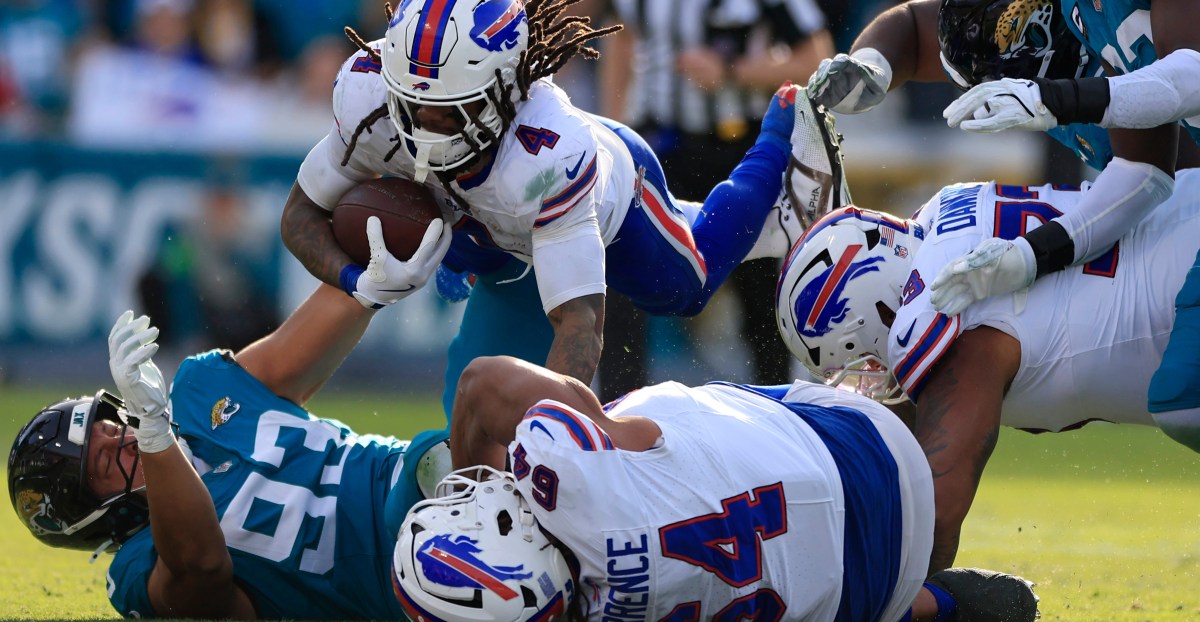
It’s the NFL playoffs. Win or go home. When the stakes are this high, you do anything it takes to win the game. We saw Buffalo Bills wide receiver Tyrell Shavers play on what turned out to be a torn ACL as the ultimate highlight of that mentality. That’s not to disparage the lesser tales of grit either.
The Bills took a beating against a Jacksonville Jaguars team that seemed intent on causing harm at times. In the end, Buffalo took home the W. In addition to their grit, there was one other secret. They were willing to play outside their comfort zone to a large degree.
Which tendencies were broken?
The Bills this season have been a run-first team, with 547 rushing attempts compared to 495 passing attempts (and 40 sacks). But what else can we say about their offense beyond that? Let’s look at a couple charts.

I crossed out the defense since we’re focusing on the offense here, but it’s legible still if you’re curious. On offense, while the Bills were the second-highest yards-per-play rushing the ball this season, that’s not true in all areas of the field.
I won’t call anyone out by name (and I’ve thought the same thing myself at times), but I’ve seen it questioned why the Bills like running it up the middle so often. First, I want to point out that the “so often” perception is indeed accurate. The Bills have run 140 runs up the middle, nearly twice as many times as any other play direction.
As to the “why” part of the question, it’s because no one does it better. I want to put things into perspective on how preposterously high 5.35 yards per attempt is against NFL defenses. From one side of the coin, it’s almost exactly one yard higher than the league’s overall average yards per carry. It’s also not a far cry from 5.6 yards per play, which is what the New York Jets averaged on PASSING attempts. That’s right. Running the ball straight up the gut, Buffalo’s rushing offense is within striking distance of the league’s worst passing attack. Best to worst might not sound like it’s that impressive, but remember we call it a passing league for a reason.
How did James Cook III do against the Jaguars? Let’s find out.

Yikes! The first reaction you have is likely the lack of five-plus-yard carries. The next is that I look like I’m full of crap, as the Bills still clearly tried running the ball up the middle a lot. That’s true, but consider these facts about the run game.
The Bills asked James Cook to run up the middle six times in the first half. That dropped to four in the second half, and two of those were the first drive after halftime. It makes sense to start the game trying to work with an obvious strength for your team. It might not be as quickly as it could have been, but Buffalo adjusted when it wasn’t working.
Further, Cook carried the ball in all directions twice as often in the first half compared to the second (10 rushes compared to five). The Bills, a run-first team that has dominated in the middle of the formation, mostly abandoned these things against a Jaguars team that was well prepared for it.
Against their usual tendencies, Buffalo’s offense passed the ball 35 times (and one sack) compared to 26 rushing attempts. I bring this up because the drop in rushing attempts in the second half was not a result of having fewer plays. As a matter of fact, they had 34 plays in the second half, four more than the first. The Bills deliberately had a more pass-oriented offense, and in the running game they moved away from what they typically do better than anyone else.
Let’s take a quick look at the passing game too.

Certainly take your time on this as well if you wish, but I’ll highlight just one major thing. Buffalo’s passing game loves, loves, loves their short right passes. They may not have a ton of passes in this (or any) direction compared to league trends but, for their own data, the short-right passes are by far the highest number of attempts.
Like the rushes up the middle, no one is better than the Bills in average gain or completion percentage toward the short-right of the field.
Okay, maybe I’ll point out one more thing. On short-left passes, the Bills are fine, with the ninth-highest average gain and an average completion percentage.

That information makes it fun to discover that quarterback Josh Allen threw 13 passes to the left/short section of the field by my count, and he had a 100% completion percentage. Compare that to eight passes to the right as I count it, with a still-excellent 88% completion percentage. The big tendency breaker here is leaning so much more on the left side of the field.
This was a playoff game that was always in doubt for both teams. At no point did anyone pull ahead by more than six points. Put differently, if the running game was working there’s no reason to abandon it. It wasn’t working, though, and the Bills adapted. Hopefully this tendency of intelligent flexibility continues. Buffalo will need it to take on the one-seeded Denver Broncos coming off some extra rest.