
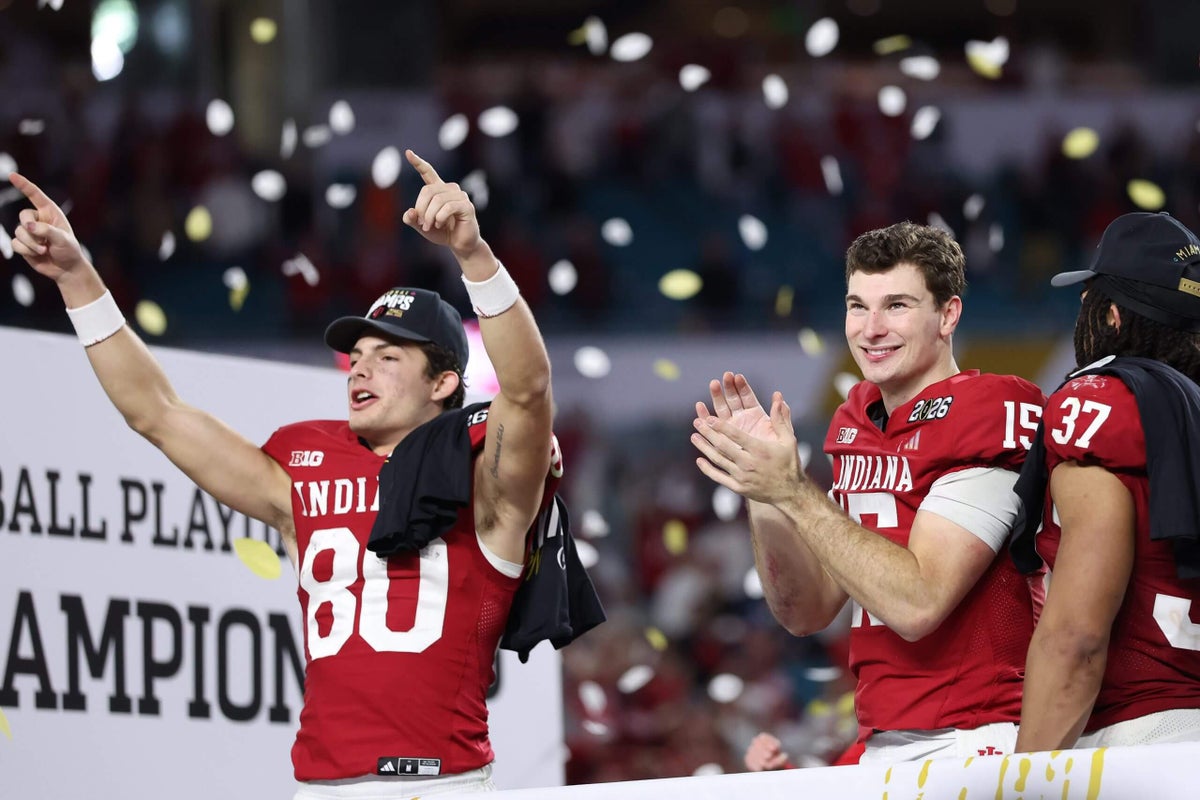
Trying to put Indiana football’s two-year turnaround under coach Curt Cignetti in context requires some creativity. You can’t just look around college football and find suitable comparisons.
We’ve already written about how Indiana had the longest preseason odds (100-to-1) of any champion this century, and twice as long as the closest team in that period (2010 Auburn was 50-to-1). Looking at Cignetti’s tenure, the team started his first season as coach with 500-to-1 odds. Stewart Mandel is calling Indiana’s championship “the most remarkable story in modern sports history.”
How unique is IU’s ascent in college football history?
There are other big turnarounds in college football, but none fully measure up.
College football hadn’t seen a first-time champion since Florida’s first title in 1996. But Florida was already a winning team long before that. The franchise had 14 top-15 seasons in the four decades before Steve Spurrier took over in 1990. In the 1980s, Florida didn’t have a single losing season. That Florida was considered a breakthrough champion shows where the bar is usually placed.
What about bigger turnarounds? Did any start as low and then achieve as much as Indiana?
IU’s opponent in Monday’s championship game, Miami, had its own turnaround before its first national title in 1983. The Hurricanes were 42-67 in the 1970s, but by the time Miami became The U, it was coach Howard Schnellenberger’s fifth season, and he had already posted three straight winning seasons and two nine-win campaigns in South Florida. Plus, Miami had five top-15 seasons in the 1950s and 1960s. Miami wasn’t a winning program, but it wasn’t a doormat like Indiana. Indiana had only two top-15 seasons in the entire 20th century.
Bill Snyder worked wonders at Kansas State and has some similarities to Cignetti in coaching style. The Wildcats had back-to-back winless seasons and had one winning season in the previous 18 years before Snyder got to Manhattan in 1989. Before Snyder arrived, the Wildcats had only made one bowl game ever (a lost Independence Bowl) and had never finished a season ranked. Under Snyder, K-State had five top-10 seasons in six years from 1997-2002. Snyder would’ve made the Wildcats a College Football Playoff stalwart if there had been a 12-team playoff then.
In terms of historical futility, Kansas State was at least as bad as Indiana. However, the Wildcats never reached the heights of Indiana’s national title.
In terms of a single-season surprise, 1995 Northwestern merits a mention. The other purple Wildcats just retook the “top” spot from Indiana for most losses in FBS history. In 1995, Northwestern won the Big Ten and went to the Rose Bowl. Northwestern hadn’t had a winning season since 1971. Like Kansas State, Northwestern absolutely fits as a viable comparison to IU in terms of losing history. Gary Barnett’s Wildcats entered that bowl game ranked No. 3 in the major polls, but the Wildcats lost.
The shock of that turnaround was at least as strong as Indiana’s, but the Wildcats did not win the national title, so it also falls just short.
Indiana: The lowest lows to the highest high
The 100-to-1 odds Indiana had to start this season are long by champion standards, but are actually the shortest odds the Hoosiers have had in the last several years.
Before the 2019 season, Indiana had 2000-to-1 odds to win the national title. Those odds imply a likelihood of 0.05 percent. That is virtually as close as you can get without the sportsbook saying, “It’s not happening.”
In 2019 and 2020, Indiana had back-to-back winning seasons totaling 14 wins. All it took was 14 wins for that to be the program’s best two-year run in nearly three decades.
In 2020, the Hoosiers went 6-2 during the COVID season and finished ranked 12th and 13th in the polls, which was IU’s best finish since 1967.
In 2021, Indiana was also 100-to-1 to win the title, coming off that season with quarterback Michael Penix Jr. returning. The Hoosiers ended up winless in the Big Ten and finished 2-10. That’s what Indiana football was.
Before what would be coach Tom Allen’s last year in charge in 2023, the odds were 500-to-1.
That’s what Cignetti inherited, along with those matching 500-to-1 odds before the 2024 season. The rest has been chronicled ad nauseam in recent weeks. IU made the CFP in Cignetti’s first year, but even after that still entered this season with 100-to-1 odds.
There are other examples of teams that had big turnarounds or surprise seasons. Some won it all, like Miami, but didn’t start from as low a place as the Hoosiers. Some did start from that low, like Kansas State and Northwestern, but didn’t quite reach the pinnacle.
There is no comparison in college football.
What about other sports?
The records for sports betting odds don’t go all the way back to the start of professional leagues, but as far as tracking goes, only one American champion had longer odds than Indiana: the 1999 St. Louis Rams, who started the season at 150-1. Kurt Warner and Marshall Faulk led a surprise team that would end up winning two Super Bowls in three years.
To find longer odds than that, you have to reach across the Atlantic Ocean for Leicester City’s famous English Premier League triumph in 2015-16. The Foxes were 5,000-to-1 to win the title. It was an incomprehensible accomplishment that will be hard to top.
For context, here are the top five biggest surprise champions based on preseason betting odds for the four major professional sports in the U.S., plus college football and college basketball, according to SportsOddsHistory.com.
College football since 2001
100-1: 2025 Indiana
50-1: 2010 Auburn
40-1: 2003 LSU
20-1: 2019 LSU
20-1: 2014 Ohio State
MLB since 1985
80-1: 1991 Twins
75-1: 2003 Marlins
50-1: 2023 Texas Rangers
50-1: 1987 Twins
40-1: 2002 Angels
NFL since 1977
150-1: 1999 Rams
60-1: 2001 Patriots
50-1: 1981 49ers
40-1: 2017 Eagles
35-1: 1982 Washington
35-1: 1980 Raiders
NBA since 1985
28-1: 2014-15 Warriors
20-1: 2010-11 Mavericks
18.5-1 (66-1 before Kawhi trade): 2018-19 Raptors
18-1: 2022-23 Nuggets
15-1: 2003-04 Pistons
NHL since 1985
60-1: 2005-06 Hurricanes
30-1: 2018-19 Blues
30-1: 1990-91 Penguins
25-1: 2003-04 Lightning
20-1: 2023-24 Panthers
College basketball since 2002
80-1: 2022-23 UConn
65-1: 2013-14 UConn
60-1: 2024-25 Florida
40-1: 2010-11 UConn
35-1: 2002-03 Syracuse
How does this Indiana team compare to recent college football champions?
For an extra piece of fun, Austin Mock — who creates projection models for The Athletic for various sports, including college football — provided hypothetical spreads for Indiana against the last six national champions. Before sharing the numbers, Austin had a warning about their merit, given all the changes in college football in the last few years (the transfer portal opening up without players having to sit out a year, the creation and growth of NIL money, as well as revenue sharing).
“I want to preface this that these are numbers relative to the average college football team,” Mock said. “I think that the top of college football has gotten worse over the last few years, especially the last two.”
Indiana -0.5 vs. 2024 Ohio State
Indiana +1 vs. 2023 Michigan
Indiana +3.5 vs. 2022 Georgia
Indiana -1 vs. 2021 Georgia
Indiana vs. 2020 Alabama: pick ’em
Indiana +1.5 vs. 2019 LSU
Have fun in the comments with these.