
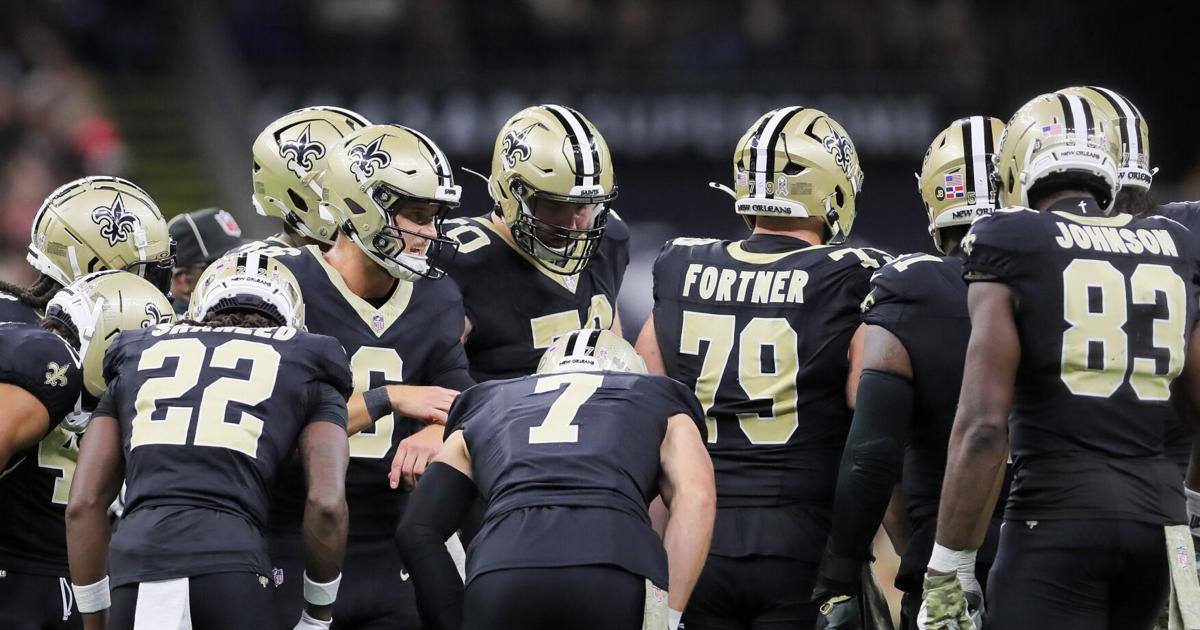
The New Orleans Saints seem to have found their quarterback. Now they need better playmakers around him.
Tyler Shough had success throwing the ball to wide receiver Chris Olave and tight end Juwan Johnson, while wideout Devaughn Vele emerged as an important contributor, too.
But general manager Mickey Loomis and coach Kellen Moore wouldn’t be blamed if they conclude the Saints’ offense needs a bit more juice heading into next season. With practices for the Senior Bowl next week, draft season is just around the corner — and finding new weapons to further boost Shough’s supporting cast should be a top priority for the Saints.
As well as Shough played down the stretch, the Saints’ offense lacked the explosiveness that’s needed to become one of the league’s better units. Consider this: When Shough took over as a starter over the back half of the season, 13.6% of the Saints’ completions ended in an “explosive” — defined as a pass of 16 yards or more.
That still ranked only 17th in the NFL.
For the year, the Saints finished with an explosive pass percentage rate of 10.2% — third-worst in the league.
That’s not the only way the Saints lacked juice, either. Let’s dig in.
Loooong drives don’t pay off
The Saints and the Dallas Cowboys led the league in drives of at least 10-plus plays with 39.
But there was a key difference between the two teams. The Cowboys, who had two elite wideouts in CeeDee Lamb and George Pickens, scored touchdowns on 17 of those drives, third-most in the NFL. The Saints? They had just 12, putting them in the middle of the pack (tied with six teams for 14th).
On one hand, being able to string together such lengthy drives highlights Moore’s sharp play-calling and quarterback play that could keep the Saints offense on schedule. But too often, the Saints didn’t have the difference-makers who could convert those long series into the end zone.
The Saints ended up kicking 16 field goals on drives that lasted at least 10 plays, the second-most in the league.
Long drives aren’t neecessarily a bad thing. The Denver Broncos, San Francisco 49ers and Houston Texans finished right below the Saints, Cowboys and Arizona Cardinals and still made the playoffs.
But breaking up those series every now and then with an explosive play can change a game, and that was a large element that was missing from the Saints in 2025.
A lack of 3-pointers
Throughout Moore’s first season, the coach loved his basketball analogies. Moore wanted his team to play with pace, similar to the NBA’s Indiana Pacers. Quarterbacks were told to take “3-pointers and layups,” which were basically deep shots or easy completions.
But in this analogy, the Saints weren’t a very good 3-point shooting team.
Early in the year, defenses were super-cautious of Olave and Rashid Shaheed beating them over the top, leaving quarterback Spencer Rattler to take what was in front of him. Though Shough showed more aggression after taking over and Olave started to torch defenders anyway, the Saints still didn’t hit on deep shots at the rate that Moore likely would have preferred.
Shough was excellent on intermediate throws of 10 to 19 yards with a completion percentage of 67.9%, but was just 9 of 36 on throws that traveled at least 20 yards through the air, according to Next Gen Stats. That 25% completion percentage ranked fifth-worst among 33 qualified passers.
And though Shough needs to improve in that area, some other data suggests he could use additional help. The rookie, for instance, was pressured on 47.2% of his deep throws, the seventh-highest rate in the league. Rattler was even above that, facing a pressure rate of 51.7% (fifth) on deep throws. Shough’s completion percentage on those throws was 12.5% worse than expected, behind only Atlanta’s Michael Penix and Kirk Cousins.
An explosive passing game is instrumental for a team’s success.The New England Patriots (18.4%, first), Seattle Seahawks (16.9%, third) and Los Angeles Rams (15.9%, sixth) all finished top six in explosive pass play percentage. Those three, perhaps not coincidentally, play in conference championships this weekend.
Run to nowhere
A strong running game obviously helps out a quarterback.
The Saints didn’t have one in 2025.
Beyond ranking 28th in total yards and 31st in expected points added per rush, there was, unsurprisingly, a lack of explosiveness in New Orleans’ rushing attack. Just 8.1% of the Saints’ runs went longer than 12 yards, which counts as an “explosive.” That number crept up to 10.1% when Shough became the starter, but it was still below the league average of 10.7%.
The Saints had just five runs that gained at least 20 yards, ahead of only the Raiders, 49ers and Kansas City Chiefs.
Shough and Taysom Hill — two quarterbacks — accounted for three of those five big gains.
Devin Neal, a sixth-round rookie, and Audric Estime, who didn’t receive a carry until December, had the other two.
Alvin Kamara, New Orleans’ normal starter, had his longest run of the season in Week 1: An 18-yard touchdown against the Arizona Cardinals. Kamara missed the last six games of the season with a knee injury. Kendre Miller, a key backup, was lost to a torn ACL on Oct. 19.
The Saints not only need a running back with noticeable burst, but also an offensive line that can create the holes for the runner to sprint through.