
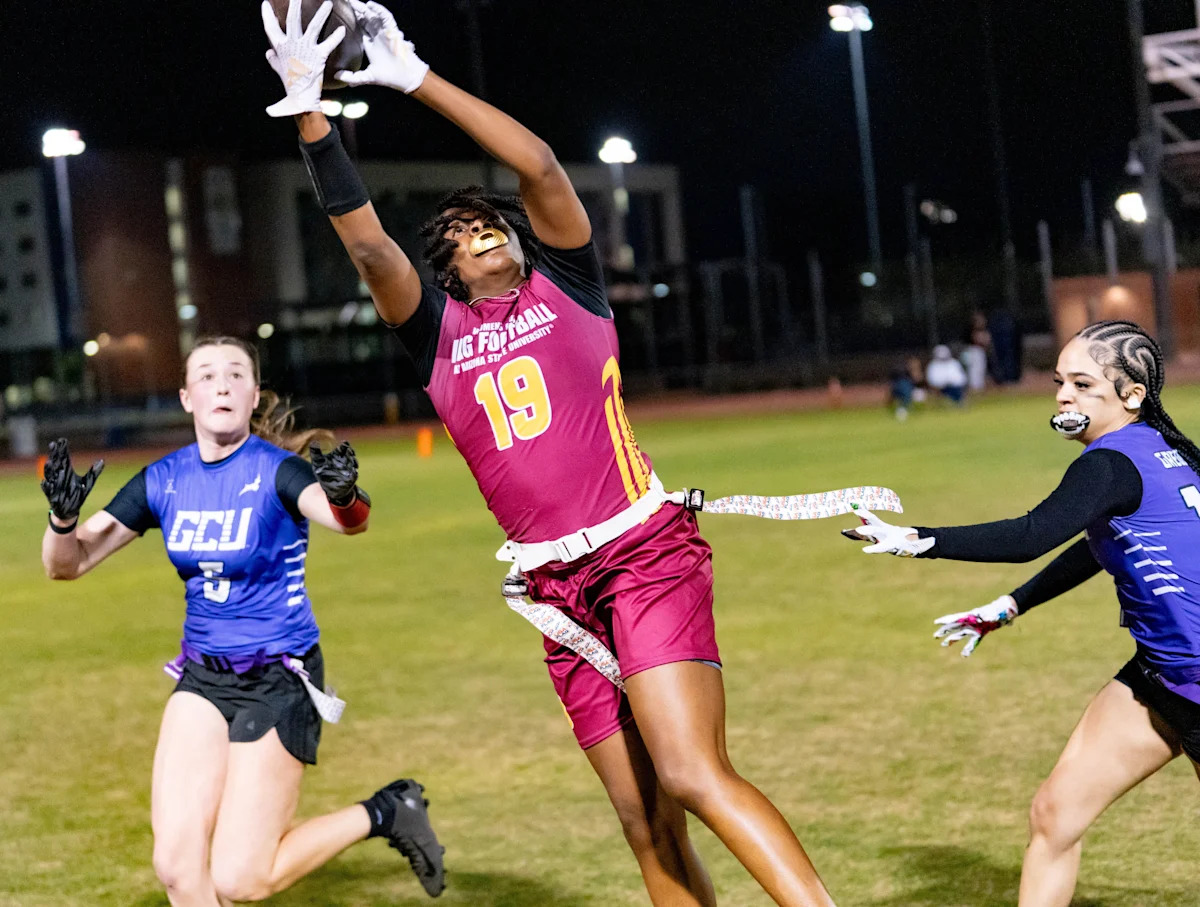
In what may soon become an official NCAA sport, Arizona State and Grand Canyon University faced each other in a club flag football game to open up the 2026 season. The two teams met on Jan. 24, with GCU defeating ASU 25-0.
GCU was led by four touchdowns from junior quarterback Ella Bernier, who ended the game with a 35-yard touchdown run.
Advertisement
But there was much more to this game than just the actual result. Flag football, which is set to make its debut at the 2028 Los Angeles Olympics, recently took the next step toward becoming a sanctioned sport by the NCAA. Saturday night’s game was a potential glimpse of the future.
The stands at GCU’s Track Athletics Field are not the biggest, but they were filled with fans.
“It’s electric,” GCU coach Brian Tice said. “This sport is growing as we speak and to have this support for two local teams, it’s amazing.”
The sidelines were also mostly filled with fans as well as the crowd cheered on both teams in the first game for the teams since flag football was officially added to the NCAA Emerging Sports program.
Advertisement
“To see all the people that come out here, just stand on a field with no stands – I mean, give us a stadium, and we’re going to fill it,” Arizona State coach Jesse Pap said. “There’s that much energy about the sport. Coach Tice and I are both excited about it.”
With flag football in the Emerging Sports program, it is now on the pathway toward reaching NCAA status. There are certain thresholds that need to be met, but enthusiasm is building.
Flag football has been one of the fastest-growing sports at the youth, high school and collegiate levels. According to the International Federation of American Football, 2.4 million kids under 17 are playing organized flag football in the U.S., while millions more participate in flag globally.
Right now, flag football is only played officially at the NAIA level, which oversees small college athletics. Arizona Christian University is set to begin its first season this year, but other states have already gotten a head start.
Advertisement
Pap and Tice hope that if flag football becomes an official NCAA sport, that it will help with recruiting.
“I think Arizona is overlooked, to be honest,” Pap said. “Coach Tice and I, we’re tired of seeing all of our stud Arizona athletes go to Kansas, Florida. We want to keep them in the great state of Arizona.”
Tice’s current roster is filled from all over the country.
“We see what type of athletes we have here,” Tice said. “The sport is just growing so fast. With it going possibly NCAA, it’s going to be a big deal for us in Arizona.”
For Bernier, who was one of the first people to sign up for the club at GCU before its inaugural season in 2024, the game was a special moment. She’s from Chicago and didn’t get to play flag football in high school. Friends and family flew in from Illinois to see her play.
Advertisement
Bernier has watched the club grow since joining. There are 28 athletes on this year’s roster.
“I’m so glad I’ve been here since day one,” Bernier said. “I couldn’t be more proud of the girls and the coaching staff we have today. I was here before I even knew flag football was a thing. To see it blow up overnight, in the Olympics now, the momentum is going crazy now. NFL teams sponsoring teams. It’s seriously going to be one of the next big things.”
Logan Stanley is a sports reporter with The Arizona Republic who primarily focuses on high school, college and Olympic sports. To suggest ideas for human-interest stories and other news, reach out to Stanley at logan.stanley@usatodayco.com or 707-293-7650. Follow him on X, formerly Twitter: @LSscribe.
This article originally appeared on Arizona Republic: GCU, ASU club flag football face off. Could NCAA sanction the sport?