
On Sunday, we highlighted three offensive prospects in the 2026 NFL draft whom the New York Jets should steer clear of in the first round.
Now, we turn our focus to the defensive side of the football.
The Jets should be careful with these two prospects.
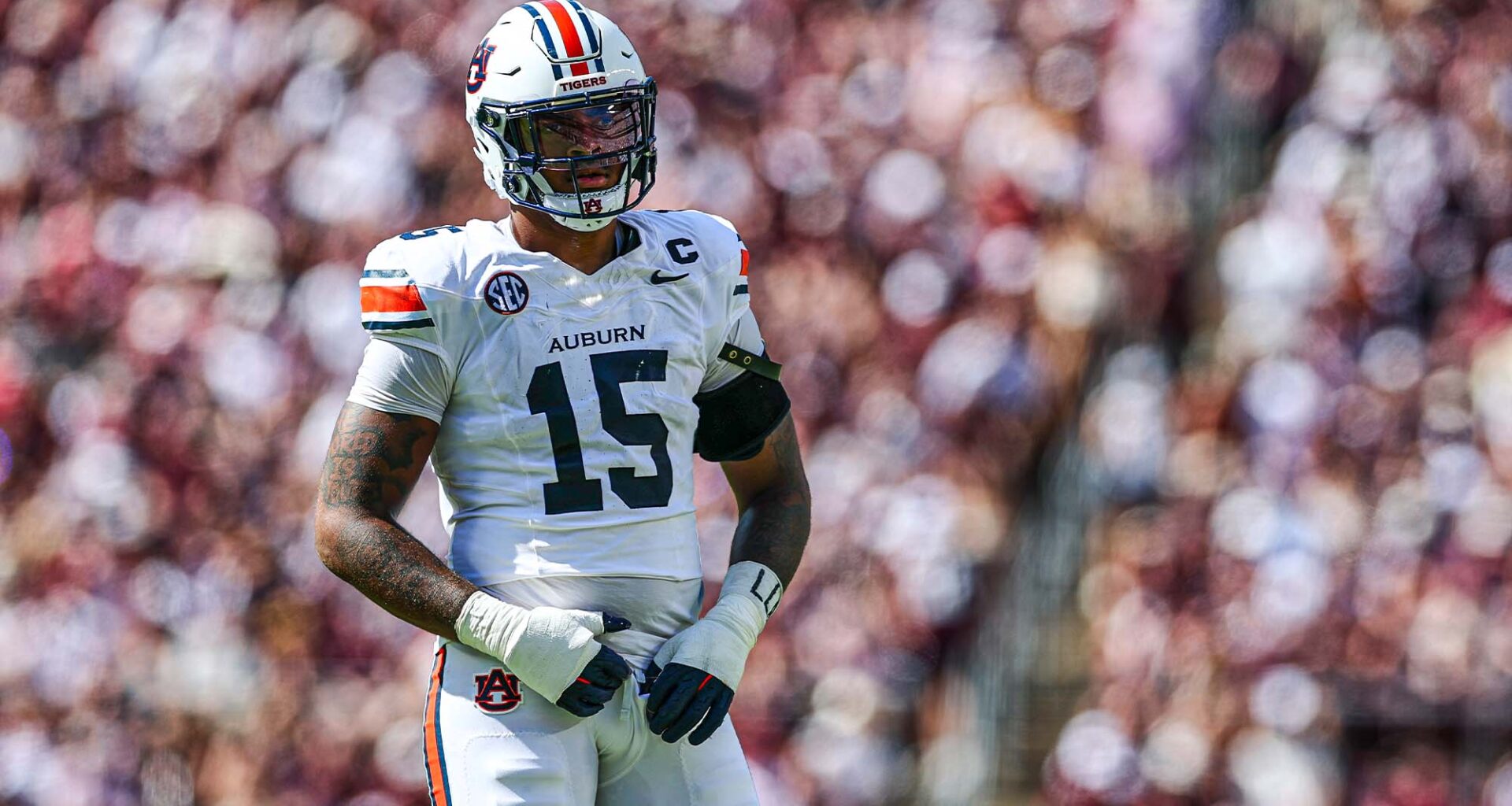
Keldric Faulk, EDGE, Auburn
Consensus big board rank: No. 11 (EDGE4)
In a recent breakdown, we discovered that there is a strong correlation between college production and NFL success for first-round prospects.
Simply put, if the prospect was dominant in college, he should have a good chance of becoming a solid NFL player. If he was unable to dominate against college competition, it bodes poorly for his NFL outlook.
Keldric Faulk falls into the latter category.
On the consensus big board, Faulk is the 11th-ranked overall prospect and the fourth-ranked edge rusher (if Arvell Reese is included). This indicates that he could be an option for the Jets with the 16th overall pick; if they fall in love with him, it is not impossible that they could take him second.
Faulk would be an unwise investment at either pick.
The 6-foot-6, 290-pound defensive end is coming off a junior season in which he posted two sacks, five tackles for loss, and 29 total tackles in 12 games. That is not the type of proven production you want to see out of a first-rounder.
Looking at more advanced metrics, Faulk had a 75.8 overall Pro Football Focus grade, a 9.5% pressure rate, a 0.6% sack rate, and an 11.6% pass-rush win rate. This gives him one of the most unappealing profiles among the top names in the 2026 edge class.
Take a look at how his combined performance across these four highly correlative metrics (“Big 4 Score”) stacks up against first-round edge rushers chosen from 2015-24:
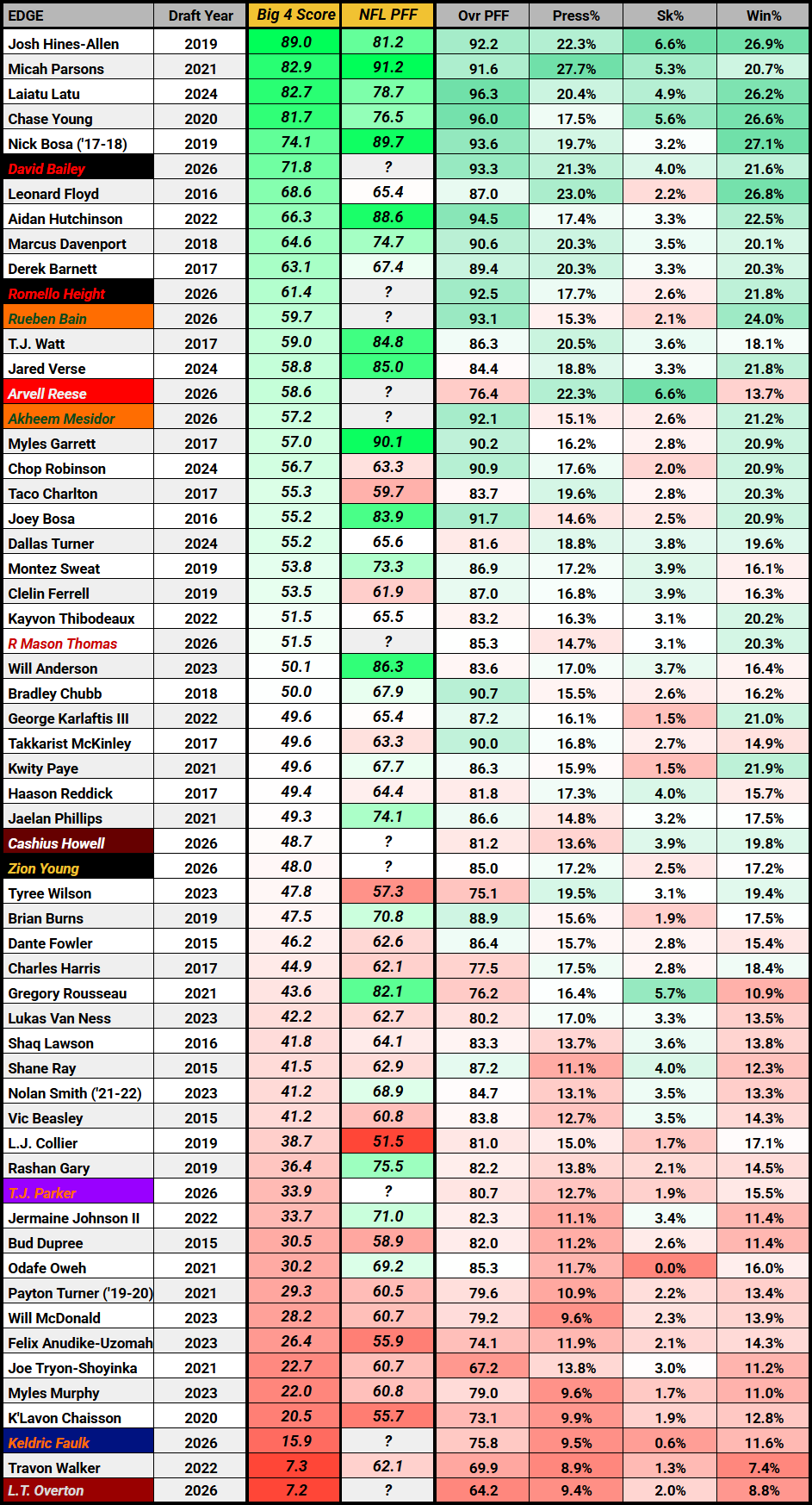
Most of the first-round EDGE prospects with similar numbers to Faulk in their final college season have not gone on to become stars in the NFL.
In fairness to Faulk, he was more productive in his 2024 sophomore season, posting seven sacks and an 83.8 overall PFF grade. However, his dip in 2025 cannot be ignored. A first-round pick is a hefty investment; teams should want players on the rise, not on the decline.
Faulk could still become a good NFL player, but his track record of production is not reliable enough to justify a first-round pick, especially at a position where college production is more correlated with NFL success than most other positions.
Caleb Downs, S, Ohio State (at No. 2 overall)
Consensus big board rank: No. 5 (S1)
To be clear, Caleb Downs is not included on this list because he is a bad prospect. He is a fantastic safety prospect.
However, the key word there is “safety.”
You don’t take those second overall.
He is not a popular mock-draft selection for the Jets at No. 2, but every once in a blue moon, you see Downs mocked to New York with the second overall pick.
This would be a football crime.
Even if Downs were a perfect safety prospect, the positional value just doesn’t make sense for the No. 2 slot. Safeties cannot affect games the same way that quarterbacks, edge rushers, wide receivers, or even offensive linemen can.
Safeties are not involved in the majority of snaps. Against the run, they often line up far away from the box. Against the pass, they are targeted less often than both the cornerbacks and the linebackers.
If you watch every snap of an individual safety’s film, you will find yourself getting bored quickly. On most plays, he will have a minimal effect on the outcome.
Is this to say that safeties don’t matter? Of course not.
But some positions matter more than others, and safety is near the bottom of the value list. NFL teams have made that clear through their financial valuation of the position. Per Spotrac, the average Week 1 starting safety in 2025 had a salary of $6.7 million, third-lowest among offensive and defensive positions, narrowly ahead of only off-ball linebackers ($6.5 million) and centers ($6.4 million).
For that reason, the Jets should not waste the chance to select an elite talent at a premium position to take a player whose position precludes him from having an omnipresent impact on the game. At No. 2, the expectation is to land a franchise-altering player with the ability to take over games, and safeties cannot do that, no matter how impressive.
If the Jets somehow have a chance to draft Downs outside the top five, they should not hesitate, but taking Downs at No. 2 is the type of outdated decision-making that would leave New York behind the times in today’s value-driven NFL.