
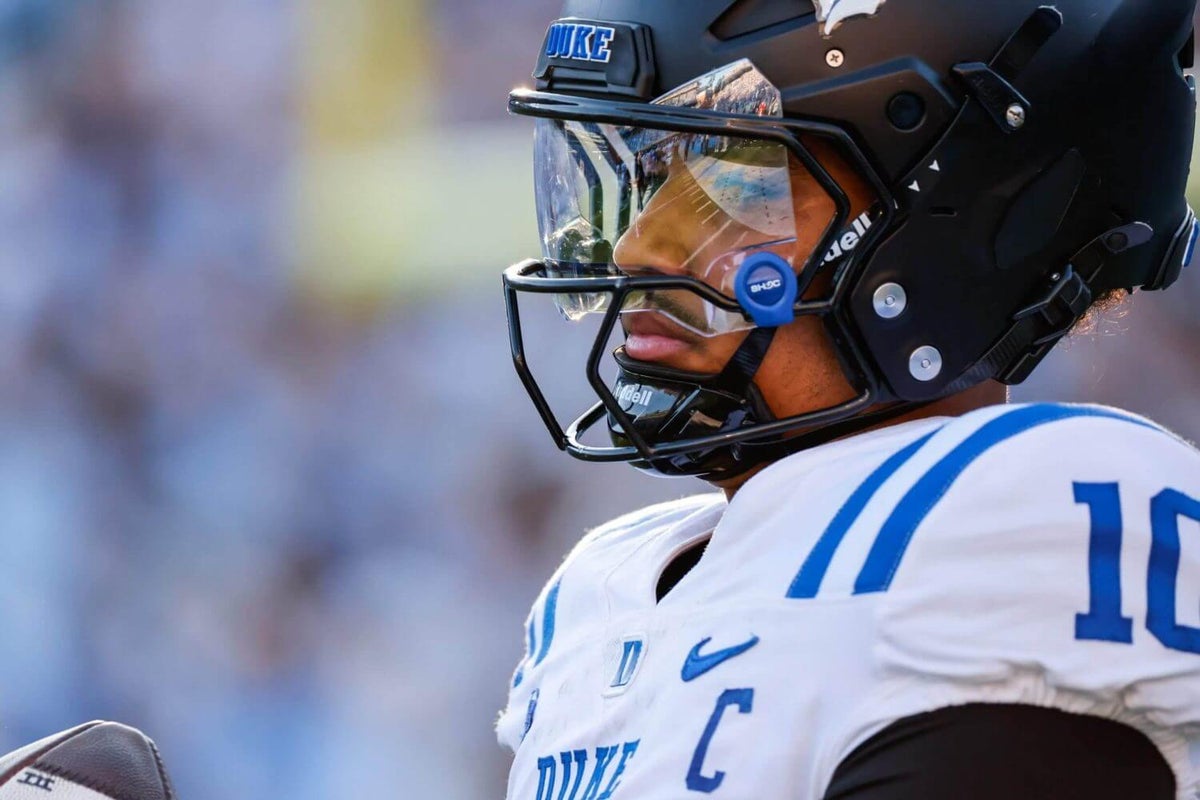
The legal mess involving Duke and star quarterback Darian Mensah is scheduled to return this week to a Durham, N.C., courtroom. At issue is whether Mensah’s multimillion-dollar contract with Duke prevents him from enrolling and playing at another school (Miami is the most likely destination) while the dispute plays out. For now, the quarterback who delivered the Blue Devils their first outright ACC title since 1962 remains stuck in transfer portal limbo.
“This case if nothing else is a cautionary tale,” said Daniel A. Etna, the co-chair of the sports law group at the New York-based firm Herrick.
So what is this cautionary tale really about? How will the latest in a surge of squabbles over college athletes’ contracts end? And what does all this have to do with a 19th-century German opera singer?
The Athletic spoke with lawyers specializing in sports, entertainment or employment about this first-of-its-kind case and where it’s going. Here’s what you need to know.
What is this case about?
On Friday, Jan. 16 — the final day of college football’s transfer portal window — Mensah informed Duke of his intention to enter the portal, even though he was under a direct revenue sharing contract with the Blue Devils that ran through 2026.
On Tuesday, Jan. 20, Duke University sued Mensah in Superior Court in Durham County. Duke sought to prevent Mensah from transferring while it pursued arbitration over the contract, which includes exclusive rights to Mensah’s name, image and likeness “with respect to higher education and football,” according to the complaint. Duke argued that Mensah transferring and competing elsewhere before arbitration would cause “irreparable harm.”
A judge granted Duke’s temporary restraining order (TRO), momentarily preventing Mensah from enrolling at and playing football for another school. However, the judge also ruled Duke could not prevent Mensah from entering the portal, which he did on Jan. 21.
That order is in effect until a judge rules on a longer-term preliminary injunction. A hearing on that is scheduled for Thursday, with a decision expected that afternoon or soon after. If Duke’s preliminary injunction request is granted, Mensah could be prevented from transferring until the arbitration process is complete. If it is not granted, Mensah could enroll and play elsewhere while the dispute is resolved. It’s also possible Duke and Mensah settle their dispute before the hearing or arbitration process.
What is arbitration?
It’s essentially “private court” — a confidential dispute resolution, as opposed to litigation in a public court. Arbitration typically moves faster than a traditional court but can still take six months to a year. It’s a common process for large companies or universities, and many athletes’ revenue sharing contracts include arbitration language for disputes.
The school is seeking monetary damages via arbitration and a restriction preventing Mensah from playing for and licensing his NIL rights to another school until his Duke agreement ends Dec. 31.
Do things like this happen in other industries?
Yes, and more frequently than you might think. A famous 1852 case (Lumley v. Wagner) involving a German opera singer is still taught in law schools and sounds similar to the Mensah case. Johanna Wagner had a deal to perform at one British theater, but another theater tried to hire her for more money. Because Wagner was a famed performer, the first theater didn’t have a viable replacement if she left; there was no transfer portal for sopranos.
“You can’t just call someone off the street of London to take over the role,” said Geoffrey Rapp, the dean of DePaul University’s College of Law.
The case led to what’s called a negative injunction. A court couldn’t force Wagner to sing at the first theater, but it could prevent her from singing at the second.
The idea still holds true. Business executives can be barred from joining a rival company and taking trade secrets with them. An actress who uses her NIL in Honda commercials can be stopped from appearing in Toyota ads (or at least be ordered to pay back her earnings plus damages).
Entertainment lawyer Nick Soltman said it’s not uncommon for TV/movie studios to threaten lawsuits against actors who try to bail on a project. Few follow through, however, because “they know it’s bad business for studios to sue talent.” An exception could be an extreme case, like an actor employed by Marvel Studios leaving to make a superhero film for rival DC Studios.
“You can’t replace a Robert Downey Jr. or whoever,” said Soltman, a Los Angeles-based partner at Kinsella Holley Iser Kump Steinsapir LLP. “(Mensah) is the college football equivalent of that.”
Does it matter that Mensah isn’t a Duke employee?
Yes. A lot.
College athletes aren’t employees. Technically, Duke didn’t pay Mensah to play football for the Blue Devils because pay-for-play is against the rules. Instead, Duke paid Mensah to license his NIL rights, which are contingent on Mensah playing football for the Blue Devils.
If Mensah were a Duke employee being explicitly paid to play football, then the university would have a stronger contractual argument that his exit would cause irreparable harm, and could establish stricter and pricier buyout terms.
“If he’s an employee, there’s no question,” Soltman said. “He can’t go and work for a rival school that’s a competitor to Duke in college football.”
For now, the employment debate is not one with which most college sports leaders are willing to engage.
“At the most basic level, rev-share deals go out of their way to make clear they are not employment agreements,” said lawyer Cal Stein, who advises colleges and athletes.
How is this situation different from previous contract disputes?
Unlike the recent dispute between quarterback Demond Williams Jr. and Washington, the Mensah-Duke deal includes no liquidated damages or buyout clause. Williams reportedly had a buyout clause with Washington that could have cost the full value of his contract — $4 million. That $4 million also would have counted against the revenue sharing cap for whatever program Williams transferred to, presenting a significant deterrent. Duke is arguing for monetary damages from Mensah, but his contract has no specified buyout figure.
This is also different from last offseason’s Xavier Lucas situation, when Wisconsin refused to grant the defensive back’s request to enter the transfer portal because of what it considered to be a “binding agreement” between Lucas and the university. Lucas unenrolled from Wisconsin and enrolled at Miami outside the portal. He played for the Hurricanes in 2025.
There is no NCAA rule preventing Lucas or any athlete from changing schools outside the portal and maintaining their athletic eligibility. But unlike Duke, Wisconsin did not sue the player to restrict his transfer; it ultimately sued Miami for tortious interference, claiming Miami intentionally interfered with a contract between Wisconsin and Lucas. That case is ongoing. It’s possible, regardless of what happens Thursday, that Duke could pursue a similar lawsuit against another school if it believes it can prove that school tampered with Mensah.
The first known legal case between a school and a player was Georgia’s attempt to compel arbitration with former defensive end Damon Wilson II. But that surfaced months after Wilson left the Bulldogs for Missouri and centers on what, if anything, he owes the Bulldogs from a $420,000 contract. Wilson sued Georgia last month, and both cases are pending. Wilson is expected to play for Miami this fall.
There’s also a pending federal lawsuit involving one-time Florida quarterback signee Jaden Rashada over a $13.85 million NIL dispute. But that was filed by Rashada against individuals (including now-former Gators head coach Billy Napier), not the school, and it stemmed from Rashada’s high school recruitment.
What’s the broader impact beyond Mensah and Duke?
Coaches and administrators have already been complaining about college players being de facto free agents every year. If Mensah’s NIL contract does not hold up in court, then schools lose their main legal tool to keep players beyond one season — or prevent other programs from poaching them.
“The wild, wild west gets a lot wilder,” said Matt Fenton, a founder of the Tampa-based employment law firm Wenzel Fenton Cabassa, P.A.
But if Duke wins, Fenton said the opposite will be true. Players with multi-year deals will be tied to schools, even if the player could get more money elsewhere or underachieves and becomes a bad bargain for his team.
Another, less extreme possibility is that schools use this as a reason to tighten their contract language concerning player exits. Perhaps clear, large buyouts prove to be a strong enough deterrent, as with Williams at Washington.
Where does the ACC stand?
Commissioner Jim Phillips declined to comment Monday on the Mensah-Duke case because of the ongoing lawsuit. He did, however, acknowledge the broader responsibility for college sports’ power brokers to “figure some of these things out sooner rather than later” for the greater good. Another one of his member schools, Clemson, on Friday publicly accused Ole Miss of tampering with transfer linebacker Luke Ferrelli.
“What we’ve shown in our industry is a lack of restraint in how we’re dealing with recruiting issues and how we’re treating each other as it relates to recruiting,” Phillips said, speaking generally. “That’s something that has to be fixed. It can’t always be just the manual and what the bylaw states or what the (College Sports Commission) states.”
Where does Miami stand in this?
The Hurricanes, fresh off a loss to Indiana in the national championship, need to replace starter Carson Beck for the 2026 season and are watching how Mensah’s legal situation plays out. Backup Emory Williams transferred to East Carolina.
As it stands, Miami has three scholarship quarterbacks on the roster: redshirt sophomore Judd Anderson, redshirt freshman Luke Nickel and true freshman Dereon Coleman. Nickel, a four-star recruit in the 2025 cycle from Georgia, played six snaps and attempted one pass this past season. He would be the likely favorite to start if Mensah doesn’t make it to Miami.
The deadline to enroll in classes at Miami for the spring semester was last week, but exceptions could be made. And the Hurricanes have recently gone through spring practice without their starting quarterback participating: Beck was recovering from elbow surgery this time last year and didn’t begin throwing passes with his teammates until late April.
What factor might decide who wins the case?
Business and entertainment lawyer Bryan M. Sullivan said much comes down to one question:
“Who’s going to be harmed more?”
Mensah is a 21-year-old in an industry where money-making windows close quickly, so a season without a paycheck would be significant. The harm to Duke is trickier to figure out because the school is technically paying Mensah to hand over his NIL rights, not to play football. Duke received a transfer commitment from former San Jose State quarterback Walker Eget, who threw for 3,051 yards, 17 touchdowns and nine interceptions in 2025 at the Group of 5 level. The Blue Devils will likely be worse on the field without one of the ACC’s top quarterbacks, but how will that affect the marketing of a world-renowned university?
How does this end?
If the two parties are unable to resolve this dispute on their own, the most likely scenario, according to the various legal experts consulted for this article, is that a judge rules Mensah can transfer and play at another school for the 2026 football season. But it will probably cost him.
“There may be a breach of contract here, but the remedy for that is money damages,” said employment lawyer Michael Elkins. “Whatever that’s worth, go sort it out in arbitration.”
There are other potential rulings, including: Mensah can transfer and play elsewhere but not make money directly from a different school; Mensah can’t enroll elsewhere; or the entire case goes to arbitration. Which means a reality in which Mensah cannot transfer and play football for a different school in 2026 is possible — but it also seems to be the least likely scenario.
“You can’t force someone to stay where they are. There is a freedom aspect in an agreement that allows an individual to terminate that agreement,” said sports lawyer Paia LaPalombara. “Can they terminate it for free? No, not necessarily. But you have the right to get out of an agreement.”
— The Athletic’s Manny Navarro contributed reporting.