
Former Des Moines Register assistant sports editor Ira Lacher writes about the games and business of sports for various newspapers and magazines.
“Dad, two of the greatest football players in the country hang out in a speakeasy downtown.”
“Are you suggesting that I, the president of Huxley College, go into a speakeasy without even giving me the address?”
“It’s at forty-two Elm Street, but you can’t go there. It’s unethical. It isn’t right for a college to buy football players.”
“It isn’t, eh? Well, I’ll nip that in the bud. How about coming along and having a nip yourself? Or better still, you wait here.”
— Groucho and Zeppo Marx, “Horsefeathers,” 1932
Did everyone in sports-land toast January 16? That was the day when the season’s transfer portal officially closed, which means you can be pretty sure who’ll be on your favorite college basketball and football teams for the 2026–27 season.
Unless a court agrees that the University of Washington is restraining Demond Williams Jr.’s right to make a living by denying him access to the transfer portal and holding him to the name, image, and likeness (NIL) contract he signed with the school. Or if another court says Darian Mensah’s access to the portal supersedes the binding NIL contract he signed with Duke University.
This isn’t the Wild West, as some critics characterize big-time football and basketball. It’s Mad Max Beyond Thunderdome.
It is ironic that while the National Football League is considered one of the most jingoistic of American sports leagues, its model of ensuring every team has the opportunity to follow a lousy season with a playoff campaign, as the New England Patriots did this year, is based on socialism. The most lucrative revenue, from TV and merchandising, is divided among the 32 teams. If you win the Super Bowl, you’re rewarded by playing among the most difficult schedules the following season. Finish with the worst record? Your hardly-a-booby prize is the opportunity to select the best college player who has declared for the NFL draft.
On the other hand, big-time National Collegiate Athletic Association (NCAA) football and basketball are a libertarian’s dream: the market rules.
For years, coaches have ping-ponged from school to school in search of more money; the transfer portal and the NIL legalization in 2021 now give players the same opportunity. In fact, Trinidad Chambliss, who quarterbacked Ole Miss’ playoff team this season, has sued the NCAA claiming denying him an extra year of eligibility and forcing him to enter the NFL draft would . . . stiff drink here . . . “likely sustain monetary losses in the millions of dollars, measured by the difference between the value of his existing Name, Image and Likeness agreement versus the likely amount of his compensation in year one of the NFL.”
Yes. Going pro stands to cost a “student-athlete” — by definition, an amateur — millions of dollars.
You don’t even have to be taking classes, as Miami quarterback Carson Beck admitted recently.
As the “Horsefeathers” dialogue indicates, colleges have been paying players to play football since the first pig was sacrificed to create the ball. The latest “rules” have brought that into the open — that’s a plus for honesty.
Now, it’s time to go all the way and admit that big-time “varsity sports,” such as football and basketball, are what they are: billion-dollar enterprises that frequently require subsidies from schools, usually in the form of fees charged to students. There is a way to remedy that:
Colleges and universities should jettison their big-time athletic programs and make them fend for themselves. “Athletic programs” would henceforth be known as what they are: for-profit businesses (“Hawkeye Sports Inc.”). As such, they would be allowed to hire whomever they wanted, and pay them accordingly. Players such as Beck — and, surely, hundreds like him — would shed the burden of being students needing to continue progress toward a degree. (Of course, if any player wanted to attend the institution as a student, they would be free to apply.)
In return, the institution would charge “Hawkeye Sports, Inc.” for its own “name, image and likeness: using the institution’s name, colors, logo, nickname, as well as stadium and arena, if institution owned and maintained.
Would this mean a student could no longer boast she shared a chem lab with the starting quarterback? Well, yeah. But athletes, even those who do attend class, have been sequestered for ages, with their own dorms, training tables, and whatnot.
Would the move toward totally admitted professionalism change the way fans feel about big-time college athletics? Yes, according to the ratings for the recent football championship game between Indiana and Miami. The contest, held in the eighth year of the transfer portal and the dawn of the NIL/pay-for-play era, drew the second-highest audience since the playoffs were solidified. Money rules.
It seems nothing can quench the American sports fan’s insatiable desire for football ad nauseam, especially since now, nearly anyone can bet on “prop bets” such as how many times the third-string center blows his nose on camera. (OK, that’s a joke, but just wait.) If fans don’t care that a 30-year-old can play with pimply-faced teenagers, nothing short of divine intervention — not big money, not scandal, not a revolving door for players and coaches — is going to cure that obsession. Why should honesty?
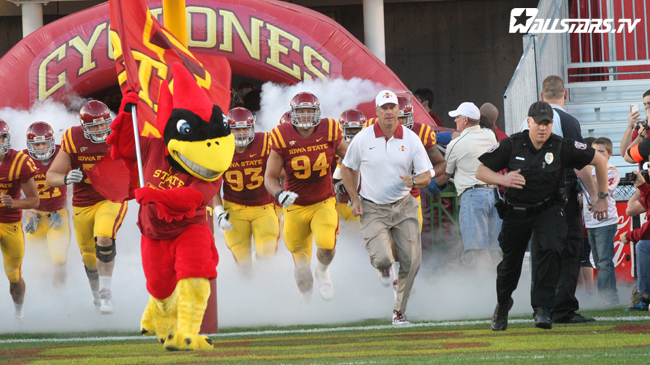
Top image: Iowa State Cyclones wide receiver Tobais Palmer (4) runs after a catch and avoids the tackle by Tulsa Golden Hurricanes defensive back Byron Moore (3) in the first quarter at Jack Trice Stadium in Ames on September 1, 2012. Photo credit: Reese Strickland-US PRESSWIRE. Available via Wikimedia Commons.