
SANTA CLARA, Calif. — Never forget Chris Matthews.
Cris Collinsworth certainly hasn’t. The NBC analyst was in the booth when the Seattle Seahawks and New England Patriots met in the Super Bowl 11 years ago. That’s when Matthews, a little-known Seahawks receiver with zero NFL catches, became a major storyline.
“Weird things happen on game day,” said Collinsworth, who will call the teams’ Super Bowl rematch on Feb. 8 with play-by-play man Mike Tirico. “Not only did Chris Matthews play, but he was having a substantial role in the game.”
Matthews broke Seattle’s early offensive drought with a 44-yard catch in the second quarter. Then he caught an 11-yard touchdown just 2 seconds before halftime. When he opened the third quarter with a 45-yard grab along the sideline, a guy whose biggest catches had come with the Winnipeg Blue Bombers and who’d been working odd jobs one year prior suddenly had 100 receiving yards and was a legitimate candidate for Super Bowl MVP.
“He came out of nowhere,” said Andy Freeland, who helps Collinsworth prepare for games and serves as his right-hand man in the booth. “It wasn’t even like there were injuries. It was a matchup thing the Seahawks had picked out before the game, and nobody knew it was gonna happen.”
But while the Patriots’ defensive backs were caught flat-footed, Collinsworth and his broadcast partner at the time, Al Michaels, were not.
Michaels added context by noting that Matthews had been working at a Foot Locker when the Seahawks asked him to try out. Collinsworth, meanwhile, correctly predicted that with time to run only a single play before halftime, the Seahawks would try a jump-ball pass to the towering receiver. He put a yellow circle around Matthews with his telestrator as the Seahawks lined up.
“Here’s a guy that’s 6-5, 218 pounds, red zone threat,” Collinsworth said before the snap. “Throw it up, give him a chance going against one of these smaller corners.”
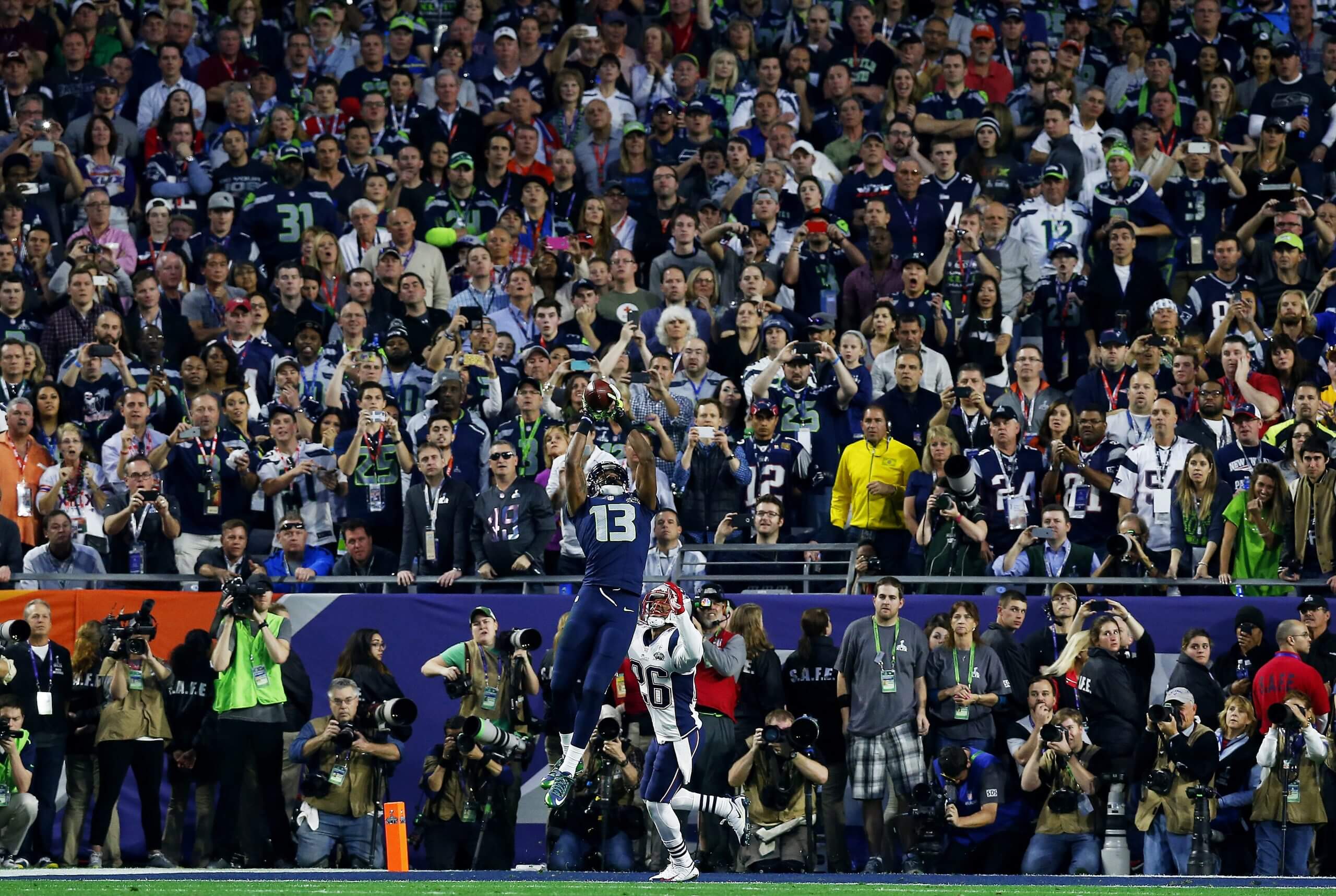
Chris Matthews (No. 13) had zero catches and only 29 offensive snaps in his career, including playoffs, before having 109 receiving yards and a touchdown in Super Bowl XLIX. (Tom Pennington / Getty Images)
The Matthews episode underscores the mindset Collinsworth and Tirico will take into next week’s game: You can never be too prepared.
Two days before the Super Bowl, for example, players from De La Salle High School in the East Bay will be at Levi’s Stadium for a game rehearsal. Decked out in their uniforms, the players will simulate pregame introductions and run plays on the field so the NBC crew can get a sense of the camera positions and the angles of the late-afternoon sun at Levi’s Stadium.
Tirico, Collinsworth and the “Sunday Night Football” crew also had a practice run of sorts last month during the Week 17 Bears-49ers game at Levi’s. Rules analyst Terry McAulay, who normally watches games from NBC’s studio in Connecticut, was in the booth that evening just like he’ll be on Feb. 8. The crew also tested some of the gadgets — for example, a wind meter — that they’ll have available for the Super Bowl.
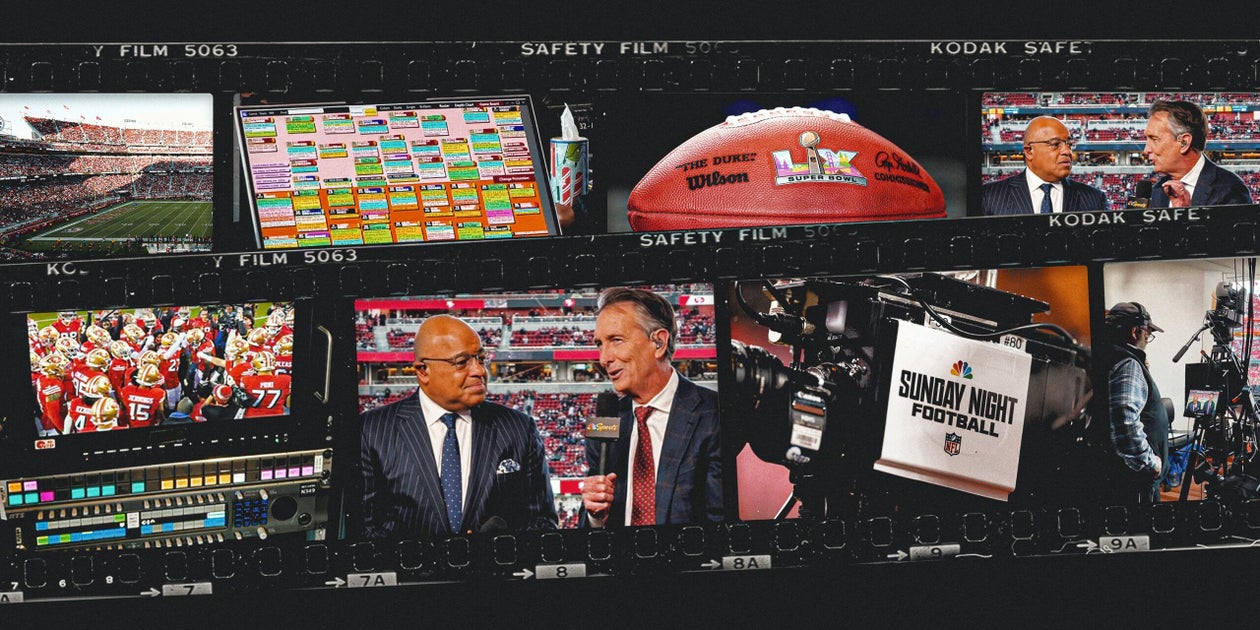
The Athletic was invited to sit in on NBC’s graphics meeting the morning of the Week 17 game and to watch Tirico, 59, and Collinsworth, 67, rehearse their broadcast intro in the booth 35 minutes before kickoff.
One thing that stood out during the booth visit was the sheer amount of technology and information at their fingertips. Collinsworth had nine devices — monitors, screens, tablets, telestrator — in his immediate orbit. Tirico, who sits immediately to his left, had a similar array. It was like they were in the cockpit of a combat helicopter. Scores, statistics, background information and replay views from various angles were within easy reach.
It’s a far cry from when Collinsworth, a Cincinnati Bengals receiver from 1981 to ’88, first entered the booth. In those days, he had a telestrator and a physical board on which he’d scribble notes and stats he could consult during the game.
The process began to change in 1992 when he met Freeland, who was working for a small, Cincinnati-based computer company at the time. The company was shooting its first-ever commercial and asked the ex-Bengals star to be in it.
“So Cris came in and sort of toured the facility,” Freeland recalled. “And me being the sports nut I am, I went up to him and sort of showed him around and started talking to him.”
It wasn’t a one-way conversation. Collinsworth was interested in what Freeland did — “I was a technician. I guess you’d call it a network engineer,” Freeland said — and the encounter ended with Freeland agreeing to create a rudimentary database on which Collinsworth could keep his notes in order. Soon after that, he hired Freeland part-time to help gather information he could use on air.
The internet hadn’t yet taken off back then, and Freeland pulled most of the facts and figures from media guides. When everyone began going online a few years later, the data exploded.
Collinsworth, who will be calling his sixth Super Bowl next week, embraced the change.
“He’s incredibly patient with technology,” Freeland said. “He’s not out there writing programs or setting up networks or anything, but he loves the technology. He loves what it can do, and he’s very patient in learning it.”
The information load took another leap in 2006 when football analytics groups like Pro Football Focus started popping up. That was good news for Freeland. There was now so much data to gather that Collinsworth hired him full-time. Collinsworth became so captivated by the new information that he bought a majority share in PFF in 2014 and is currently the company’s chairman.
Collinsworth loves to sift through the granular data but knows he can’t drown viewers in numbers, especially during a Super Bowl when so many casual viewers are tuning in. He pictured a mom, dad, son, daughter and grandmother watching the big game in the family living room.
“And if I’m going on about 3.7 yards per carry against a Cover 2 defense, Grandma’s going, ‘Gimme the remote!’” he said.
That’s where Tirico comes in.
Next week’s game will be his first Super Bowl. But the versatile broadcaster is a veteran of the Olympics — he’ll be flying to Italy, home of the upcoming Winter Games, immediately after Seahawks-Patriots — during which compelling stories, not stats, are king.
The Super Bowl audience is similar, he said.
“It’s people who have consumed all the content for two weeks and people who are waiting for Bad Bunny,” Tirico said. “So you’re merging eight lanes of traffic onto this narrow balance beam. It’s a little bit of everything.”
Collinsworth and Tirico have been full-time SNF partners since 2022. During a half-hour interview the morning of the Bears-49ers game, they alternately poked each other and lobbed compliments in each other’s direction.
“He’s not afraid to answer any question,” Tirico said. “I’ve worked with people you have to be very specific with. ‘What exactly are you going to ask them? Well, be very careful.’ Cris is so knowledgeable and quick on his feet that you could ask him anything, and he’s going to give you an honest answer.”
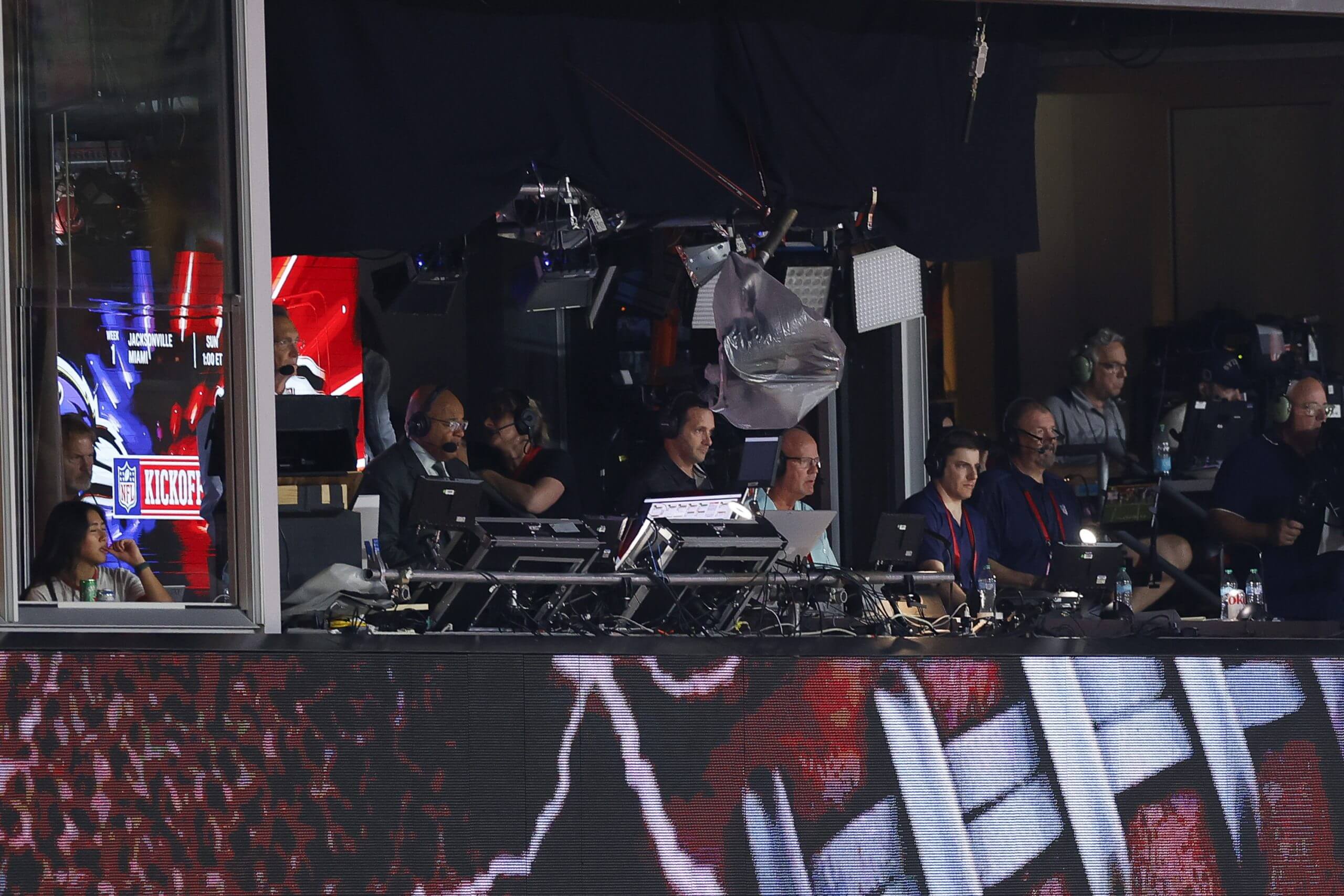
A view inside the NBC broadcast booth at Arrowhead Stadium in Kansas City during the 2024 season opener. (Aaron M. Sprecher / Getty Images)
Their work week typically begins with Collinsworth reviewing the teams’ most recent games. He records his observations and sends them to Tirico so he can start to get a sense of what his partner is thinking about as the game approaches.
“I’ll get (Collinsworth’s tapes) sometimes Wednesday, sometimes Thursday,” Tirico said. “Sometimes I’ll listen to them on the flight on the way out Friday morning …”
“… On double speed,” Collinsworth quipped.
“I listen to the first minute at regular speed,” Tirico corrected after a laugh. “Then I listen at double speed to get through them quick, because Cris is very deliberate as he’s watching tape. But it helps. It helps because I know how he sees the game.”
They’ll watch the home team’s Friday practice together and sit down with the head coach and key players for a production meeting. Then there’s a Friday night dinner and a car ride back to the hotel to further discuss the game ahead. On Saturday morning, they’ll watch an hour and a half of film along with director Drew Esocoff.
“All of that fills you with a thousand things,” Tirico said. “I’ll know the places that have the most fertile ground to cover.”
And then it’s time for kickoff.
One of Collinsworth’s favorite lines is that he and Freeland spend a week compiling heaps of information and coming up with an array of storylines, “… and then a game breaks out.”
If there are surprises, he’ll lean into the database he and Freeland started 34 years ago. Freeland figured the amount of information at Collinsworth’s fingertips could fill a phone book.
“If he sat and read that document on the air, it would probably take 10 hours,” he said.
The announcers will use only a tiny fraction of it during the three-hour game. But as Matthews showed 11 years ago, that sliver of information can be critical.
The Seahawks wideout finished with 109 receiving yards, tying the Patriots’ Julian Edelman for most in the game. If Seattle had scored a touchdown from the 1-yard line at game’s end instead of throwing an interception, he would have been considered for MVP.
Collinsworth credited Freeland and the NBC crew for being prepared for the Super Bowl curveball.
“Andy pulled that one out and had quite a bit on (Matthews) and his role,” he said. “(He’ll) have something on every player, even if they’re on (injured reserve) or not expected to be a major contributor.”
Said Freeland: “That was really a situation where the data was invaluable. Because you can just click on his name and all the notes pop up in the side panel.”
Collinsworth said he never knows if a Super Bowl broadcast has been a success until around noon the next day. That’s when the reviews begin coming in, and his phone starts going off. He remembers getting a post-Super Bowl call around that time from a New York Times reporter and immediately being defensive.
“And (the reporter) was, ‘No, no — I actually liked the broadcast,’” Collinsworth said. “And then it was (in a pleasant voice), ‘OK, then how can I help you?’”
Said Tirico: “I’ll be somewhere headed to Milan — about 40,000 feet at that point. So I’ll find out when I get off the plane.”