
Jan. 30, 2026, 12:02 p.m. ET
2025 was a tale of two seasons for Baker Mayfield. It started with a potential MVP candidacy and ended with questions about whether the Bucs should extend his contract beyond 2026.
In the first half of the season, Mayfield proved that, if only for a limited time, he could carry the Tampa Bay offense on his back. He had the Bucs 6-2 at the bye after missing at least two starting offensive linemen in any given game, including All-Pro left tackle Tristan Wirfs for three games, and relying on a rookie wide receiver to be his primary weapon.
Despite all of the injuries, Mayfield pushed the ball down the field more than he had the previous season, averaging 8.6 air yards per attempt, a 22.9% increase from 2024. This led to an increase in big-time throws per PFF, which Mayfield threw on 6.7% of his attempts. If Mayfield had maintained this rate, he would have been second only to Matthew Stafford by season’s end.
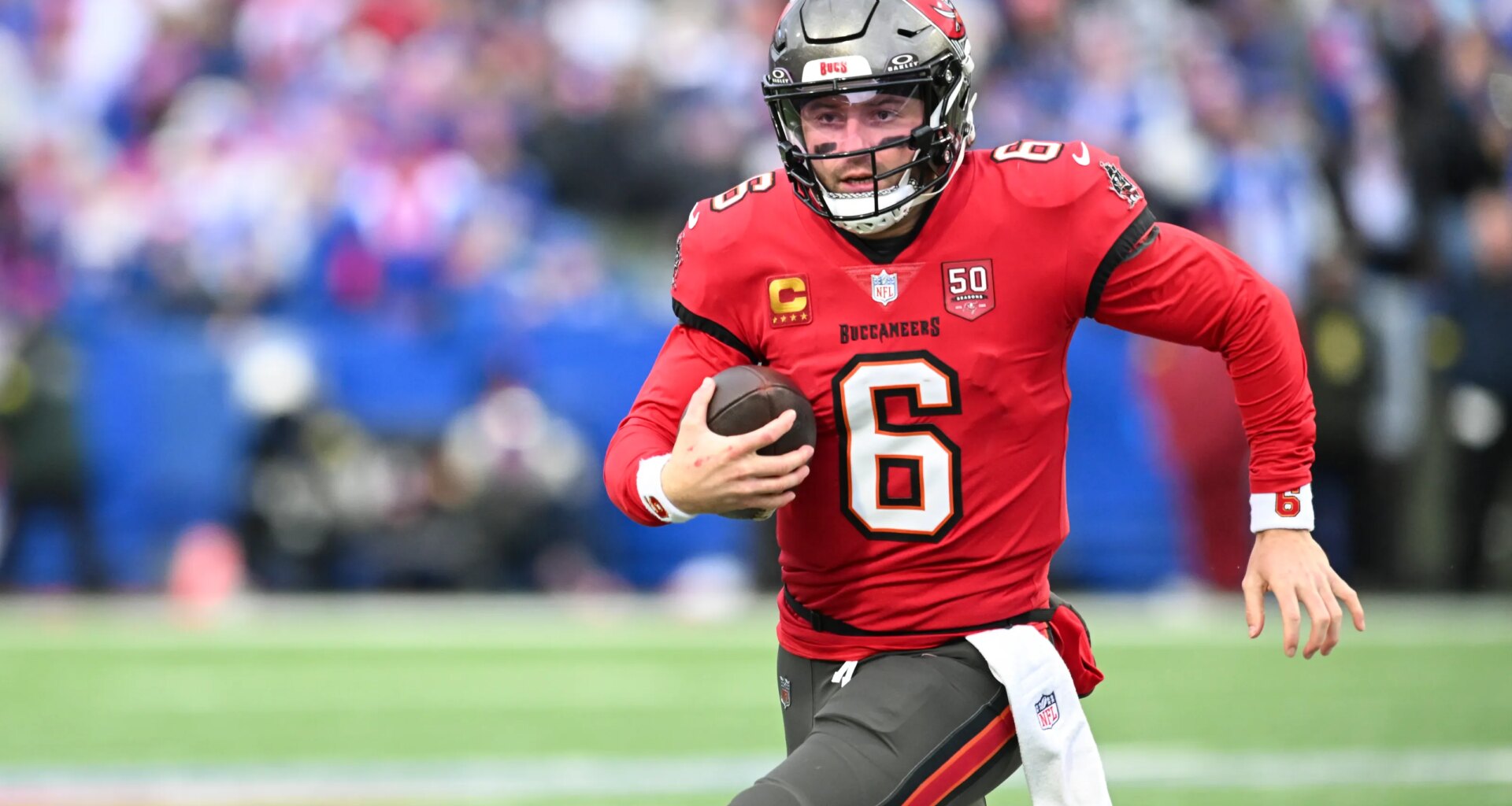
Where Mayfield really made a difference was on the ground. In the Bucs’ first eight games, Mayfield led not only his team but all NFL quarterbacks averaging 7.2 yards per rush attempt. His ability to escape sacks and pick up yards on the ground almost single-handedly kept Tampa Bay’s season alive over the first half of the season.
However, Mayfield’s play in the first season was a mirage. The wins were there, but the underlying play could not sustain them. Mayfield’s completion rate over expectation in the first eight games was just -1.8, which ranked 26th among 33 qualifying quarterbacks. In 2024, Mayfield’s CPOE ranked sixth in the NFL at 3.6. He also threw 13 turnover-worthy plays per PFF. At 4.8%, Mayfield’s turnover-worthy throw rate in the first eight games eclipsed every season prior.
Need a news break? Check out the all new PLAY hub with puzzles, games and more!
Reality arrived for Mayfield and the Bucs in the second half of the season. Despite getting healthier at receiver, Mayfield’s early success was exposed as his diminished accuracy and decision-making cost his team chances to win down the stretch. After throwing just two interceptions in the first eight games, Mayfield threw nine over the last nine games.
Mayfield finished the season averaging 0.092 EPA per play with a -2.1 CPOE, respectively ranking 18th and 26th among 32 qualifying quarterbacks. Mayfield was top-10 in both metrics last season. He also threw for 992 fewer yards and 17 fewer touchdowns, though that was as much a function of the offense’s general problems as just Mayfield himself.
Despite his problems, the Bucs are not going to make a change to their quarterback in 2026. They would not be able to if they wanted. Their free agent options are no upgrades to Mayfield, and with the 15th overall pick in the 2026 draft, they have no shot at a legitimate starting-quality prospect.
The big question the Bucs face with Mayfield is whether to sign him to an extension, and if so, how much? Mayfield is currently playing on a three-year deal averaging $33.3 million per year, which puts him 19th among NFL quarterbacks. Mayfield has largely outplayed this contract, if not by much. In his three seasons since joining the Bucs, Mayfield ranks 12th in EPA, 15th in success rate, and 20th in CPOE among NFL quarterbacks.
The numbers do not tell the entire story. While the metrics show an average NFL starting quarterback, Mayfield is among the most volatile starting quarterbacks in the NFL. Going from being a top-five performer to a near bottom-five takes more than changes at offensive coordinator and injury luck. Mayfield’s 2025 performance affirms his unpredictability: at the height of his offense’s injuries, he was playing his best.
Mayfield is well-liked by the organization and by his teammates, which should motivate them to do a deal. The timing may be ideal as Mayfield’s struggles would justify a more modest offer. Where the top NFL quarterback salaries are pushing $55 million and beyond, Mayfield’s valuation may fall just short of this. Spotrac places his projected value at around $53 million per year, which would be well short of setting the market. It may even be in Mayfield’s best interests to take a little less for the Bucs to better stock the roster around him.
Conversely, Mayfield may want to play out the final year of his contract without an extension. Given his volatility, Mayfield could end 2026 on a much more positive note and be in a much stronger negotiating position.
One thing Mayfield does not have to worry about is competition. While the Bucs also need to explore their options for QB2, the lack of available quarterback talent limits them to a search for Mayfield’s backup.
While bringing Teddy Bridgewater back is the easy option, it may not be the best one. He looked old and slow in the one half he played against the Los Angeles Rams, completing just eight of 15 passes for 62 yards. However, the veteran quarterback market is bleak enough that Bridgewater may be their only option.
Tampa Bay may turn to the draft to take a developmental backup, as they lack the capital to take much more. One possible option is former Clemson QB Cade Klubnik, who entered 2025 as a possible first-round pick but finished it as a reclamation project.
Though a bit undersized at 6’2″ and 210 pounds, Klubnik is a decent athlete with an NFL-caliber arm. His main problem is making the plays when they are available to be made. He is a fine passer on schedule, but he lacks the play-making ability and overall consistency to be a viable NFL starter. Even as thin as this year’s quarterback class is, Klubnik is likely to fall to Day 3 of the draft, an ideal position for the Bucs to fill their need at backup quarterback.