
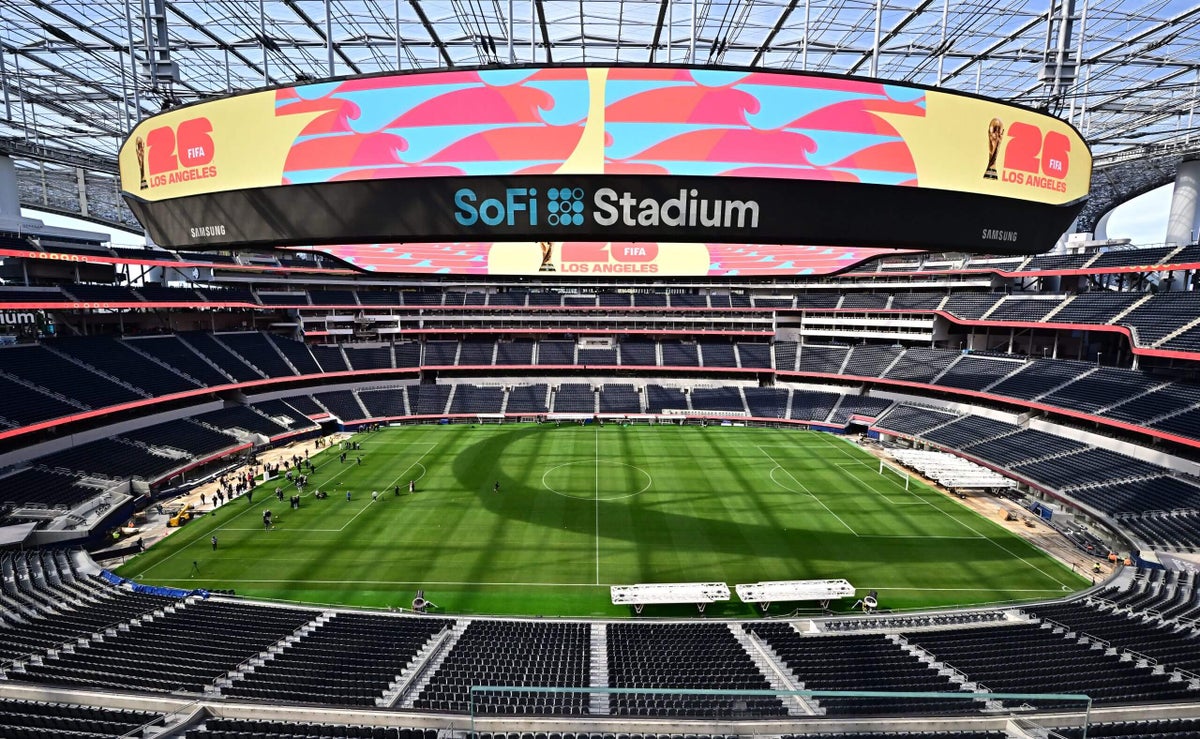
In the seven months between one American football season and the next, NFL stadiums are typically busy. They host concerts and other sports, monster truck tours and more, adapting for each event one week at a time. But in 2026, a handful have cleared their summer calendars, and will transform for two full months to welcome a tournament of peerless proportion: the World Cup.
“Transform” is the operative word because many of the 11 U.S. stadiums set to host World Cup games were built primarily for gridiron football. They were built for a sport commonly played on artificial turf; and for NFL fields that are 53.3 yards (48.7 meters) wide, almost 20 meters narrower than a World Cup soccer pitch.
So, they have undergone construction above and below ground. They will carve out space for wider fields. All 11 stadiums — even the four that play NFL football on natural grass — will bring in special sod carefully crafted by agronomists and approved by FIFA.
They will also change their names to “Los Angeles Stadium” and “New York New Jersey Stadium” rather than SoFi and MetLife. By FIFA decree, they will “debrand” by covering or scrubbing thousands of logos and signage from their premises — everywhere from the walls of suites to the top of their retractable roofs.
The following is a rundown of their makeover plans, which have been in development for years; and which, now, with the NFL season coming to a close with the Super Bowl this Sunday, are nearly ready for action.
Grass replacing artificial turf
Seven of the 11 U.S. stadiums — plus an eighth World Cup venue in Canada, Vancouver’s BC Place — have had synthetic surfaces for their entire existence. Those stadiums are:
Lumen Field in Seattle
SoFi Stadium in Inglewood, Calif. (near Los Angeles)
AT&T Stadium in Arlington, Texas (near Dallas)
NRG Stadium in Houston
Mercedes-Benz Stadium in Atlanta
MetLife Stadium in East Rutherford, N.J. (near New York)
Gillette Stadium in Foxborough, Mass. (near Boston)
All have hosted soccer matches on natural grass over the years. But in most of those instances, the grass was laid, strip by strip, over artificial turf or directly on the stadium’s floor. Some pitches played fine, but others felt spongy or jumpy and drew criticism from players. Plus, if they were pieced together only a few days before a game, they’d be patchy. But, on the other hand, if they were laid too early, the grass would start to die after multiple weeks without proper nourishment and air flow.
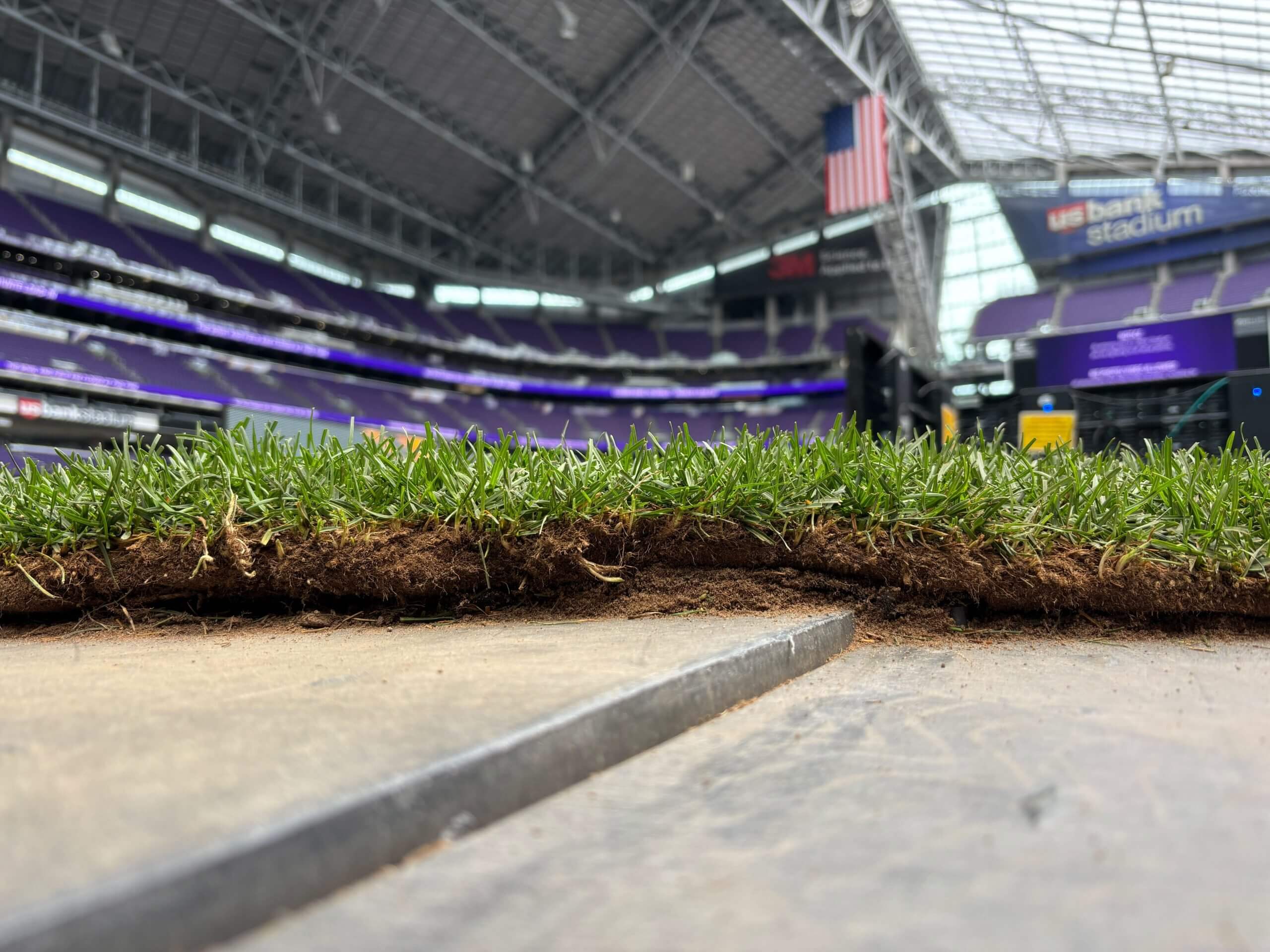
Grass laid over a non-grass surface at Minnesota’s U.S. Bank Stadium at the 2025 Concacaf Gold Cup (Henry Bushnell)
So, years ago, experts concluded that the plan for 2026 would have to be different.
The solution was for stadiums to install irrigation and ventilation systems. Those will allow artificial-turf venues to build a more “conventional” grass field atop 10-plus inches of sand, and to maintain the field for two months as if it were a permanent playing surface. (They will then remove it and return to artificial turf before the 2026 NFL season, largely because artificial turf allows them to accommodate more non-sporting events in their downtime.)
Over the past few years, researchers, FIFA’s experts and stadium managers also explored an innovative plan for stadiums that wouldn’t install necessary infrastructure below ground. They developed a “shallow pitch profile,” featuring sod and a thinner layer of sand atop a permeable black drainage module. SoFi Stadium piloted the system at last year’s Concacaf Nations League finals, and MetLife Stadium, among others, used it for the Club World Cup. At some stadiums, a version of the “shallow pitch” concept will be used again in 2026, though the base layers of sand will be deeper than last summer — at least 10 inches deep, a FIFA spokesman told The Athletic. Exact specifications and modifications will vary from stadium to stadium.
The other barriers, literally, are roofs. Three U.S. stadiums — Mercedes-Benz Stadium, NRG Stadium and AT&T Stadium — are indoor venues with retractable roofs. A fourth, SoFi, is technically open-air but with a translucent roof that blocks about 65 percent of the sun’s rays, according to Otto Benedict, the stadium’s SVP in charge of facilities. Grass, of course, feeds on sunlight, so maintaining it indoors has been a challenge. But the solution has become relatively commonplace: LED “grow lights” that replicate sunlight.
In fact, the technology has become so advanced that stadiums will keep their retractable roofs closed for the duration of the World Cup. The venues in Atlanta and Houston, for example, will ship in a cool-season grass grown at a turf farm in Colorado, keep their buildings air conditioned at around 72 degrees Fahrenheit and trust that the grow lights will give the grass what it needs.
The grass will also be reinforced by synthetic fibers, which will be stitched into the sod, making it a “hybrid” surface — around 90-95 percent natural grass and 5-10 percent artificial.
Most pitches will be installed in May, weeks before the start of the tournament, which kicks off June 11.
Widening the fields, at the expense of seats
The other main structural incongruence of NFL stadiums as World Cup venues was their narrowness.
They were built to get fans close to American football action, with concrete stands featuring built-in seats that curve from sideline to endline. There is space, of course, between the playing field’s boundary and the first row of seats, but not quite enough space for a World Cup.
FIFA requires a pitch that’s 68 meters by 105 meters (74.4 by 114.8 yards); and, more importantly, a total field area that’s at least 85 meters by 125 meters (93 by 136.7 yards), according to contractual agreements with stadiums signed last decade. Those requirements clashed with the corners of NFL fields, where the edges of end zones are often not far from the facing of the stadium’s lower bowl. When these stadiums previously hosted soccer, pitches were often narrower than what FIFA requires. At least a few of the 11 U.S. stadiums have never hosted an event that required a field this wide.
So, during NFL offseasons in 2024 and 2025, in addition to installing grass-related infrastructure, some stadiums have cut into their concrete structures and essentially replaced permanent stands with demountable bleachers. Those bleachers were in place for the 2025 NFL season but will be removed over the coming months for the World Cup. (At MetLife Stadium during last summer’s Club World Cup, for example, dozens of sections and rows of bleachers and seats were perched on trucks in adjacent parking lots; and inside the stadium, the front row of some sections was Row 5 or Row 11.)
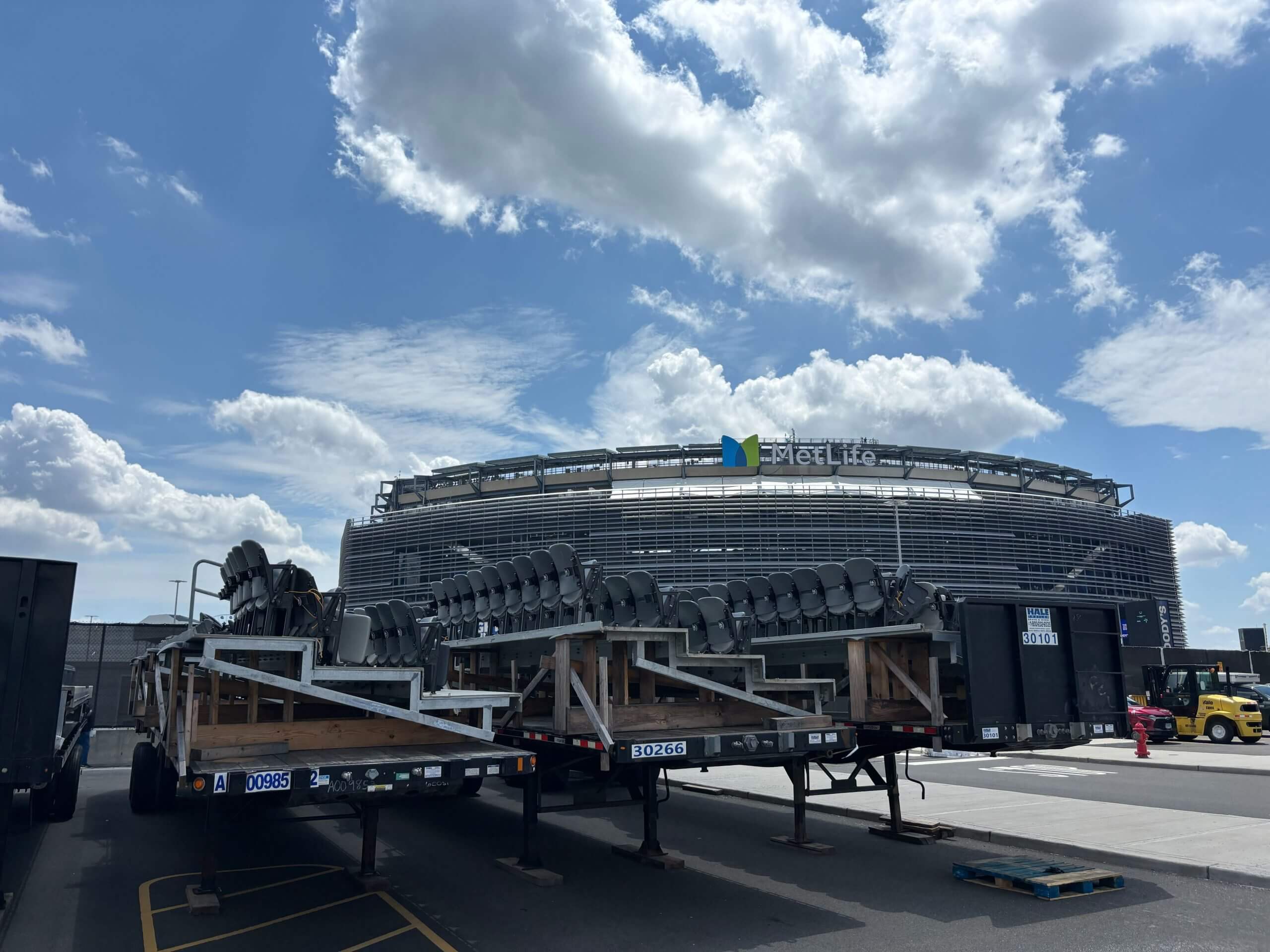
Removable bleachers sit on flatbeds outside MetLife Stadium, site of the 2026 World Cup final (Henry Bushnell)
The capacity of most or all U.S. stadiums will therefore be less than it is for NFL games, with the exact difference often in the thousands but varying from stadium to stadium.
Some field-side suites, such as the ones at SoFi Stadium, will also be impacted — though in some cases, FIFA and stadiums have negotiated compromises, and total field area requirements have been reduced. (All pitches will still be 68 meters by 105 meters; the surrounding areas, though, which are largely for photographers, broadcasters and advertising, offer wiggle room.)
And at some venues, the entire floor and field will be raised — by around 15 feet at AT&T Stadium, for example — to accommodate the modifications.
There will also be less-visible work done to reformat VIP areas as FIFA desires.
All in all, according to contracts and people with direct knowledge of preparations, the pitch work, construction and other items will cost some stadiums more than $10 million apiece.
Strict signage
The final core component of the transformations will be “debranding.”
When the stadiums signed up to host this World Cup, they agreed to FIFA’s “clean site” policy, which is stricter than that of any other event organizer.
FIFA demands that the stadiums remove or obscure all advertising. The requirement protects the exclusivity that FIFA offers to its sponsors, including Coca-Cola, Visa and Aramco. It has also given headaches to stadium operators. Adam Fullerton, the VP of operations at Mercedes-Benz Stadium, said that he and his team must handle “somewhere over 2,000 cover-ups across the stadium, both inside and outside.”
For some venues, including Mercedes-Benz, this includes hiding giant logos or lettering on the stadium’s roof. In Houston, for example, there is giant “NRG Stadium” signage high above a main entrance and also on the roof’s sky-facing eyelids. It is all visible when the stadium hosts College Football Playoff games or Super Bowls, but must be covered prior to the World Cup.
FIFA, meanwhile, will dress up the stadiums with its own branding and signage.
It will also refer to the venues as “Atlanta Stadium” and “Houston Stadium,” for the same reason. Even the famous Estadio Azteca in Mexico will be “Mexico City Stadium.” Only BC Place — which is named after the Canadian province in which it sits, British Columbia, rather than a commercial entity — will get to keep its name in some form.