
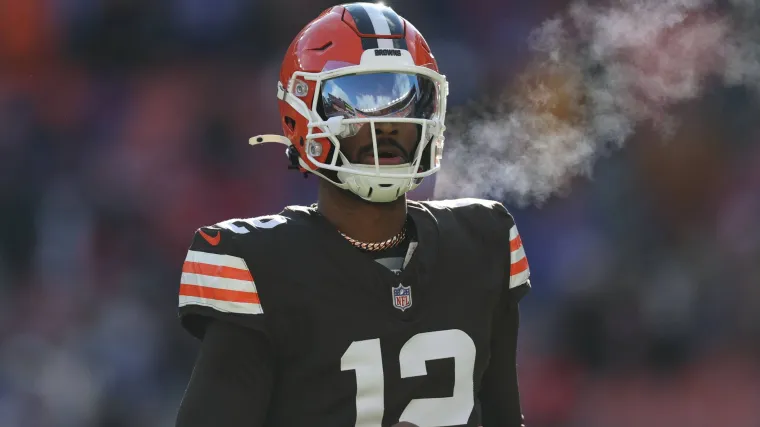
Shedeur Sanders’ first NFL season ended with an honor few expected and a debate that refused to fade. Despite a rookie year marked by inconsistency, the Cleveland Browns quarterback was selected to the 2025 Pro Bowl, a decision that quickly drew scrutiny around the league. His performance during the Pro Bowl Games only added fuel to the conversation.
In the AFC’s 66–52 loss to the NFC, Sanders threw for two touchdowns but also committed two interceptions in the flag football format. Both turnovers were recorded by members of the Chicago Bears defense, bringing an odd continuity to his season.
Those interceptions marked the fifth time in 2025 that Sanders had been picked off by Bears players, each by a different defender. The mistakes did little to quiet critics who already questioned whether his play warranted a Pro Bowl nod.
Statistically, Sanders’ rookie campaign told a mixed story. Across eight appearances, he totaled 1,400 passing yards, averaging 175 per game. He finished with seven touchdown passes against ten interceptions and posted an 18.9 QBR.
While his yardage output suggested some baseline competence, the efficiency metrics painted a far less flattering picture. The Pro Bowl, traditionally seen as a reward for excellence, suddenly became a lightning rod for larger questions about standards and perception.
Why Sanders’ Pro Bowl selection ignited league-wide debate
The backlash intensified after Sanders’ confident comments ahead of the game. “I proved to myself I’m able to dominate in this league,” he told Kay Adams. For many observers, that declaration clashed sharply with the numbers on the stat sheet and with what unfolded on the field in Orlando.
Former NFL safety and three-time Pro Bowler Tyrann Mathieu summed up that frustration on his podcast, saying, “We cannot reward mediocrity… If you have more interceptions than touchdowns, there’s no way you should be rewarded.”
His remarks echoed a broader concern that name recognition and entertainment value may be influencing accolades tied to real financial consequences.
Sanders himself struck a different tone in a later interview with Associated Press writer Rob Maaddi. He admitted the selection caught him off guard and described his season as a day-to-day process rather than a march toward accolades.
Over Cleveland’s final seven games, he completed 56.6% of his passes, added 169 rushing yards and one rushing touchdown, and lost two fumbles on 21 carries. The flashes of mobility and arm talent were evident, but so were the growing pains.
Ultimately, the debate surrounding Sanders says as much about the Pro Bowl as it does about the quarterback. He did not vote himself into the game, nor did he set the criteria. His rookie season showed potential, flaws, and confidence in equal measure.
The league’s challenge now is deciding whether the Pro Bowl is meant to recognize production, promise, or popularity, because Sanders’ selection forced all three into the same uncomfortable spotlight.
More Browns News: