
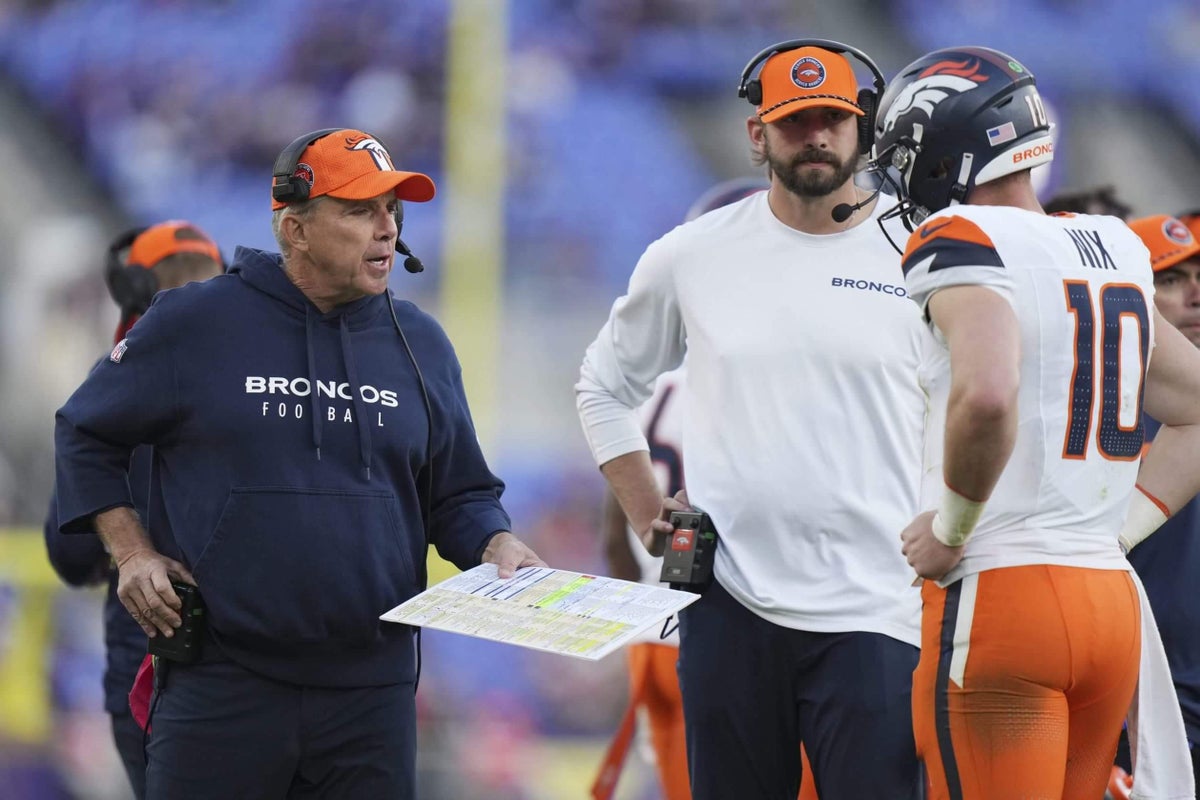
The Broncos are still stinging.
The Super Bowl will kick off Sunday and seeing the Patriots represent the AFC following a 10-7 win against the Broncos in the conference championship game in Denver last month will be a reminder of how close they came.
“Everyone knows the Broncos should have been in there,” wide receiver Courtland Sutton told reporters at the Pro Bowl in Santa Clara, Calif., earlier this week.
The Broncos began their quest to that stage next season by retaining two key members of their coaching staff. Defensive coordinator Vance Joseph was somehow not hired for one of the 10 head coach openings around the league and will thus be back in Denver for a fourth season in that role. It is perhaps as big a win as any the Broncos will have this offseason.
Davis Webb, meanwhile, will take over as Denver’s offensive coordinator, filling a role created when head coach Sean Payton fired Joe Lombardi days after that loss to the Patriots. Webb’s promotion came as he fielded interview requests for head coach and coordinator positions for nearly a half-dozen teams.
It makes Webb a key figure in a critical offseason for a Broncos offense that must improve for the team to ultimately take the final step onto a Super Bowl stage. Here are three key priorities for the Broncos to address as the first offseason under the newly configured offensive coaching staff begins.
Play-calling about more than the who
The Broncos’ announcement about Webb’s promotion to the offensive coordinator role didn’t address one of the biggest questions that accompanies that move. Will Payton, for the first time in his career as a head coach, cede play-calling duties to his top offensive lieutenant?
The Broncos don’t appear to be in a hurry to officially answer that question, though it’s bound to be one Payton is asked when he speaks at the NFL Scouting Combine later this month in Indianapolis.
Let’s table the “who” of the play-calling equation for Denver’s offense and focus on the “how” of it all. Namely, how can the Broncos be more efficient with the communication chain? We will start by framing the issue properly. The crowd at home games this season wasn’t counting down the play clock as they did for the Broncos at times during the 2022 season with Nathaniel Hackett as head coach and play caller, a move that was equal parts derision and an actual attempt to be helpful, depending on which fan you asked. The Broncos had relatively few procedural penalties last season and were, on average, slightly quicker at getting from the huddle to the line of scrimmage than they were during quarterback Bo Nix’s rookie season in 2024.
None of that means there isn’t room — perhaps even a substantial amount of it — for improvement in terms of how quickly and efficiently the Broncos move through the communication process. There were multiple instances last season of Nix expressing some frustration with the rate at which plays were being dialed into him, though he also said there were times he needed to display more urgency in the huddle. Payton shed light on the challenge ahead of Denver’s first playoff game against the Buffalo Bills last month.
“The thing that I have to continue, that changes as you get older, is you still have to be quick,” Payton said during a surprisingly introspective moment. “Play just ran, next play. …When I was younger, we’d run a reverse on the 8-yard line, and I think nothing of it. As you get older, you think about all the ramifications. So I have to also remove that. It was said that as you get older, maybe you don’t drive in the rain at night. … I can’t let that happen as a play caller.”
The continuity should help. If Payton retains play-calling, it will be the third year he and Nix have piloted the offense together on game days. If it’s Webb, Nix will be working with the coach he has spent the most time with daily across the past two seasons. Either way, a quicker process must be the result heading into next season.
“The worst play call is a late play call,” new Cardinals coach Mike LaFleur said at his introductory news conference earlier this month. “Get the play call into your quarterback. Get the play call in to the offense so they can go operate.”
Nix showed a greater command of the offense at the line of scrimmage in his second season, exploiting vulnerabilities in defenses with pre-snap checks. That processing is a strength of Nix’s game and the more time the Broncos can create for their quarterback to survey, the more Denver’s explosive play rate will rise.
A stronger identity in the run game
Payton did not leave much doubt about where he believes the Broncos fell short in the run game this season.
“I feel like we’re far enough along with the RPOs and some of that, but when we want to run it under center and control a game, we’ve been able to do it a few times, but not as much as I’d like,” the coach said at season’s end.
That was especially true after the Broncos lost J.K. Dobbins to a foot injury in Week 10. The team, after that point, averaged only 3.2 yards per carry from running backs on plays that began with the quarterback under center, a figure that ranked 26th in the NFL. The Broncos were 23rd in under-center rushing efficiency (3.1 yards per carry) when leading in games during that same stretch.
The Dobbins injury certainly impacted the Broncos. They ranked fifth in under-center rushing (4.5 yards per carry) before the veteran went down and were seventh in that category when leading in games (4.5). Whether the Broncos re-sign the productive, but oft-injured Dobbins is to be determined. The focus, regardless of that personnel decision, should be on mastering consistent run-game schemes that can allow Denver to thrive with multiple running backs.
The Broncos began last offseason prioritizing a steadier diet of outside-zone concepts. The usage of those concepts, though, waxed and waned throughout the season, leading to something of a gumbo pot of run schemes. Denver found some success with rookie RJ Harvey’s big-play run ability on outside runs, but the inside running was often inefficient or, in other cases, under-utilized by the Broncos after Dobbins went down.
The Broncos overcame that rushing inefficiency by going 11-2 in one-score games this season, but they don’t want to live on a razor’s edge as often next season. It starts with creating a more dependable rushing attack when control over the game is at stake.
“That’ll be one of the points of emphasis that I think that we research and look into heavily,” Payton said. “I want to play from the gun, but I also will always want to play with a two-back or multiple tight end mindset, have that flexibility. It’s a good question. I think it’s one of the key things that we have to do this offseason.”
Impacting red zone plan
One concerning trend for the Broncos: their red-zone touchdown rate dropped to 57.9 percent in 2025 (13th in the NFL), down from 62.5 percent in 2024 (seventh).
Nix saw his efficiency numbers in that part of the field fall, too. His completion percentage fell from 64.7 percent in 2024 to 60 percent last season. Yards per attempt dropped from 4.8 to 3.8 and his EPA (expected points added) per dropback fell from 0.22 to 0.16. He has protected the ball well in that critical area of the field, throwing only two combined interceptions during his first two seasons and taking six total sacks, but he threw only 15 red-zone touchdown passes last season after throwing 22 as a rookie.
Better efficiency in the red zone will be at the heart of Denver’s quest to produce a top-10 offense for the first time since 2014. The Broncos, in particular, have to nail more of the four-point plays — Payton’s term for third-down plays in the red zone. Convert them, and a team typically goes on to score a touchdown. Fail and, AFC Championship Game notwithstanding, a team is typically forced to settle for a field goal — a four-point swing.
The Broncos in 2025 were only 12-of-33 on third-down attempts inside the red zone, a 36.4 percent conversion rate that ranked 18th in the NFL. The Broncos could certainly use another pass-catching weapon in this area of the field. Tight end Evan Engram caught only one touchdown during his first season in Denver and only seven teams have recorded more touchdown receptions in the red zone from their tight ends the past three seasons than the Broncos (12). Denver also ranks just 17th in EPA per rush in the red zone since 2023, though they saw an uptick this season and could have a bona fide goal-line option in Harvey.
The Broncos are not worlds away in their red-zone operation, but Payton and Webb need to find answers to help the Broncos be more efficient at finishing drives.