
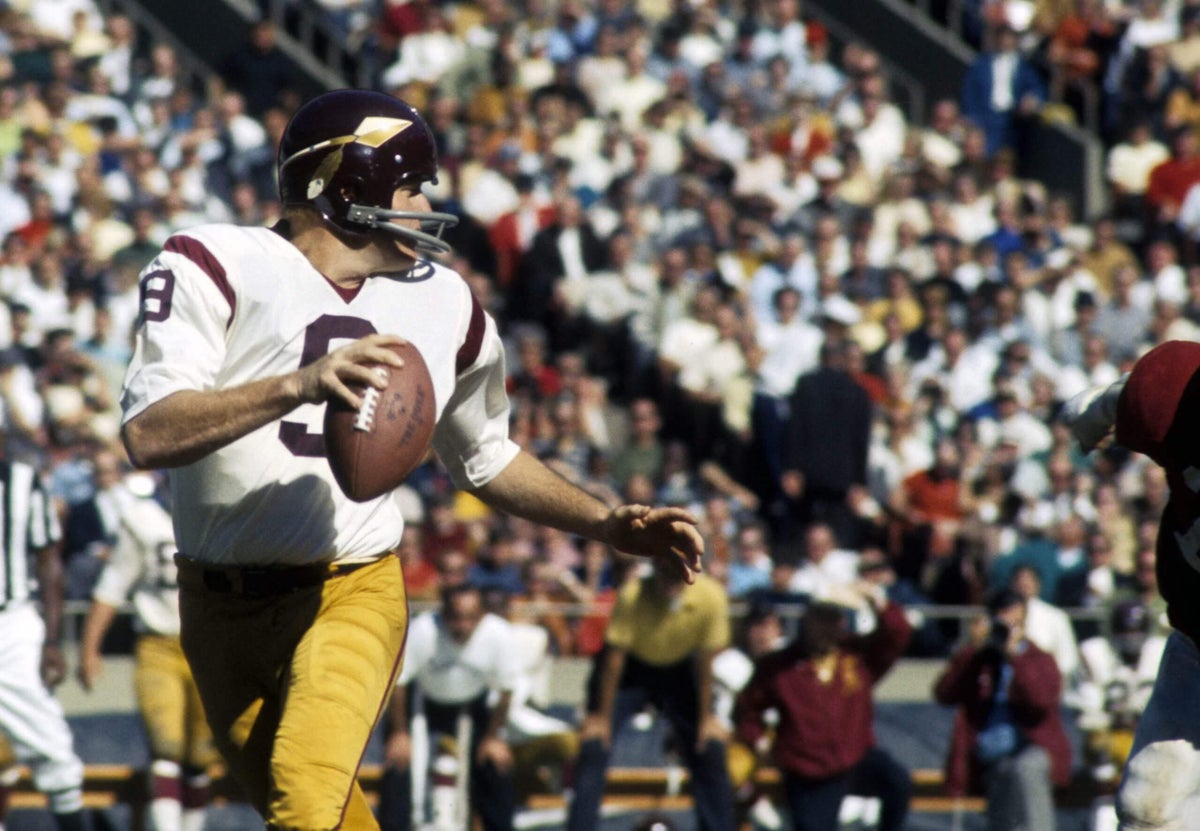
Sonny Jurgensen and I would sit on a couch, which was just outside the press room at Redskins Park, or stand together, over by the receptionist’s desk. (The receptionist, for decades, was B.J. Blanchard, a soft-spoken, but wonderful delight of a human. She knew everything, but said nothing. Everyone loved B.J. Dan Snyder, years into his reign, laid off B.J., and a lot of other good people who worked in Ashburn. Which is all you need to know about Dan Snyder.)
Sonny talked. I listened.
I was a know-nothing-about-football kid when I covered the then-Washington Redskins for the Washington Post in the early 1990s. Anyone who walked through the double doors was likely to know more about the game than I did. And, certainly, Christian Adolph (Sonny) Jurgensen III did.
Sonny died Friday. He was 91. The franchise hasn’t had a quarterback with his combination of electricity or personality since. Well, until 2024, maybe. But in the pantheon of Washington quarterbacks, only Sammy Baugh and Doug Williams had the presence and impact that Sonny did. Beloved doesn’t begin to describe what D.C. thought of Sonny, whose second act in town was as part of the beloved radio broadcast trio that did games for WMAL-630: Sonny, Sam (Huff, the Hall of Fame linebacker) and Frank (Herzog, the play-by-play man and sports anchor for many years for the ABC and CBS affiliates in town).
“Thow the ball,” Sonny would say on the radio, over and over, swallowing the “R.”
Sonny thew the ball as well as anyone of his generation. He never became as well-known nationally as he deserved because his teams were mostly terrible, while Johnny Unitas’ Colts won multiple NFL titles, and Joe Namath’s Jets pulled off one of the great upsets in sports history, beating Unitas’ Colts in Super Bowl 3.
But people in D.C. know. They remember Sonny leading the Skins 60 yards down the field in the final two minutes against Miami in 1974, at age 40, throwing the game-winning pass to Larry Smith in the final seconds to beat the mighty Dolphins. They remember the 99-yard TD pass to Jerry Allen in 1968 — which, of course, equaled an NFL record.
Sonny was blond, with a paunch that often hung over his belt, detailing the way he lived when he wasn’t on the field. But he had a smile and a caustic sense of humor. And if there’s another NFL player who was present at the Hershey Arena in Hershey, Pa., the night that Wilt Chamberlain scored 100 points for the Philadelphia Warriors against the New York Knicks in March 1962, I’ve yet to meet him. I met Sonny, who was, and who loved hoops.
He was often hard on the beat writers who covered him during the 11 years he played in Washington, during which time he became a Hall of Fame quarterback, passing for most of his 32,224 yards and 255 touchdowns. He was the conductor for the NFL’s most explosive offense in the late ’60s, lighting up the skies at RFK Stadium with bombs to Charley Taylor, Bobby Mitchell and Jerry Smith, the only reason to watch the then-hapless franchise. He could, famously, throw a football behind his back.
But during my time with him, mostly during my three years of beat writing, he couldn’t have been more generous with his time, or thoughts. The kindness extended to when he, John Riggins and I worked together for two years on “Redskins Report,” the first iteration of the late George Michael’s weekly talk show about the team, on WRC-4. We got into one argument, one time. Sonny loved Gus Frerotte, who’d been taken in the seventh round of the 1994 draft, but who quickly and obviously showed he was better than Heath Shuler, who was the team’s first-round pick that year, and who the front office and coaching staff viewed as the franchise’s savior.
I didn’t disagree with Sonny about that, but I’d gotten from some of the coaches that Frerotte was still not picking up the details of the offense and was making mistakes. Which I reported. Sonny disagreed. Which he said on the show.
“I feel the tension on the set,” Riggins said, a wide grin on his face.
Sonny spoke with reverence about the position he played as well as any man who’d ever gone under center. What a quarterback sees as he scans the field. What it was like to get blindsided. Why the quarterback had to have the autonomy to call his own plays, because what the coaches drew up during the week from the comfort of their meeting rooms often was not present on the field, as Jurgensen looked into Ray Nitschke’s eyes. Why quarterback, in his view, was the worst-coached position of any on a football team. So few knew what it was like to actually play the position, to get all the scrutiny and scorn when things went bad. He lived it under George Allen, just as he had earlier in his stint in town under Otto Graham.
A Hall of Fame QB himself, Graham was a health fiend who implored his still-young charge to eat better and get more sleep.
To which Jurgensen, known to close down the Dancing Crab, a famed watering hole in Northwest D.C., famously retorted, “He likes candy bars and milkshakes, and I like women and scotch.”
This was only kind of true. Sonny was married for more than 40 years to his beloved Margo — who, as was often the case of the wives of famous/infamous men, knew exactly how and when to best burst his occasional balloon of self-importance and puffery. How everyone loved Margo.
Washington got Jurgensen from the Eagles for Norm Snead and cornerback Claude Crabb in 1964. The trade was on April 1. Sonny thought it was an April Fool’s joke. He’d taken over for Norm Van Brocklin in 1961, the year after the Eagles won the NFL championship, and started 35 of 37 games. In 1961, he was a first-team All-Pro, passing for more than 3,700 yards and 32 touchdowns. But the Eagles wanted Snead.
“I had just met with the new coach of the Eagles, who had come in with the new owner,” Jurgensen said in an interview with Redskins.com in 2010. “I met with him, sat in his office for a few hours, talked about what we were going to do, what offense we were going to have and how we were going to win again.”
In Washington, Jurgensen was unleashed. In 1967, he threw for 3,747 yards, setting then-single-season records for attempts (508) and completions (288). Mitchell, Taylor and Jerry Smith each caught more than 60 passes, setting a record for a 14-game season. (The 1978 Vikings equaled the feat when the league expanded the regular season to 16 games.) Taylor (70 catches), Smith (67) and Mitchell (60) finished first, second and fourth in the league in receptions that season.
But the team was still awful.
“I don’t want to throw 40 touchdowns and lose; I want to throw 10 touchdowns and win,” Jurgensen said.
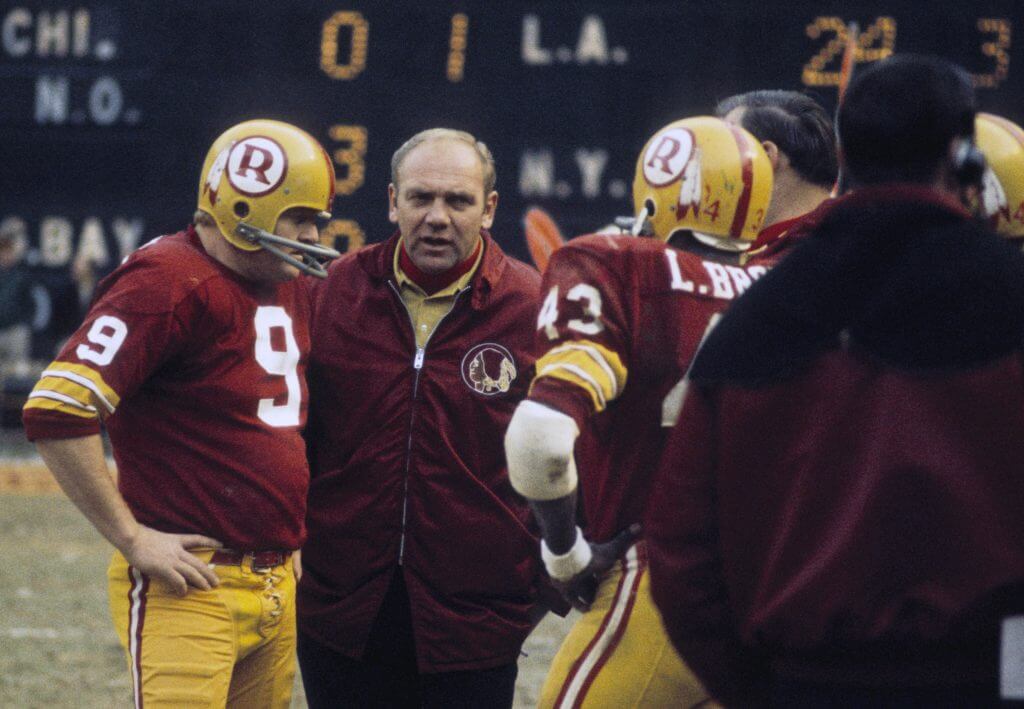
Sonny Jurgensen, here meeting with Washington coach Bill Austin during a 1970 game, retired as one of the most prolific passers in NFL history. (Dick Raphael / Imagn Images)
That’s why Sonny’s favorite season in Washington was 1969 — Vince Lombardi’s first and only season in D.C. Vince did not care what Sonny did at night. Be yourself, he told his QB. And Sonny responded with his best season, leading the NFL in passing yards, completions and completion percentage. Washington went 7-5-2, its first winning season in 14 years. Decades later, when Sonny talked about Lombardi, who soon after the season was diagnosed with a virulently fast-moving cancer that killed him less than a year later, he still did so wistfully. He’d taken Lombardi’s wife, Marie, to see him at Georgetown University Hospital in the last months of Lombardi’s life.
When Allen came to town in 1971, he picked Billy Kilmer as his starter. Kilmer managed a game; Jurgensen orchestrated it. Allen, who famously said that when you dropped back to pass, three things could happen, and two of them were bad, wanted a game manager. But Sonny won the job outright in 1972. Unfortunately, he stepped into a hole in Yankee Stadium, where the Giants were playing their home games at the time, and ruptured an Achilles tendon. Kilmer got the job back and led Washington to its first Super Bowl appearance.
Allen wanted the two QBs to hate each other. Instead, they became fast friends and running buddies after dark. Sonny stopped drinking in the ’80s, having been stopped while behind the wheel too many times by too many cops — almost all of whom let him off with a wave and a smile, he being Sonny and all. He still loved his cigars, though.
The now-Commanders retired Jurgensen’s No. 9 in 2023, not that anyone had worn it since his retirement following the 1974 season. Everyone in D.C. knew who number nine was, and always would be.