
Imagine an NFL quarterback being benched three times in this era and then becoming a shoo-in for the Pro Football Hall of Fame.
Imagine a quarterback having his throwing shoulder shredded only to play another 15 seasons, win a Super Bowl and break just about every passing record.
Imagine that happening while playing for the New Orleans Saints, a franchise with only one playoff win in its first 39 years of existence, a team that was coined the Aints, whose fans wore bags over their heads at games for several years.
That’s what Drew Brees can do for you.
How could anyone really blame the San Diego Chargers — the team that selected Brees in Round 2 of the 2001 NFL Draft — for looking to replace Brees with Eli Manning or Philip Rivers after Brees’ first two seasons as a starter? In the current state of the NFL, there’s no way Brees would have been the starter heading into 2004. Rivers would have been given the reins, with Brees holding the clipboard until his contract expired, leading to an uncertain and possibly meandering future.
Brees staved off Rivers for two seasons, but a torn labrum and partially torn rotator cuff in his right shoulder gave the Chargers an easy out to let Brees walk in free agency after the 2005 season.
“I remember playing against him in San Diego and saying that he was really good, but not great,” former Saints linebacker and Brees teammate Jonathan Vilma said. “I believe what changed him is when he almost had football taken away from him with the shoulder injury. I think that changed him as a competitor and as a person. Then you paired him up with Sean (Payton) and he turned from really good to great quickly.
“I especially realized that once I got to New Orleans. This guy is awesome. Flat-out awesome. He made the games easier on Sunday because none of the other quarterbacks can do half the things he does.”
The Nick Saban-coached Miami Dolphins didn’t trust Brees’ health, instead opting to sign Daunte Culpepper — who was coming off a serious knee injury — during the 2006 offseason. A life-altering decision by the Dolphins for Brees and Saban. Would Saban have left for Alabama if Brees went to Miami? Would Brees have blossomed with the Dolphins as he did under Payton with the Saints?
It’s as if Brees and the Saints were meant to come together at that moment in 2006. The quarterback, the franchise and New Orleans itself all needed each other. Brees needed a team to believe in him. The Saints needed to gamble for a franchise quarterback. The city needed a heartbeat following Hurricane Katrina.
Everybody needed each other, which is why Brees became one of the most important people in the history of New Orleans. That’s not an exaggeration. Brees competed in a quarterback era with Tom Brady and Peyton Manning, often falling behind those two in all-time great conversations. But neither of those two quarterbacks, or really any quarterback ever, played a bigger role in revitalizing a city and a region like did Brees following Katrina.
Brees’ résumé speaks for itself. It would make him Hall of Fame-worthy whether he earned all of his accolades in New England, Indianapolis, San Diego, Miami or anywhere else.
To do so in New Orleans, at the time when Brees did it? There will never be another situation like it.

Drew Brees thanks the fans after breaking the career passing yards record in 2018. (Scott Clause/ USA Today Network via Imagn Images)
It’s funny, though, how one throw from Brees still sticks with me even after watching tens of thousands of passes in practices and games while covering him as a beat writer or columnist for all 15 years of his Saints career.
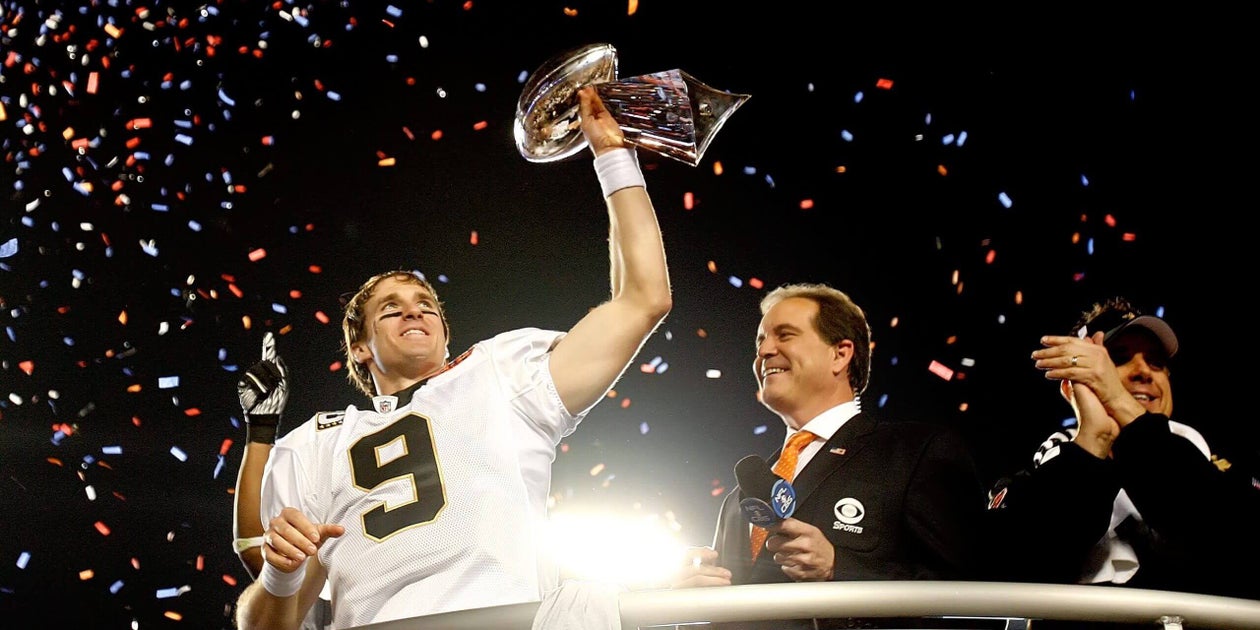
Brees missed Robert Meachem on a deep ball on third-and-2 to force a punt in the Saints’ first possession of Super Bowl XLIV. He overthrew Meachem by a couple of yards on a throw Brees might seriously make 99 out of 100 times. I remember sitting in the auxiliary press area in the end zone at Miami’s Hard Rock Stadium and thinking how that was the first nervous throw I’d ever seen from him.
To this day, it feels like the only nervous pass I’ve ever watched him attempt.
“The Saints had led the league this year in first-possession touchdowns and had scored on their opening drive in each of the two playoff games,” CBS’s Jim Nantz said during the broadcast after the incomplete pass.
Three incomplete passes followed on the next drive, leading to another Saints punt. The Colts marched 96 yards on the next possession to go up 10-0 before the first quarter even ended. The world had witnessed Hall of Fame-bound quarterbacks crumble in Super Bowls. Brees stood nowhere near Hall of Fame status that night in Miami. But hey, it was a cute little run for the Saints to at least play in the Super Bowl.
That’s when Brees truly introduced himself to the world.
He threw more touchdowns (two) than incompletions (one) in the second half to propel the Saints to their one and only Super Bowl title in franchise history. The performance propelled him into becoming one of the most prolific passers in NFL history and a first-ballot inductee into the Pro Football Hall of Fame on Thursday night.
Brees’ perseverance through those early jitters in Super Bowl XLIV always stuck with me. It led me several years later to write a story about a simple question: How do you manage nerves?
“I get butterflies,” Brees told me eight years after his Super Bowl triumph. “To me, nerves are your edge. If you don’t have that edge, then I think that means trouble. It’s one thing to be relaxed; it’s another to be confident. Yes, it’s calm, it’s cool, it’s confident, but it’s this edginess that you know and understand the situation. You know what the goal and the purpose is. You know what can and can’t happen in this situation.
“I call that the edge. You’ve got to have a little bit of that, because that’s your edge. I’m programmed. I’m wired. How did that happen?”
Brees then referred me to “The Talent Code,” written by Daniel Coyle and published in 2009. Brees studied how to handle nerves and then put it into practice during the most important and pivotal moment of his NFL career.
“There’s a substance that wraps your nerves called myelin,” Brees said. “When you do different movements, and you pattern certain things, that’s muscle memory. It’s the talent code. It’s the skill code. Once it’s there, it’s there. You just kind of build on it.”
Myelin, according to Coyle, is a “microscopic neural substance that adds vast amounts of speed and accuracy to your movements and thoughts.”
“Bottom line is whatever happens on that field, I’ve typically encountered that situation on the field before, and I can reference it,” Brees said. “My recall on stuff like that is kind of crazy, compared to (how) I won’t remember something (pointing to a Saints media relations staffer) told me 30 minutes ago. But I’ll remember a pass or a look or a situation in a football game 15 years ago.
“I guess you’re just wired certain ways.”
Ain’t that the truth.