
The 60th Super Bowl is being played in Santa Clara on Sunday, and this one, like each of the previous games, promises to not only crown a champion but leave an indelible mark on the history of the sport. Here is a look at 60 quirky, interesting, odd and not-so-well-known details that have helped make Super Bowl lore, featuring one from each of the contests starting in January 1967 right up to kickoff of this latest game between the Patriots and Seahawks.
I: There were thousands of empty seats for the first championship game between the NFL and upstart AFL. About 62,000 fans showed up at L.A. Coliseum, which seats close to 100,000, making this the only Super Bowl that was not a sellout. It also was the only Super Bowl ever broadcast on two major U.S. television networks (NBC and CBS, which owned the rights to each league, each aired the Packers’ 35-10 win over Kansas City).
II: Vince Lombardi’s last game as head coach of the Packers was a 33-14 victory over the Raiders in Miami. After his death a couple of years later in 1970, the league named its silver Super Bowl trophy after him.
III: Here’s a fun way to get under the skin of Jets fans: Tell them the Jets have never won an NFL championship. Although Joe Namath and Co. did shock the Colts — and the world! — with their 16-7 victory in Miami in the first game ever officially called a Super Bowl, the Jets still were very much part of the AFL and not an NFL franchise at the time. Their win helped even the perceptions of the two leagues, though, and was a huge step in the merger between them in 1970.
IV: Bud Grant never won a Super Bowl with the Vikings, but he did make a fashion statement in this game, becoming the first head coach in the game not to wear a tie on the sideline. By contrast, his dapper opponent, Kansas City’s Hank Stram, was decked out in a three-piece suit that included a red vest and a sport coat with the team’s logo on the breast pocket. Formal beat Casual that day in rainy New Orleans, 23-7.
V: A lot of firsts in this game: the first nail-biter (the Colts beat the Cowboys, 16-13, on a field goal by rookie Jim O’Brien with five seconds left in regulation), the first non-quarterback to win MVP (linebacker Chuck Howley took that honor), and the first Super Bowl played on artificial turf.
VI: When the Cowboys beat the Dolphins, 24-3, it was the first time a team was held without a touchdown in the Super Bowl. The next time it would happen was when the Patriots beat the Rams, 13-3, in Super Bowl LIII, 47 years later.
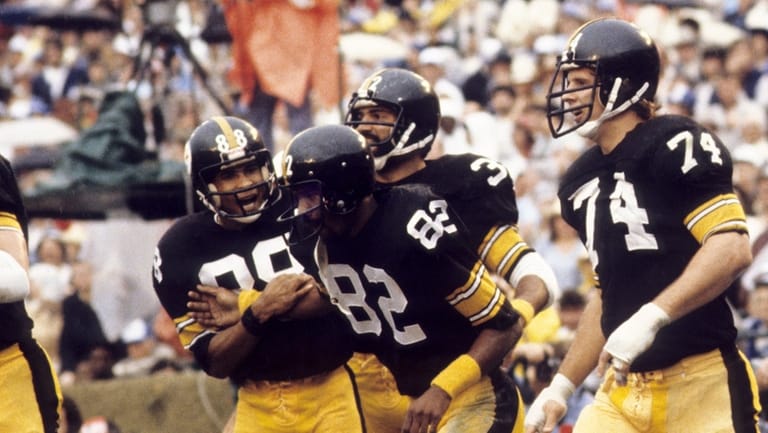
Steelers’ John Stallworth, middle, Lynn Swann, left, and Franco Harris, back left, were three of the many future Hall of Famers playing in Super Bowl XIII. Credit: Sports Illustrated via Getty Ima/Heinz Kluetmeier
VII: A 14-7 win over Washington capped the only perfect season in the Super Bowl era, but the undefeated Dolphins certainly didn’t finish strong. They became and remain the only Super Bowl champion to win their title despite being shut out in the second half of the game.
VIII: A lesser-known Joe Namath Super Bowl guarantee: On television before the game, the Jets quarterback said, “If Miami gets the kickoff and scores on the opening drive, the game is over.” The Dolphins did indeed become the first team to score a touchdown after receiving the opening kickoff in a Super Bowl and went on to beat the Vikings, 24-7.
IX: In a first half that sent pool boxes into a tizzy, the Steelers led the Vikings 2-0 at the break on the strength of the first safety in Super Bowl history. It occurred when Fran Tarkenton was sacked in his own end zone by Dwight White. Pittsburgh went on to a 16-6 win and the Vikings had the ignominy of having lost three of the first nine Super Bowls.
X: While the Steelers were beating the Cowboys, 21-17, scenes for the 1977 film “Black Sunday” about a fictional terrorist attack on the Super Bowl via the Goodyear Blimp were being filmed in and around the Orange Bowl. At one point, actor Robert Shaw had to run the length of the field behind the Steelers’ bench while the game was in progress.
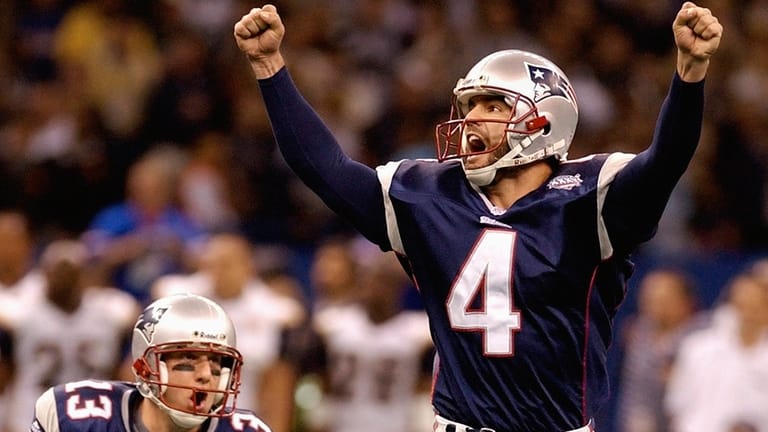
Adam Vinatieri’s 48-yard field goal on the final play of Super Bowl XXXVI gave Patriots the win over the Rams. Credit: AP/Amy Sancetta
XI: Who sang the national anthem before the start of this game? Trick question: Nobody! It’s the only Super Bowl in which “The Star-Spangled Banner” was not performed. Vikki Carr did sing “America the Beautiful” in its place before the Raiders beat the Vikings, 32-14.
XII: The Super Bowl came indoors for the first time with the Cowboys beating the Broncos, 27-10, at the Superdome in New Orleans. Super Bowl IX was supposed to be played in the same building, but construction wasn’t completed in time, so that game was moved to Tulane Stadium. Super Bowl XII also was the first one to kick off in prime time on the East Coast with a now-familiar 6:17 p.m. start.
XIII: The game featured 17 players and, counting head coaches Chuck Noll and Tom Landry and others associated with the contest, a whopping 26 current (at the time) and future Hall of Famers, making it one of the greatest assemblages of NFL talent in Super Bowl history. It also was a terrific game. With both teams vying to become the first team to win three Super Bowls, the Steelers beat the Cowboys, 35-31.
XIV: Widely considered one of the worst teams to ever reach the Super Bowl, the Rams had a 9-7 regular-season record, had barely outscored their opponents (323-309) and were playing with backup quarterback Vince Ferragamo, who had completed less than 50% of his passes and thrown twice as many interceptions (10) as touchdown passes (five) since replacing starter Pat Haden. Still, the Rams gave the Steelers a game and even led going into the fourth quarter before Pittsburgh scored 14 unanswered points for a 31-19 victory and a fourth title in six seasons.
XV: The Raiders became the first wild-card team to win the Super Bowl; they had finished tied with the Chargers at 11-5 in the AFC but lost the tiebreaker based on net points in division games (San Diego was +60, Oakland was +37). The Raiders wound up beating those Chargers in the AFC Championship Game in San Diego before topping the Eagles, 27-10, for their second Super Bowl title.
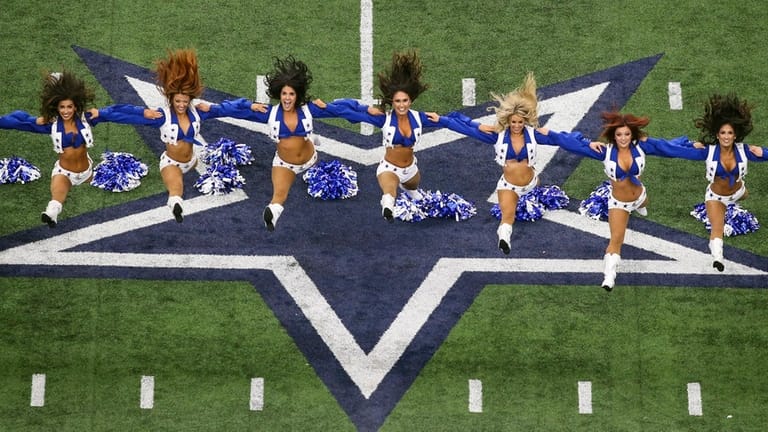
The Dallas Cowboys Cheerleaders perform before a game against the New York Giants on Sunday, Sept. 11, 2016 at AT&T Stadium, in Arlington, Texas. Credit: TNS/Richard W. Rodriguez
XVI: The Bengals’ 356 yards of offense to the 49ers’ 275 marked the first time in Super Bowl history that the losing team outgained the winning team in total yards. The Bengals were stymied by four turnovers that led to 20 of the 26 points scored by the 49ers. Cincinnati had the fewest turnovers of any NFL team in the regular season with 24.
XVII: For only the second time in the history of the game, a rematch of a previous Super Bowl was played; Washington had lost to the undefeated Dolphins 10 years earlier. It was the first time in which the team that lost the first Super Bowl meeting won the second as Washington prevailed, 27-17.
XVIII: The official highlight film of the Raiders’ dominant 38-9 win over Washington wound up being the last time John Facenda — the enunciating announcer from Philadelphia and possessor of “The Voice of God,” which became the dramatic signature tone of NFL Films — would do voice-over work for a football game. He died later that year.
XIX: At 33–3, the combined records for the two teams coming into the game were and still are the best in Super Bowl history. The 49ers were 17–1 and the Dolphins 16–2, including their playoff games. With Dan Marino and Joe Montana going head-to-head, this became the first Super Bowl in which both quarterbacks topped 300 passing yards. The two teams gained a combined 851 offensive yards, a record at the time. Despite the eruption, the 49ers beat the Dolphins handily, 38-16.
XX: The last Super Bowl in which both teams made their debut in The Big Game. With only four current teams having never advanced to the Super Bowl and three of them (the Browns, Texans and Jaguars) playing in the AFC (the Lions are the other), it likely will remain the last, too, barring expansion or realignment.
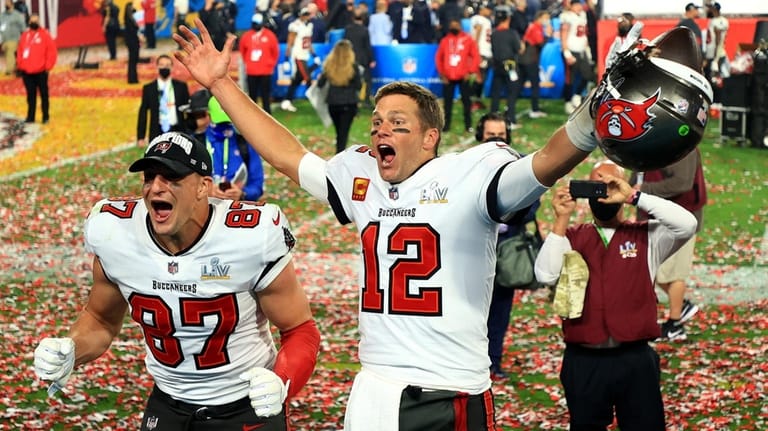
Rob Gronkowski and Tom Brady celebrate after Tampa Bay beat Kansas City in Super Bowl LV. Credit: Getty Images/Mike Ehrmann
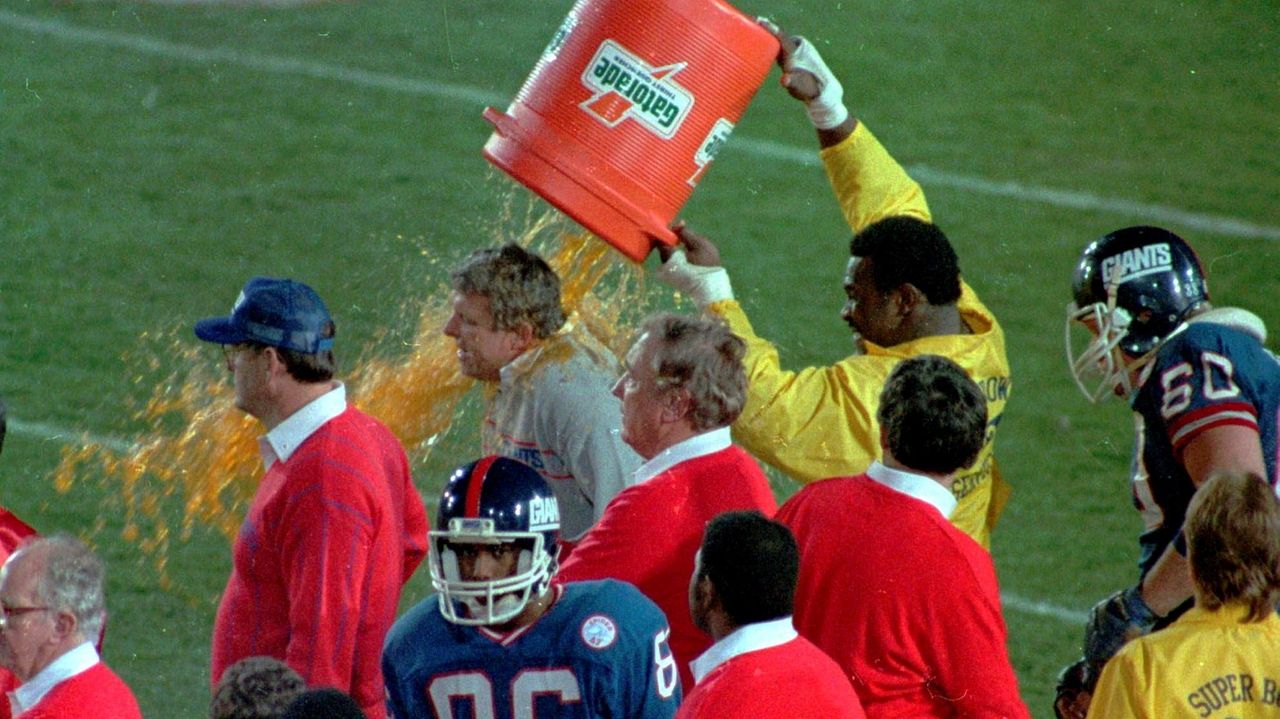
XXI: The Gatorade bath began with the Giants during the 1984 season when Jim Burt did it as payback for Bill Parcells’ demanding style of coaching (although the Bears claim they invented it around the same time). It made its Super Bowl debut in this game after the 1986 season when Harry Carson donned a disguise on the sideline and doused Parcells to celebrate a 39-20 victory over the Broncos. By that time it had become, as it remains, a symbol of affection and respect rather than retribution.
XXII: Starting quarterback Doug Williams had to undergo a three-hour emergency root canal the day before the game to treat an abscessed molar. It didn’t prevent him from completing 18 of his 29 passes for 340 yards and four touchdowns — all thrown in a 35-point second quarter — and earning MVP honors as Washington chewed up Denver, 42-10.
XXIII: Before leading the 49ers on an 11-play, 92-yard championship-winning touchdown drive against the Bengals late in the fourth quarter, quarterback Joe Montana stood in the huddle with his teammates during a TV timeout and pointed out a celebrity watching the game from the stands. “Hey, isn’t that John Candy?” he asked them. That observation came to define Montana’s calmness in big moments.
XXIV: A lopsided result with the 49ers throttling the Broncos, 55-10, led to one of the weakest television audiences in Super Bowl history. About 73 million viewers tuned in, the lowest number since Super Bowl III.
XXV: Everyone remembers Whitney Houston’s rousing national anthem before the game, but why does no one ever talk about the halftime show? Because hardly anyone saw it. While the New Kids on the Block (with special guest Warren Moon) did perform at the break for the fans in the stadium, the television audience spent that time watching an ABC News report hosted by Peter Jennings giving updates on the days-old Gulf War. The halftime performance was shown in some markets on tape delay after the Giants beat the Bills, but many affiliates showed a new sitcom instead.
XXVI: The Metrodome in Minneapolis hosted the game in which Washington beat Buffalo, 37-24, just a few months after it hosted a World Series (in which the Twins beat Atlanta) and a few months before it hosted the NCAA men’s basketball Final Four (in which Duke beat Michigan for the championship). The site remains the only venue to be home to all three of those massive sports events in the same 12-month period.
XXVII: The Cowboys’ 52-17 victory over the Bills made Jimmy Johnson the first coach to win both a Super Bowl and a college football national championship. He had led the University of Miami to its title in 1987.
XXVIII: Often called the Super Bowl Rerun, this was the fourth rematch between two teams that had met in past Super Bowls but the first (and still only) time they met in back-to-back years. They wore the same uniforms as the previous year, too, with the Bills in blue jerseys and the Cowboys wearing white. The game was even aired on the same network, the only time that has happened, as NBC outbid competitors for the broadcast rights. And yes, the results were similar if not identical: Dallas 30, Buffalo 13.
XXIX: The game was played in Miami but it featured two teams from California in the 49ers and Chargers. It was the first and only time two teams from the same state faced each other in the Super Bowl (the Giants and Bills came close four years earlier, but even though they are the New York Giants, the team is based in New Jersey, which, if you look at the map compared to New York, is . . . wide left). San Francisco beat San Diego, 49-26, with Steve Young throwing a record six touchdown passes.
XXX: Dallas beat Pittsburgh for its fifth Super Bowl trophy, but this one was given to the team in a slightly different fashion: It was the first Super Bowl in which the hardware was presented to the victors on the field rather than inside the winning locker room, a tradition that continues to this day.
XXXI: Desmond Howard had a 99-yard kickoff return for a touchdown in the third quarter. He also had 90 yards in punt returns and became the first — and still only — special teams player named Super Bowl MVP as the Packers beat the Patriots, 35-21.
XXXII: Despite suffering a migraine headache that forced him to sit out most of the second quarter, Terrell Davis ran for 157 yards and three touchdowns, including the go-ahead points with 1:45 remaining when the Packers allowed him to score in an attempt to preserve time for their own drive. Davis was named MVP. No running back has won Super Bowl MVP honors since.
XXXIII: John Elway became the first quarterback to retire off a Super Bowl victory. About four months after leading the Broncos to a 34-19 win over the Falcons (and his former Broncos head coach, Dan Reeves) the emotional Elway announced that he would not be returning to the league. Only one other quarterback has ever gone out on top in such a fashion since: Peyton Manning also did it with the Broncos in Super Bowl 50.
XXXIV: The Rams won their third championship for their third city. This 23-16 thriller over the Titans, which came down to the final tackle a yard shy of a touchdown, occurred while representing St. Louis; the franchise previously won pre-Super Bowl NFL titles in 1945 while playing in Cleveland and 1951 while in Los Angeles.
XXXV: Early in the second quarter, a holding penalty on Giants defensive tackle Keith Hamilton negated a 43-yard interception return for a touchdown by Jessie Armstead that would have tied the score at 7. It shifted momentum dramatically in what became a 34-7 win for the Ravens. It’s the only Super Bowl a New York City-based team has ever lost.
XXXVI: Tom Brady earned his first Super Bowl win and was named MVP, but it was Adam Vinatieri who kicked a 48-yard field goal as time expired to give the Patriots a 20-17 win over the Rams. It marked the first time in Super Bowl history that a game was won by a touchdown or field goal on the final play.
XXXVII: The Buccaneers beat the Raiders, 48-21, in what is now and likely will remain the last Super Bowl played in the month of January (it took place on Jan. 26). Every Super Bowl since has taken place in February.
XXXVIII: Scoring definitely came in bunches in this game: After both teams were scoreless through the first 27 minutes of play, there were 24 points scored in the final three minutes of the second quarter. Then, after a scoreless third quarter, 37 points were scored in the fourth quarter. It all added up to a 32-29 win by the Patriots over the Panthers.
XXXIX: Deion Branch caught 11 passes for 133 yards to earn MVP honors, but he did not score a touchdown in the Patriots’ 24-21 win over the Eagles. He became the third offensive player to win the award without accounting for a score: Joe Namath in Super Bowl III and Fred Biletnikoff in Super Bowl XI were the others.
XL: Ben Roethlisberger completed 9 of 21 passes for 123 yards and two interceptions to give him a quarterback rating of 22.6, the lowest ever for a winning quarterback, as the Steelers beat the Seahawks, 21-10. Despite Roethlisberger’s low production, the game’s MVP was a Pittsburgh receiver. Hines Ward had five catches for 123 yards, but the bulk of it came on a 43-yard gadget-play touchdown pass thrown by fellow wide receiver Antwaan Randle El.
XLI: With only 183 miles between Chicago and Indianapolis, this game between the Bears and Colts featured the two teams closest to each other, geographically, in any Super Bowl matchup. The distance was only a few miles closer than the Giants (East Rutherford, New Jersey) and Ravens in Baltimore in Super Bowl XXV and the Jets (Flushing) and Colts (Baltimore) in Super Bowl III. It retained its title even after the Giants faced the Patriots (Foxborough, Massachusetts) the following year.
XLII: David Tyree entered the Super Bowl with only four catches for 35 yards throughout the regular season and playoffs, and two of those catches had come in the Week 17 game against the Patriots. He wound up making four in the Super Bowl, though, including two of the most important grabs in Giants history: a touchdown reception early in the fourth quarter that gave them a 10-7 lead and the iconic “Helmet Catch” that helped set up the game-winning TD for the improbable upset over the 18-0 Pats. The latter was the final catch of Tyree’s career.
XLIII: The Steelers and Cardinals faced each other in this Super Bowl, but 6 1⁄2 decades earlier, they had come together to form a single team. In 1944, with rosters depleted during World War II, the NFL began temporarily combining franchises and the Steelers and Cardinals (then playing in Chicago) became a team called “Card-Pitt.” They went 0-10.
XLIV: The name of the onside kick play that the Saints used to open the third quarter was “Ambush.” Punter Thomas Morstead, who handled kickoffs, knocked the ball to his left and it bounced off Colts receiver Hank Baskett before a pile of players jumped on it (it took officials more than a full minute to sift through the pile). New Orleans’ Chris Reis eventually recovered it. The Saints took the lead on that possession, 13-10, in their eventual 31-17 victory.
XLV: The game was played in Dallas, home to perhaps the most famous cheerleaders in sports, yet it was and remains the only Super Bowl in which neither of the teams brought an official cheerleading squad to the event. The Packers didn’t need the pom-poms to beat the Steelers, 31-25.
XLVI: The Giants’ victory over the Patriots came with a bit of ignominy: At 9-7, they had the worst regular-season winning percentage of any championship team before or since.
XLVII: Play between the Ravens and 49ers was interrupted for 34 minutes because of a power outage in the Superdome in New Orleans with 13:22 left in the third quarter and the Ravens leading 28-6. When play resumed, the 49ers scored the next 17 points and had a chance to tie the score at 31 in the fourth quarter, but a two-point conversion pass was incomplete. The Ravens won, 34-31.
XLVIII: Played at MetLife Stadium in East Rutherford, New Jersey, the Seahawks’ win over the Broncos was the first and only Super Bowl held in an open-air stadium in a cold-weather city, but at kickoff on Feb. 2, 2014, the temperature was a mild 49 degrees. It wound up being the third-coldest Super Bowl behind Super Bowl VI (39 degrees) and IX (46 degrees), both of which were played at Tulane Stadium in New Orleans.
XLIX: Add this to Tom Brady’s Super Bowl records: When the Patriots beat the Seahawks, it ended a 10-season gap between his third and fourth championship, giving him the longest time between titles for any starting quarterback.
50: The Broncos beat the Panthers in the only Super Bowl to eschew the tradition of Roman numerals. The longest Roman numeral ever associated with a Super Bowl came with the seven letters needed to designate Super Bowl XXXVIII (38) and it will remain that way until Super Bowl LXXXVIII (88) which, assuming no interruptions, will be played at some point in the year 2054. By the way, the longest Roman numeral possible for a Super Bowl is the 15 letters in MMMDCCCLXXXVIII, which would be the 3,888th edition.
LI: The Patriots not only came back from a 28-3 deficit in the third quarter to beat the Falcons but did so as the first team to win a Super Bowl without the benefit of an extra point. They missed the one kick they attempted after their first touchdown (it hit the upright), converted two two-point conversions in the fourth quarter and didn’t have to attempt an extra point after James White’s touchdown run on the first possession of overtime.
LII: The Eagles’ win over the Patriots made the NFC East the first and still only division in the league in which all four teams have won a Super Bowl. As of last year, the NFC East also is the only division in the league in which all four teams have won at least two Super Bowls.
LIII: The Patriots and Rams set records for the largest age difference between opposing starting quarterbacks and head coaches in a Super Bowl as 41-year-old Tom Brady faced 24-year-old Jared Goff while 66-year-old Bill Belichick faced 33-year-old Sean McVay.
LIV: Kansas City became the third team in Super Bowl history to overcome a double-digit deficit and go on to win by double digits (Washington in Super Bowl XXII and New Orleans in Super Bowl XLIV also had done that), but it is the only one to do it all in the fourth quarter. Midway through the fourth, KC trailed the 49ers 20-10 and, according to NextGen stats, had a 94.5% probability of losing. Kansas City then scored 21 unanswered points in the final 6:13 for a 31-20 victory.
LV: Even though the Buccaneers became the first team to play a Super Bowl on their home field, it wasn’t all that much of an advantage. Only 24,835 fans (and about 30,000 cardboard cutouts of fans) were allowed in Raymond James Stadium (capacity a little over 70,000) because of COVID-19 protocols. The Bucs still won, though, 31-9, as Tom Brady earned a Super Bowl ring — his seventh — in his first season with Tampa Bay.
LVI: Although the Rams and Bengals were division winners, they also were No. 4 seeds, making it the first Super Bowl without one of the top three sides from either conference.
LVII: Patrick Mahomes led Kansas City to a thrilling 38-35 victory over the Eagles and became the first player to win the regular season and Super Bowl MVP in the same season since Kurt Warner in 1999. There were nine regular-season MVPs between them who reached the Super Bowl, but all of them lost.
LVIII: The overtime game between Kansas City and San Francisco lasted for 74 minutes and 57 seconds of game time, making it the longest Super Bowl and seventh-longest NFL postseason game ever.
LIX: Jalen Hurts and Patrick Mahomes became the fourth set of quarterbacks to face each other in a Super Bowl rematch and the first to split the results of those games, with Philadelphia beating Kansas City. In the three previous rematches — Terry Bradshaw vs. Roger Staubach, Troy Aikman vs. Jim Kelly and Eli Manning vs. Tom Brady — the same quarterback won both times.
LX: This will be the third time two head coaches with the same first name face off in a Super Bowl, and all three times the shared name was Mike. Mike Vrabel and Mike Macdonald join Mike Tomlin and Mike McCarthy along with Mike Shanahan and Mike Holmgren.
Tom Rock began covering sports for Newsday in 1996 and became its NFL columnist in 2022. He previously was Newsday’s Giants beat writer beginning in 2008.