
For many, including myself, Super Bowl 60 isn’t about football, touchdowns, or watching fit athletes in compromising positions. We have Heated Rivalry for that, thanks.
By now, watching for the ads — or the Apple Music halftime show — is a cliche. Watching for hope? That just might be a new phenomenon.
To Latin communities in San Francisco and beyond, Bad Bunny’s appearance is more than a musical performance; it’s the celebration of a cultural victory in the midst of heightened immigration enforcement and mounting fear.
It’s about seeing a man unapologetic, proud and ready to perform on one of the world’s largest stages in his native tongue. For many fans, it’s a mirror held up to them on such a stage. It’s a message that says — just as he did during his Grammy’s acceptance speech: “We’re not savage, we’re not animals, we’re not aliens. We are humans, and we are Americans.”
 Bad Bunny receives the award for Album of the Year at the 68th GRAMMY Awards. | Source: Christopher Polk/Billboard/Getty Images
Bad Bunny — born Benito Antonio Martínez Ocasio — has sold out stadiums around the world with music that’s infectious, fun, and oozing sazón. But his rise hasn’t come from smoothing out his identity for mainstream America; it’s come from doubling down on it. He’s used his platform to challenge machismo, blur gender norms, and draw attention to the crises facing Puerto Rico.
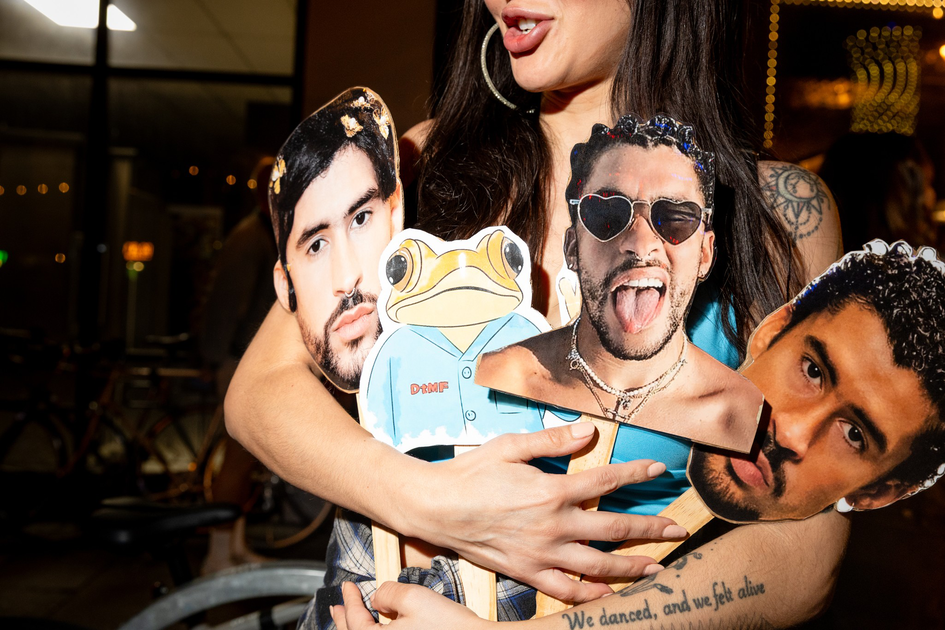
It’s these themes that both propelled Bad Bunny into a global pop icon and excited people enough to draw hundreds to the Mission on Thursday evening for a look-alike contest that morphed into a kind of community tailgate for the Benito Bowl.
“We just published one little social media post and it went viral,” said Luis Angel Quiroz, founder and creator of Mission Lotería, a San Francisco-based event group that organized the contest.
It felt right to turn the group’s weekly Loteria game night into a night celebrating who has marked several firsts for the Latin community.
Quiroz’s team knew that the event would be popular and hoped it would be a hit. But even they were caught off guard by the turnout.
 Adan Marquez and friends hold Bad Bunny Loteria squares during the Bad Bunny look-alike contest at Tacolicious.
 Nixon Rodriguez wears a shirt reading “Aqui se habra español” during the Bad Bunny look-alike contest.
“He’s Puerto Rican, but he represents all Latinos, and he stands up for what is right. He’s not a machista. He is a new generation, a new breed of gentlemen, as a queer Latino, I really admire that ” Quiroz said.
Maria Yos, 54, a Bay Area resident of Guatemalan heritage, was one of the hundreds of people taking in the festivities on the sidewalk as the crowd spilled out onto Valencia Street.
“He’s someone who helps the community and he’s Latino. I think that’s what people like. That’s why people are excited,” Yos said in Spanish. It was hard not to be inspired by the joy she saw around her, particularly because of its stark contrast to how much quieter she’s noticed the Mission in the last few months.
“I’ve seen many people who no longer want to go out because they’re afraid that they’ll be grabbed up [by ICE] and try to find ways to stay in,” she said.
That fear — both palpable and persistent — was also a concern to Quiroz and his team. Though it was a hard conversation, and one Quiroz noted that should not have had to take place during a time of celebration, they also had to put a plan in place in case ICE showed up.
But even then, the crowd that gathered to dance, sing, and share space functioned as a physical manifestation of a fundamental truth: Latin joy and culture is not something that can be erased or taken away.
 Attendees cheer as contestants showcase their Bad Bunny.
“Latinidad has been here forever, Boricuas are native, and America came later,” said Alicia Lopez-Torres, 27, a Puerto Rican San Franciscan whose family immigrated to the Bay Area in the’ 60s and ‘70s.
For Lopez-Torres, this moment feels like experiencing a piece of history in real time. Both because she is a fan of reggaeton music and because she’s excited about seeing a fellow Puerto Rican take center stage on one of the most televised events, especially because of the complex history many Puerto Ricans have experienced in the United States.
“Puerto Rico, being on the grand stage and Puerto Ricans being persecuted for so long in America, being one of the oldest colonies…and people not accepting that we are a colony at all,” Lopez-Torres said.
Ramona Soberanis, 53, a Mission resident and a Chicana, first heard of Bad Bunny during a work trip with the Department of Public Health to help with the aftermath of Hurricane Maria. The devastating storm killed 2,975 people in Puerto Rico in 2017.
The disaster, the deaths, and the corruption that hampered the recovery inspired
songs like “El Apagón,” and “Lo que le pasó a Hawaii.”
The latter track tackles displacement and the diaspora of Boricuas while also alluding to communities who have faced the same plight.
“I’m born and raised in the Mission. So, we know about gentrification,” Soberanis said. Bad Bunny’s music has become part of a new soundtrack for the Mission District.
“You just hear it playing everywhere you go. I mean, coming out of people’s houses,” she said. “It’s awesome. And now that he’s representing us on the Super Bowl stage, it’s even bigger.”
 Attendees take photos with Juan Cavalleiro, one of the Bad Bunny look-alike contestants..
 Ramona Soberanis poses for a portrait as she waits in line.
It’s impossible to predict how Benito will use his time on Sunday evening, and it’s naive to think a celebrity can solve everything or really anything through a 15-minute performance. One man can’t fix the uncertainties the Latin community is facing at the moment, but he can remind us that our stories and our culture matter.
“When are we ever gonna see this again? Should we celebrate this? Obviously. Should we be loud? Obviously,” said 22-year-old Adan Marquez. “We should be doing everything to emphasize that this just happened.”