
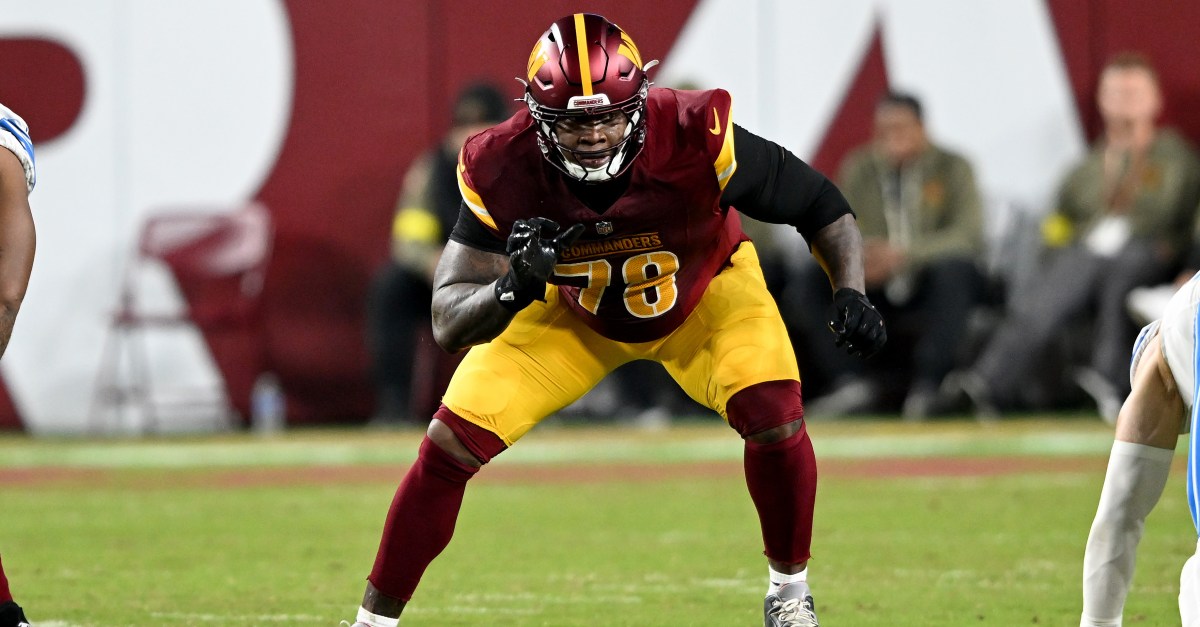
The recent release of the ESPN Top 100 Real MVP Candidates included several talented teams boasting multiple candidates. Not surprisingly, Washington only provided one. What did catch my attention was the ranking this lone selection received.
Offseason addition Laremy Tunsil was listed at No. 24, slightly behind Garrett Bolles but ahead of other quality tackles like Penei Sewell, Dion Dawkins, and Trent Williams. While this does not necessarily mean that author Seth Walder believes Tunsil is the second-best offensive tackle in the league, it does mean, based on statistics and metrics, feedback from NFL front office personnel, and colleagues at ESPN, that he believes Laremy Tunsil is in the upper tier in terms of value for his team. With that in mind, I thought a review of Adam Peters’ most significant offseason trade would be in order.
Laremy Tunsil was a Pro Bowl snub this season; it is hard to see how his performance on the field didn’t warrant selection. Tunsil has been elite in terms of pass protection for multiple years, and nothing changed with his arrival in Washington. In his previous three seasons, Tunsil had allowed a 3.1% pressure rate, and this season was no different, with the big tackle allowing just two sacks and 15 pressures through 14 games prior to injjury, on his way to earning his fourth PFF passing grade of 85 or better in the past six seasons.
The biggest surprise this season was Tunsil’s performance in the run game, which was called into question at the time of last year’s trade. Tunsil was only defeated on 7.9% of run plays, which ranks second best among NFC offensive tackles with at least 250 run block snaps, behind only Trent Williams. Overall, the Washington Commanders finished the season ranked fourth in rushing yards per game and tied for fourth in yards per carry. Much of their success came behind Laremy Tunsil:
While his performance was great, fans expected nothing less given his prior history and the compensation involved for both the Texans and Tunsil (more on that later). But along with those high expectations came concerns at the time of the trade and prior to the start of the season regarding two other aspects surrounding the former Texans tackle: penalties and locker room presence.
In 2024, Tunsil was charged with a league-leading 19 penalties, including 12 false starts. Fans were concerned that his high penalty rate would follow him here, and anxiety grew when Tunsil recorded 7 penalties in the first quarter of the season. However, the newly minted Commander would go on to commit only one additional penalty for the rest of the season. His season total of 8 was less than his penalty count going into Week 3 of last season.
So, Tunsil significantly reduced his total penalties in his first season with the Washington Commanders, but what about the locker room? Following the trade, Albert Breer reported that one of the reasons the Texans were willing to trade Tunsil was concerns regarding his contributions to a “toxic” locker room for the offensive line:
After a full season with the Commanders, any locker room concerns are a distant memory. In his end-of-season press conference, Adam Peters had this to say, “He’s a great leader, and he’s really not upfront about it. He’s an outstanding mentor to the other O-linemen. He’s a really good teammate in a lot of ways that you don’t really see because he’s not looking for attention.” This sentiment was reiterated by Kliff Kingsbury, Bobby Johnson, and rookie Josh Conerly. There seem to be no locker room issues with Tunsil in the Washington, and he has elevated the play of other members of the line including Chris Paul Jr.
Clearly, Laremy Tunsil is a talented and the proven commodity, but does that justify the cost for Washington to retain his services?
This must be examined on two fronts, the first revolving around draft capital. Adam Peters sent the Texans four draft picks to acquire Tunsil: a 2025 third-round pick, 2025 seventh-round pick, 2026 second-round pick, and a 2026 fourth-round selection. While four picks would seem like a substantial investment there are some aspects of the trade that are not always mentioned; remember that Washington also received a 2025 fourth-rounder in return. This reciprocal pick was somewhat obscured by the fact Peters had already traded Washington’s 4th-round selection to New Orleans in the deal to acquire Marshon Lattimore. Therefore, Washington only made one selection in the fourth round of the 2025 draft instead of two. This helps soften the blow, while then loss of seventh rounder does little to impact the value of the trade.
The inclusion of a first-round selection in the upcoming 2026 would have been catastrophic, but Adam Peters has wisely been very reluctant to part with these selections. Considering the talent available in the free agency in 2025, or more accurately, not available, and that Brandon Coleman was the projected starter at the time of the trade, the majority expense of a pair of Day 2 picks seems like solid value.
The other variable in calculating the return on investment for the trade has yet to be quantified. In addition to the key concerns discussed above, one of the other reasons the Texans were willing to part with Tunsil was the associated cost of a contract extension. While Adam Peters has already confirmed he wants to get a deal done sooner rather than later, the actual cap required to extend Laremy for the foreseeable future has yet be determined. Fortunately, Hogs Haven cap guru Bill Horgan has provided a hypothetical framework we can use for evaluation purposes:
Hypothetical contract extension for Laremy Tunsil
Let’s keep the numbers fairly simple and assume that Tunsil:
signs a 4-year extension (2027-2030),worth $30m per year ($120m total),with $18m of his 2026 salary converted to signing bonusroster bonus of $25m paid at the start of the 2027 season
The new structure could look something like this:
Bill’s projected numbers would provide the team with immediate cap savings and secure Tunsil’s services until franchise QB Jayden Daniels reaches his thirties. The projected AAV would make Laremy the highest-paid left tackle in the league, but if Tunsil continues to perform as he did this season or even improve at age 31, he would be worth the deal. As Bill outlined in another preseason article he could do just that:
It is, in fact, not particularly unusual for elite offensive tackles to play at a high level well past their age 35 season. Jason Peters played for 21 seasons, retiring at age 41, and while he played a lesser role in his final couple of seasons, he was a full-time starter through his age 39 season. Andrew Whitworth earned 1st-team All-Pro honors in his age 34 and age 36 seasons, and was a full-time starter until he retired at the end of the 2021 season at 40 years of age. His team, the Rams, won Super Bowl LVI in the final game of his career.
All of this is to say that Trent Williams, who remains elite at the position 15 years after being drafted #4 overall by the Redskins in 2010, is not some one-of-a-kind unicorn who discovered the fountain of youth. Elite offensive tackles can play long past the age when most running backs, receivers and defensive backs have lost the elite athletic ability that allowed them to thrive in the NFL.
The biggest argument against the Laremy Tunsil trade is that Adam Peters should have drafted a similar, younger player. However, as most fans know, it is not that simple.
It was rumored Washington’s front office attempted to trade back into the first round of the 2024 draft to secure a blindside protector for their newly drafted quarterback, but the associated costs were too prohibitive. Peters was able to draft Josh Conerly Jr. in the tail end of the first round in 2025, but as we saw this season, the rookie is clearly in need of more development.
The same can be said for Aireontae Ersery, the left tackle the Texans drafted in the second round to replace Tunsil. Ersery generally had a good season, and the Texans did make the playoffs, but the rookie struggled in the postseason. This includes a playoff loss to the Patriots, where pressure on C.J. Stroud played a significant role in the quarterback’s four first-half interceptions. While Ersery was decent in pass protection, unlike Tunsil, he did not perform well in the run game, receiving a PFF grade of 51.8 in run blocking and an overall grade of 58.9, neither of which compare well to Tunsil’s respective marks of 75.3 and 76.5
In summary, Adam Peters’ trade for Laremy Tunsil provided Washington with an outstanding player, and once the expected extension is complete, this long-term building block at a key position will be secured for years to come.
The draft compensation was not insignificant, especially considering the second-rounder will be the No. 38 overall, but retention of the team’s first-round selections was a shrewd priority for GM Adam Peters.
Paying a player at the top of the scale is always significant, but Washington has the cap space necessary to mitigate impacts to the roster long term. A similar tackle acquired in free agency would demand an equivalent investment, if one was even available to sign. Ideally, Adam Peters would have drafted a younger version of Tunsil in the draft and may have done so with the selection of Josh Conerly Jr., but rookie development takes time, and while having two bookend tackles may have been considered a luxury at one point, in today’s NFL it is more of a requirement.
For a team largely bereft of elite talent, the trade for Laremy Tunsil was a key move in elevating the franchise’s long-term prospects, and, based on Tunsil’s 2025 performance and expected ‘26 offseason extension, a clear win for Adam Peters.