
On Feb. 11, the streets of Seattle will flood blue and green with Seahawks pride for a Super Bowl championship parade and ceremony.
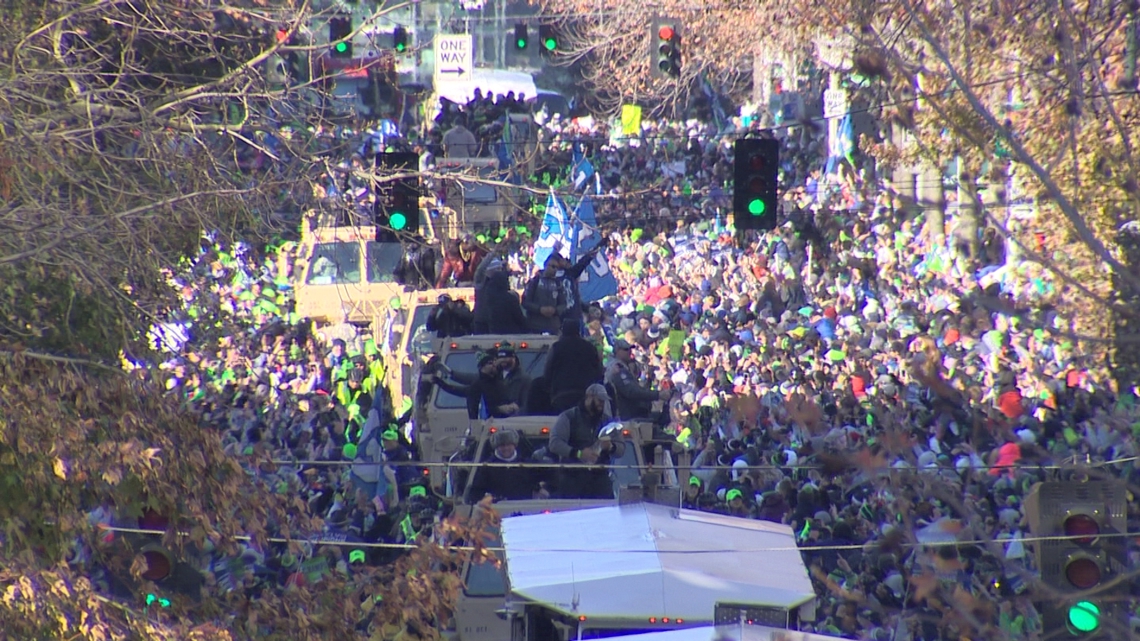
SEATTLE — Twelve years ago, more than 700,000 fans gridlocked Seattle as they celebrated their beloved Seahawks winning Super Bowl XLVIII.
For the 2026 parade and celebration – Seattle Police and parade coordinators expect the crowd to be about one million, give or take.
Twelve years ago, on Wednesday morning, Feb. 5, 2014, first-time Super Bowl champions Seattle Seahawks could not make it to the staging area near the Space Needle to reach their own victory parade.
The road block: a mass of fans. The parade started about 40 minutes late due to the large crowd.
When the procession finally lurched forward — attendees witness a motley fleet of Ride the Ducks tour boats and National Guard Humvees.
According to the city of Seattle, the 2014 parade is the largest public gathering in Seattle’s recorded history.
Fans packed Fourth Avenue and surrounding plazas, some sections reaching more than 100 feet deep, forming walls of people that closed in on the parade route before it began.
Coming together quickly
The Seahawks crushed the Denver Broncos 43-8 on Super Bowl Sunday. By Monday morning, Seattle officials were scrambling to prep for a city that hadn’t thrown a men’s professional championship parade since 1979, when the SuperSonics won the NBA title.
They had just over 48 hours to prepare.
The city activated its Emergency Operations Center, coordinating law enforcement, fire, transportation, state agencies, and stadium operations.
Fans began arriving the night before, even as temperatures dropped below freezing, to stake out prime viewing spots.
Seattle’s trains, buses and ferries carried seeming record numbers of passengers.
Link Light Rail carried 71,000 one-way passengers that day — 41,000 more than normal. Sounder commuter trains hauled 38,000 riders, more than triple their usual volume. Ferry terminals and Metro bus stops were packed that transit across the region was slowed down.
According to the city of Seattle, the transit crush meant some people never reached the parade at all.
The roar of the 12s
At 12:12 p.m. on Feb. 5, 2014, Washington state attempted something unprecedented: a coordinated moment of collective noise.
The state officially held a “moment of loudness” in honor of the 12th Man. At the same moment in time — 12:12 — from Spokane to the San Juans, people stopped what they were doing and yelled.
Skipping school?
More than 13,000 Seattle Public Schools students — roughly a quarter of the district’s student population — did not show up for classes that day. Other districts preemptively excused absences. Some private schools simply canceled classes.
Businesses along the parade route shuttered so employees could join the celebration.
It was clear that Seattle had granted itself an unofficial holiday.