
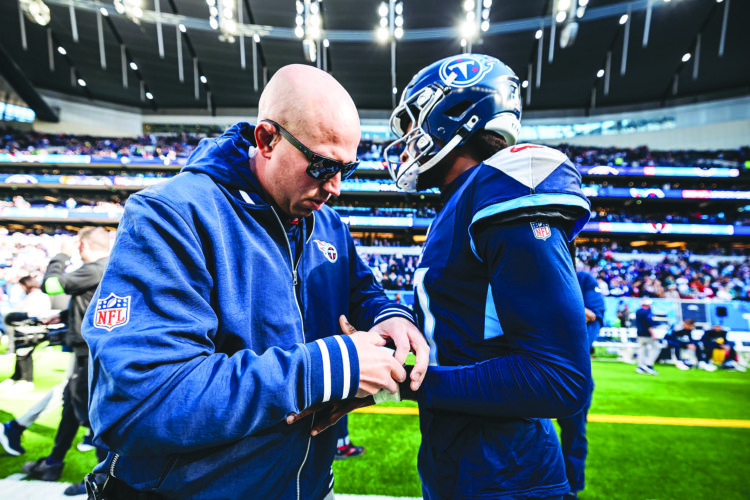
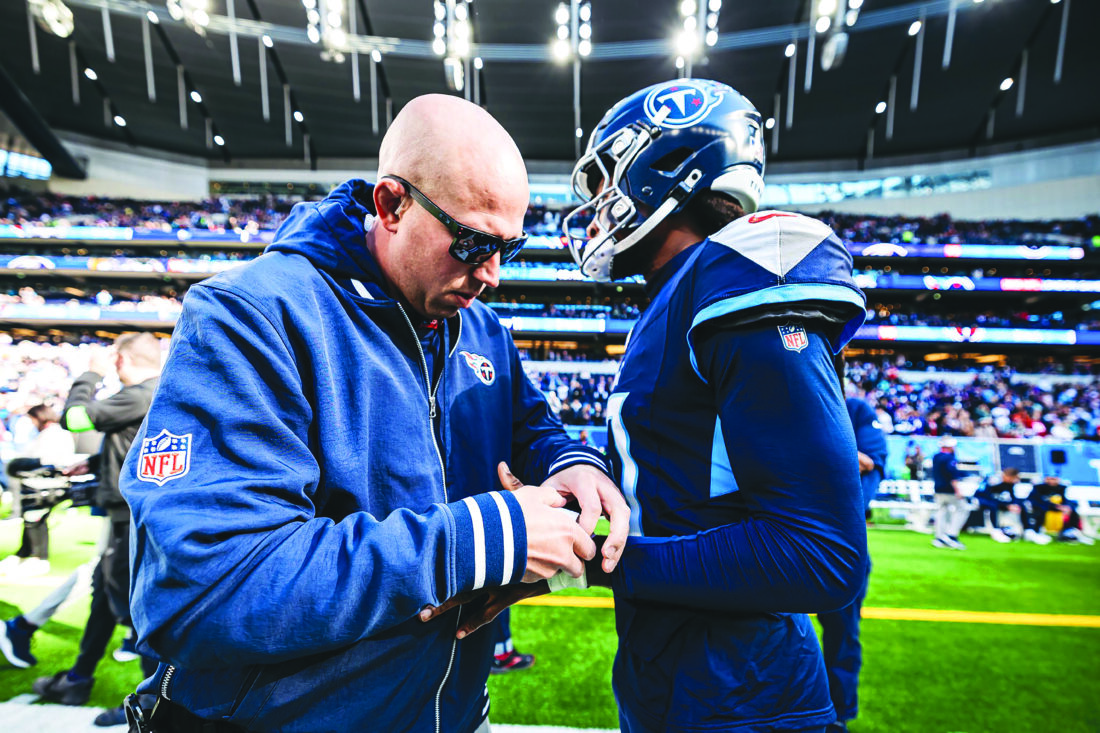
Submitted photo
Matt Gregg tapes up the hand of a Tennessee Titans player during a game.
NASHVILLE, TN — On most days in professional football, the people doing the most consequential work are the ones least likely to be noticed.
They arrive early, stay late, and speak softly.
Their success is measured in absences.
No limp. No relapse. No season cut short.
Matt Gregg has spent his career in that space, and after ten seasons with the Tennessee Titans, he just finished his first year with a title that matches the responsibility — Director of Sports Medicine.
Gregg’s path there was never hurried. It unfolded the way careful work does: incrementally and without announcement. He spent six seasons as the Titans’ associate head athletic trainer before the organization elevated him in 2025. By then, the trust was already established. Titles were almost a formality. The work had been happening for years.
Long before Nashville, it began in Lewistown, Pennsylvania, where Gregg was an athlete himself. He said growing up there shaped how he thinks about sports and responsibility. “Growing up as an athlete in Lewistown definitely helped shape the way I think,” Gregg said. “I had some great coaches growing up, especially in wrestling with Ken Whitsel, Mike Robinson, Kirby Martin, and Noah Miller to name a few. I learned some valuable lessons not only in sports but in life.” Those lessons, he said, still guide him.
Wrestling mattered.
It taught patience and honesty.
You can’t hide from the work, and you can’t skip it.
Gregg also credits his parents for reinforcing that idea. “They never pushed me to do anything that I didn’t want to do,” he said, “but once I committed to something, they provided me with the opportunity and encouragement to see it through to the end.” Accountability wasn’t imposed. It was expected.
He carried that expectation to Duquesne University, where he earned his undergraduate degree in athletic training and competed as a Division I wrestler. Wrestling has a way of clarifying effort, and Gregg absorbed those lessons early. From there, he went to Louisiana State University, earning a master’s degree in kinesiology while serving as a graduate assistant athletic trainer. At LSU, he worked with the women’s gymnastics team, a setting that demanded precision and care. He also spent the 2011 season as a seasonal athletic training intern with the Pittsburgh Steelers, where the scale grew larger and the margins thinner.
His entry into the Titans organization came through Saint Thomas Hospital, where he assisted the team’s athletic training staff for two seasons. It wasn’t glamorous. It was instructive. Gregg said he had opportunities elsewhere that might have looked better on paper. He stayed. The goal was fit, not speed.
From there, the progression was steady.
Assistant athletic trainer. Associate head athletic trainer. Director of Sports Medicine.
Gregg said there was no moment when the job suddenly felt heavier. “I don’t think there was a specific moment that the responsibility felt different,” he said. The transition reflected years of preparation and guidance. He credits mentors John Norwig and Todd Toriscelli for teaching him the profession’s details and, just as important, how to manage people.
That emphasis on people shows up in the way Gregg has built his department. Most of the Titans’ sports medicine staff came through the organization as interns. “A majority of our current sports medicine staff here started as interns and learned the job and expectations here from the ground up,” Gregg said. “Everyone has done almost every role on our staff at some point, so they completely understand and value the culture that we have here. No job is too small.”
Culture, Gregg believes, isn’t sustained by speeches. It’s sustained by repetition. “Just like our organization has high expectations for our players and coaches, we have high expectations of our medical staff,” he said. “When people value the standard and the culture, they work to help maintain it on a daily basis because it’s important not only to the department but to them as an individual.”
Gregg’s first season as director came at a moment of organizational change. The Titans closed the year and brought in Robert Saleh as head coach, shaped by his time as defensive coordinator with the San Francisco 49ers and his experience as head coach of the New York Jets. New leadership often brings new demands. Gregg said alignment has never been a problem. “This has never been an issue with any of the coaches that I’ve worked with,” he said. “We all share the same goal. The goal of all of this is to win games.”
That clarity helps. “When the players perform at their best, the team wins more games,” Gregg said. “It’s our job, along with many others in the organization, to help the players perform at their best to help the team win games.” The medical staff works within that shared understanding, balancing urgency with restraint and performance with longevity.
When the season ends, the work becomes quieter. Gregg said the sports medicine staff conducts a comprehensive internal review every year. What they examine first depends on what unfolded. “What we review first is situationally dependent upon different things that occurred during the season,” he said. No area is exempt. “They’re all important.” Reflection, he said, is how improvement happens.
That long view shapes the advice Gregg offers to young people watching from home. “I think that a lot of young people in today’s world struggle to understand that it is unrealistic to think that you’ll finish school and immediately get a job at the top,” he said. “You’re just not ready.”
Gregg’s own path is a study in accumulation. Two seasons through the hospital sponsor. Three as an assistant. Six as associate head athletic trainer. One season completed as director of sports medicine. “You have to be patient with learning the process,” he said. “You can’t skip steps.”
The work remains mostly unseen. That’s part of its purpose. When it’s done well, nothing happens. Players keep playing. Careers extend quietly.
For Gregg, that absence is the measure.
Ten seasons with the Titans, one as director of sports medicine, built on care and patience.
Somewhere back in Lewistown, the lesson still holds.
Do the work. Do it well. Let time take care of the rest.
Their training now complete, Pennsylvania’s newest State Game Wardens are working in their newly assigned …
COCOLAMUS — East Juniata girls basketball lost to Mifflinburg on Tuesday night, 43-22.
For the visitors, …
Six Seven is the viral meme trend that has taken social media by storm, and on June 7, 2026, it will truly be Six …
CURVE, Pa. – The Altoona Curve, Double-A affiliate of the Pittsburgh Pirates, will play as the Pennsylvania …