
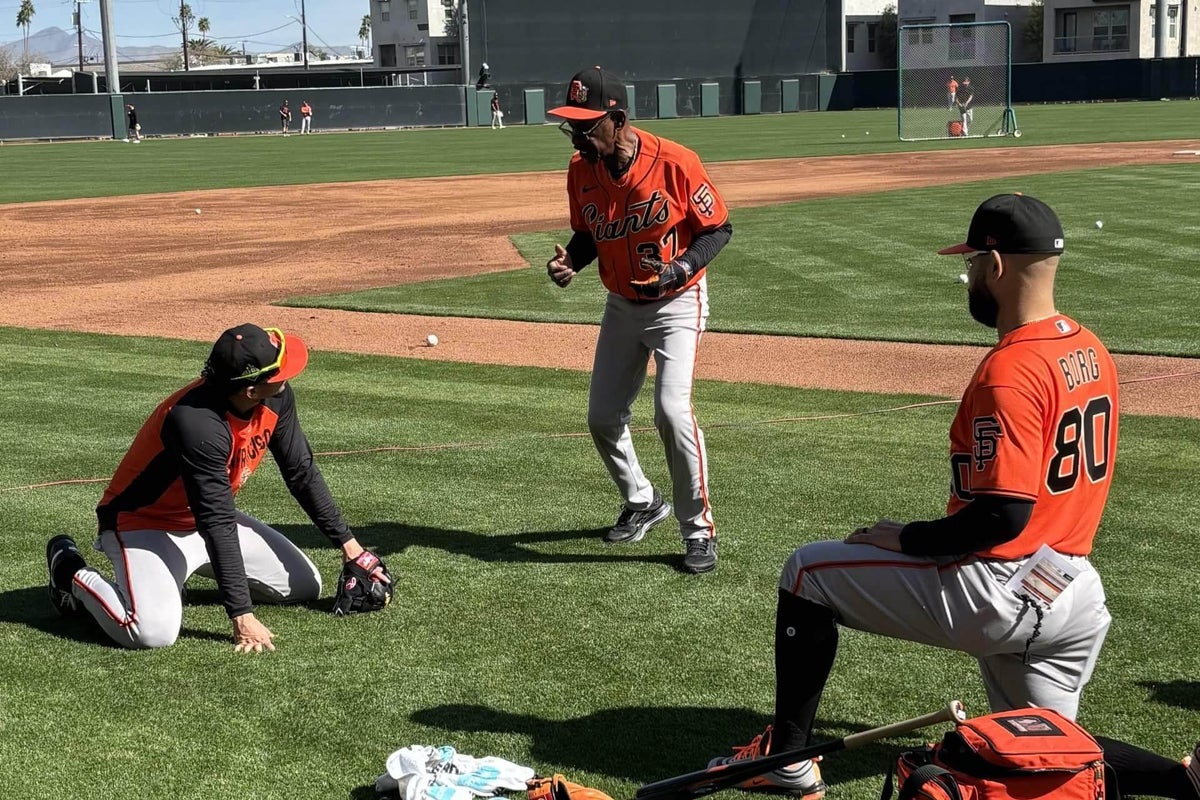
SCOTTSDALE, Ariz. — For anyone who has ever watched Ron Washington work with infielders, the sight was unusual, jarring even.
That wasn’t Washington, the San Francisco Giants’ new infield instructor, performing one of his famous drills Tuesday morning, hitting one-hop fungos from his knees to Giants first baseman Rafael Devers a short distance away. It was new Giants third-base coach Hector Borg, with Washington hovering close, shouting words of advice and encouragement.
A man coming off quadruple bypass heart surgery last summer and turning 74 in April can’t get down and dirty as often as he once did. But Washington, back on the field after losing his job as Los Angeles Angels manager in September, is still “Wash,” teaching, gesturing, cussing, squeezing every ounce out of every baseball day.
Oh, he dropped to his knees at times Tuesday, hitting fungos and flinging one-hoppers at his new pupils, just as he did with Eric Chavez in Oakland and Elvis Andrus in Texas, Freddie Freeman in Atlanta and Zach Neto in Anaheim. But even though the Giants’ first full-squad workout isn’t until Sunday, most of their infielders already are in camp. Washington said he can’t handle ‘em all.
Borg, 40, will ease some of his burden. A longtime Giants minor-league coach getting his first chance in the majors, Borg managed the Dominican Republic to a bronze medal in the 2020 Olympics, which were held in 2021.
“If I had to do it by myself, I’d will myself to do it, because that’s who I am,” Washington said. “But I like this guy. He’s willing to help. He’s trying to learn the game of baseball. So, I’ve got a friend. And that friend is going to help me make sure I get through this.”
Washington concedes he isn’t at full strength. He took an elevator at the Giants’ spring complex on Tuesday rather than the stairs to the third floor with the pitchers, catchers and other coaches for new manager Tony Vitello’s first meeting. But take a guess who was the last man off the field Tuesday, long after the pitchers and catchers departed.
The oldest guy in uniform.
After his surgery, the 5-foot-11 Washington dropped from 172 pounds to 152. He’s now up to 165. He proudly rolls up his sleeves and points out the definition returning to his biceps. He is exercising, eating better, taking the cholesterol medication that might have prevented his arteries from clogging if he had been more diligent after it was first prescribed to him in his 60s.
Ten years ago, Giants third baseman Matt Chapman was a minor leaguer with the A’s, the youngest player in Oakland’s major-league camp. Washington wanted him on the field, taking grounders, by 6:45 a.m. Chapman would arrive, only to see Washington waiting with a fungo in his hands and a cigarette in his mouth, ready to go.
The cigarettes are gone now. The fungo is not. Washington said he begins his 90-minute workout routine at 4 a.m. He and Borg start planning the day around 5:30.
Devers and Casey Schmitt were among the first to arrive for Wash’s drills Tuesday. Shortstop Willy Adames went later, with newly signed second baseman Luis Arraez, a player Washington is expected to help improve defensively, paying close attention. Finally, utility man Tyler Fitzgerald stopped by.
“Want some?” Washington asked. “Let’s go.”
The Angels, after losing 99 games in Washington’s first season, were 36-38 on June 20 when he went on medical leave. They went 36-52 the rest of the way under Ray Montgomery.
Yet, Washington said when the team declined to pick up his option on Sept. 30, general manager Perry Minasian told him the decision was based not on his health, but the club’s performance.
“I have to accept that,” Washington said then.
But he doesn’t have to believe it.
“I didn’t lose that job because of the record we had,” Washington said. “I lost that job because of my condition.
“If I wouldn’t have had an operation, I still think Perry would have kept me over there. I understand what he did. But the Giants came in and didn’t second-guess. They came in and believed in me.”
And they weren’t alone.
Washington said Cincinnati Reds manager Terry Francona called him the day after the season ended. They spoke for about two weeks, and, according to Washington, grew increasingly excited by the possibility of Washington joining Francona’s staff.
It didn’t happen.
“They got afraid of me,” Washington said, referring to the Reds’ front office. “They got afraid of my condition.”
Reds general manager Nick Krall denies that was the case. Krall knew Washington from his time as an intern with the A’s in 2002. Francona worked alongside Washington as the A’s bench coach in ‘03. Both are fond of their former colleague, with Krall saying, “I love Wash.”
But after bench coach Brad Mills retired and third base coach JR House left for the Arizona Diamondbacks, Krall said the Reds wanted to replace them from within by promoting Mike Napoli and Willie Harris.
Washington, though, had another old friend who was eager to reunite with him: Giants bench coach Jayce Tingler, who worked in the Texas Rangers organization while Washington was the team’s manager.
Tingler was a low-level minor-league coach and manager during Washington’s tenure, then minor-league field coordinator. Where he stood in the organization made little difference to Washington. Tingler said the manager always treated him and his staff like “absolute gold.”
On Oct. 22, the Giants made Vitello, Tingler’s close friend and former college teammate at Missouri, the first college coach to jump directly into a major-league managing job. Tingler, who managed the San Diego Padres in 2020 and ‘21, was practically an automatic choice for Vitello’s staff. But Vitello wanted at least one more experienced hand.
“He kept bringing up tendencies, traits, characteristics,” Tingler said. “He said he wanted a guy that has been there, who is well-respected, had a work ethic. It immediately dawned on me — I’ve got a guy. Tony basically was describing Ron Washington.”
Did Washington, who entered pro ball 55 years ago, think twice about working for Vitello, who has never worked at the professional level?
Just the opposite.
“It didn’t bother me at all. There are a lot of guys in the game today that never played in the big leagues. They’ve got jobs, and they’re doing a good job,” Washington said. “He’s sharp. He knows baseball. And he’s got myself and Tingler and other coaches around to help him where he might have some deficiencies.
“I don’t want him running around here thinking he don’t belong. That man has managed a lot of ballgames and he has been successful. Yeah, it’s not pro ball. But he stood in a dugout and he had to make decisions.”
Vitello, in turn, already is a fan of Washington, saying if you ask him a question, he not only will provide the answer more often than not, but “give it to you with all his soul.”
Even Minasian, the Angels executive who parted with Washington, offered high praise to his younger brother Zack, the Giants’ GM.
“He’ll be great. He’ll be awesome,” Perry told Zack. “Just make sure he’s healthy.”
In his final days with the Angels, Washington felt sluggish. His ankles were swollen. Doctors performed a battery of tests. The final one, an angiogram, revealed the blockage in his arteries.
Washington said he wasn’t scared until he was in the recovery room after his quadruple bypass and saw wires popping out of him everywhere. At one point, he thought he had died. But no, he was just living a bad dream.
The surgery was on June 30. By July 15, he was in rehab. Riding a stationary bike. Walking on a treadmill. Doing shoulder exercises. Washington was alarmed that he became so thin. Pointing to his legs, he said, “These sons of guns were so skinny, it was ridiculous.”
Washington was an infielder with the Los Angeles Dodgers in 1977, the Minnesota Twins from 1981 to ‘86 and three other clubs from ‘87 to ‘89. He lost two World Series as manager of the Rangers. He won one as a coach with the Braves. He approached his recovery with his usual fervor, an energy that some half his age cannot duplicate.
“Whether it’s a rehab situation or his new diet or his new habits . . . I wouldn’t call it bragging, but he believes in himself,” Vitello said. “And if it’s a competitive situation, he’s going to be good at it.”
Washington adopted a low-sodium diet. No more bacon, ham and processed meats. Egg whites and turkey sausage are more his speed now. And, he said, “I’m eating the hell out of some fruit.”
About six weeks ago, he started lifting weights. At first, he could barely pick up a three-pound dumbbell. His doctor told him, don’t get anxious, build up slowly. Now, Washington said, “I’m throwing five pounds around like it’s nothing.” One day he will go to 10 pounds. No need to rush. Maybe this summer. Maybe next year.
Washington said he would have worked hard regardless, but when the Giants hired him, “I really buckled down and made sure I got myself strong, ready to come out here. Every day, the (players) try to get stronger and build. I’m no different. I’m trying to get stronger and build, too.”
Zack Minasian said the Giants obviously will watch Washington closely. Vitello, noting that Washington is following the necessary regimen, said, “I don’t worry about him more than I worry about anyone else.” But Giants president of baseball operations Buster Posey perhaps put it best.
“You’re concerned, but you’re going to trust the doctors and trust him, what he’s saying and feeling,” Posey said. “You can make an argument as well that it would be more detrimental for him to sit at home and not be out here doing what he loves.”
Borg is on one knee, Adames on both, fielding one-hoppers. Off flips. Off the fungo. With his mitt. With a pancake training glove. Standing up, moving side to side.
Washington stands nearby, explaining to Adames, an eight-year veteran, that his drills are all about mastering technique, creating proper angles with your hands. At one point, Washington bends down and holds Adames’ elbow, advising him to keep his glove down, then extend upward through the ball. One move. One motion.
“Oh yeah!” Washington shouts when Adames nails the technique. “Beautiful!”
Most players know of Washington’s reputation as an infield guru, if not the story of Chavez, the A’s former third baseman, presenting the coach with his 2004 Gold Glove.
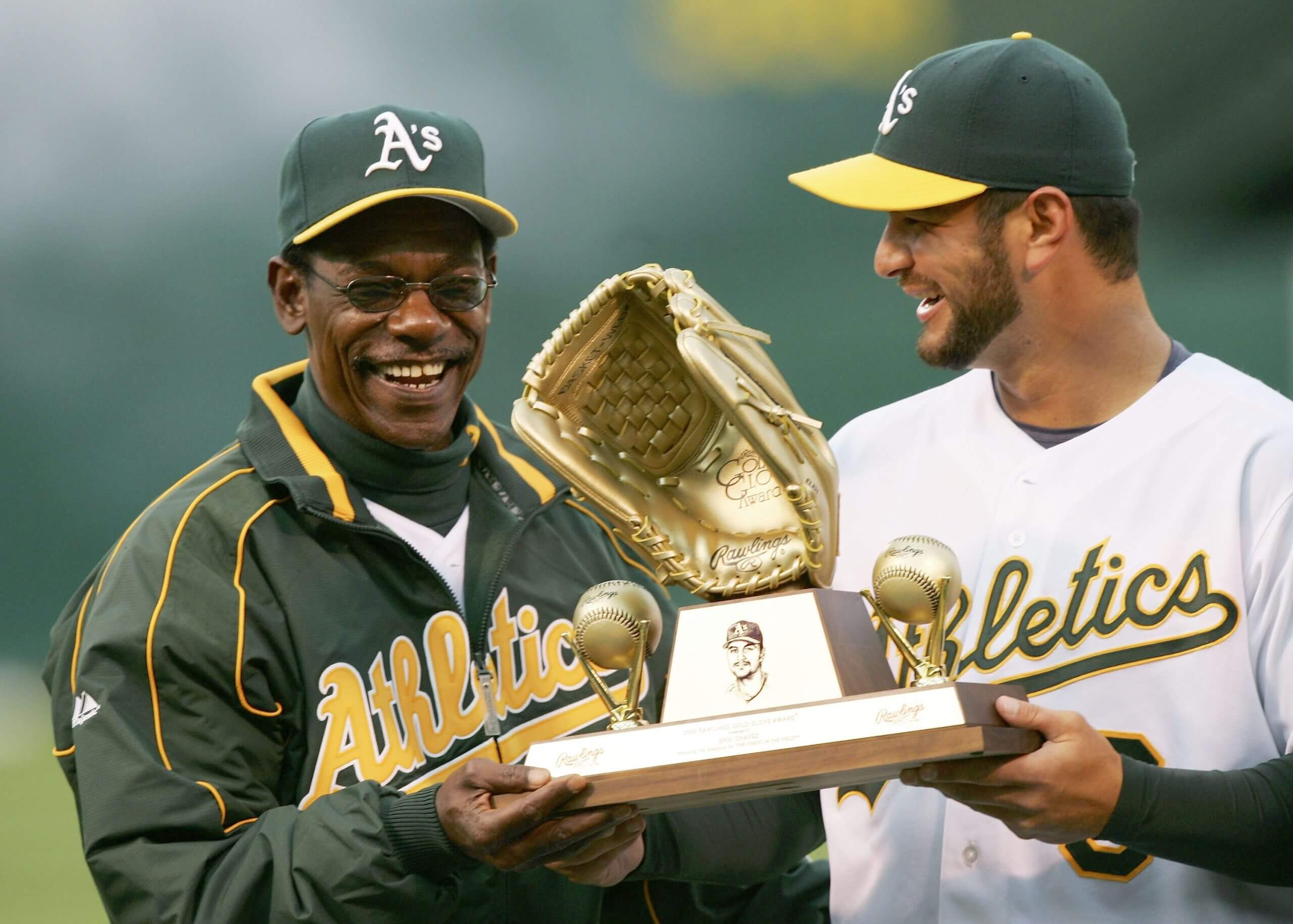
Washington and Eric Chavez celebrate the third baseman’s fifth consecutive Gold Glove award on Opening Day in 2006. (Jed Jacobsohn / Getty Images)
Devers, who converted from third base to first after getting traded from the Boston Red Sox to the Giants in June, beams when asked what it’s like working with Washington. And Washington already is raving about Devers, who the Giants believe by the end of last season was above-average at first.
“I always thought he was a good third baseman when he was in Boston,” Washington said. “Yeah, he made some mistakes. But the mistakes he made were decisions. We can fix those, so he makes better decisions. That’s just getting yourself in a better position, knowing what you’re doing.
“I don’t just teach infield. I teach definition. I teach understanding. I teach why. I teach how. Everything we’re doing out here, we’re doing with a purpose, and with some knowledge behind it.”
Not surprisingly, Washington also believes he can help Arraez, who said he chose a one-year, $12 million deal with the Giants over multiyear offers from other clubs because he wanted to return to second base after playing mostly first base last season for the Padres.
Arraez, who turns 29 in April, rated among the worst defenders at second in 2023 and ‘24.
“Will he be a Gold Glove? I don’t know,” Washington said. “But can we make him efficient? Yes. That’s what our goal is. Just to make him efficient.”
Washington did not look or act like a man less than seven and a half months removed from quadruple bypass surgery. No, he sounded as fierce as ever, talking about giving today hell, and tomorrow, too. As another spring dawned, hearing him shout at Adames, “I’m a bad m—–f—er!” was almost as sweet a sound as hearing the first pop of the glove.
The way Washington sees it, his career features one example after another of people believing in him. The Giants believed in him when other teams did not. And he will do everything possible to reward their faith.
“I’m not going to let ‘em down,” Washington said. “I’m working my ass off to make sure I don’t let ‘em down.”