
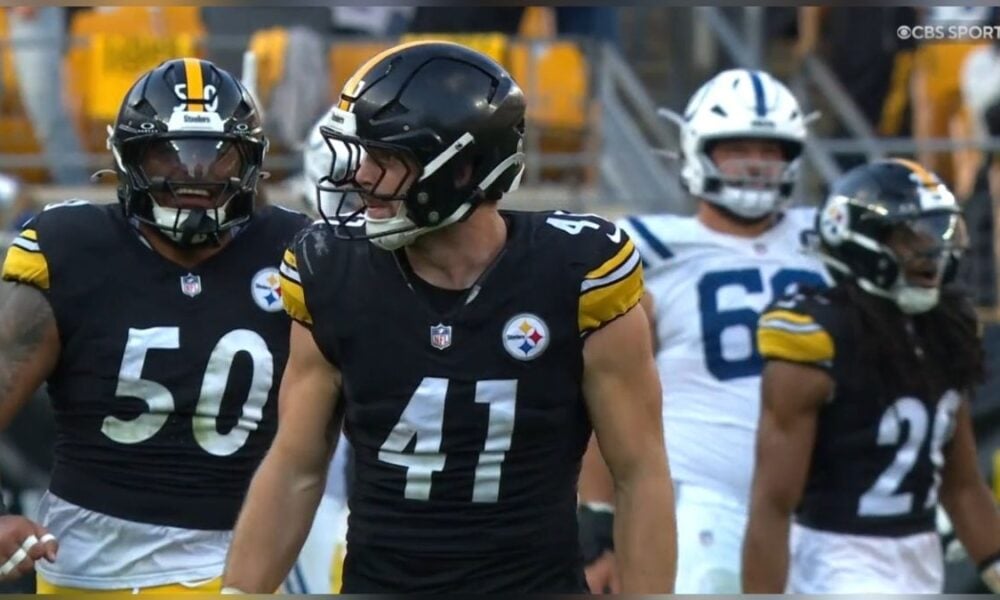
I was as confident in linebacker Payton Wilson as I was any Pittsburgh Steelers player in 2025. As a rookie, he laid a solid foundation and, with his athleticism, work ethic, and effort, seemed ready to break out as a sophomore. Health, his biggest red flag out of NC State, hasn’t been the issue. He’s been durable and available every step of the way.
And yet. Wilson did not take that jump. His second year was much like his first. Not terrible, but underwhelming in usage and performance, leaving me to wonder what his ceiling and future might be.
Opting not to use a single snap of dime defense the entire season, Pittsburgh banked on its athleticism at inside linebacker to win out. Patrick Queen and Payton Wilson. Two guys who would lead a 40-yard dash. But that speed hasn’t translated into coverage. Both have been average in coverage, and that might be charitable. In fairness, truly good coverage linebackers are rare, and the league only has a handful of them. But Wilson didn’t offer enough, especially for someone who believed he could be the NFL’s best at the job.
He had one impressive showing as part of Pittsburgh’s takeaway-fest against the Indianapolis Colts, picking off one pass and tipping another that fell into Jack Sawyer’s arms. But those plays weren’t evident the rest of the season. Per our charting, he allowed 76 percent of his targets to be completed and allowed one touchdown.
Though I am careful to lean on PFF’s grades, especially anything in coverage, it’s worth noting how poorly he ranked. A lowly 35th out of 50 qualifiers, a big regression from an 8th-place finish as a rookie.
It isn’t just about his coverage. In fact, that might be the more minor of his concerns. Run defense has been the bigger question. Checkered medical history aside, Wilson’s on-field knock at NC State was his run defense. While tall, a severe lack of length (30 1/2 inches) is unusual for someone of his height. Last offseason, we noted his hesitancy to trust and read his keys and play downhill, causing him to be late to fill his gap and stuff the run.
Largely, that didn’t change in 2025. Wilson hardly improved. That’s evident in his tape and Pittsburgh’s use.
Wilson began the season as an every-down player alongside Patrick Queen. His role slowly shrank throughout, and by year’s end, he ended in the same spot as 2025. A purely nickel-package player who was ignored in base downs.
For the season, Wilson played in just 85 of the team’s 337 base groupings, be it 3-4 or 4-4 personnel. That’s just 25.2 percent. Of those 87, a whopping 53 – 60.9 percent came in the first two weeks against the New York Jets and Seattle Seahawks. Over that span, Pittsburgh allowed 249 rushing yards to running backs. With Wilson on the field in those base looks, the Steelers gave up nearly 6 yards per carry.
Needing to make a change, Wilson immediately saw his playing time reduced. Even with thumping ILB Malik Harrison injured, the Steelers still pulled Wilson off. Cole Holcomb, in his first action since a severe November 2024 knee injury, took Wilson’s place in base. By Week 3 against the New England Patriots, Pittsburgh played 34 snaps out of its 3-4 or 4-4. Wilson didn’t play a single one.
Suddenly, Pittsburgh’s run defense improved and leveled off. Not all because of Wilson’s removal, but it certainly played its part. The Steelers were content letting that happen the rest of the year. When Harrison returned in November from his knee injury, he became the “base” linebacker opposite Patrick Queen.
By year’s end, Harrison was often playing as much, if not more, than Wilson.
In Week 15 against Miami, Harrison out-snapped Wilson 29-21. Same story in Week 17 against Cleveland, 26-23. In the winner-take-all season finale versus Baltimore, a game in which Pittsburgh had to stop the run, Wilson barely sniffed the field. He registered just 11 snaps to Harrison’s 36. It was a “big people” game. Wilson wasn’t part of the plan.
Harrison was signed for his run-stopping abilities. The Elandon Roberts replacement, but a younger version with extra special teams value. There’s no shame in Wilson not being on Harrison’s level. But the fact that the coaching staff sees such a gap between Harrison, an objectively worse and lower-ceiling player overall, and Wilson that they’ve opted to remove Wilson from any run downs entirely is a big red flag.
An issue his coaches pointed out throughout last season.
“I think the biggest thing, again, for him moving forward is always going to be the block capability because he’s a run-and-hit guy, and sometimes they’ll scheme you up where you got to be able to defeat a block and get off,” then-DC Teryl Austin said last October. “That’s an area he’s gotten better, but we still need him to be better”.
Even with a new coaching staff, it’s hard to play in Pittsburgh if you can’t stop the run. The defense hasn’t been good enough at it the last two seasons. If Wilson can’t turn the corner and doesn’t become a high-end coverage player, it’s hard to find a fit or a role for him. He doesn’t call the defense. He doesn’t play the run. He’s just okay in coverage.
The guy is talented. His speed is high-end, and his effort is commendable. Sideline-to-sideline in open grass, the guy covers an unusual amount of ground. A hard worker, he’s almost always the first guy on the grass at training camp. A solid 10 minutes before the majority of the team saunters down the stairs and spills onto the field. Maybe the light is about to come on. Maybe a new coaching staff will jumpstart him.
However, Wilson will have the same positional coach to work closest with him. Scott McCurley was one of just two 2025 assistants kept by Mike McCarthy. It’s fair to wonder whether that move was in the team’s best interest or whether McCurley is one of McCarthy’s “guys” destined to have a job. McCarthy hired McCurley in 2006 and spent their entire time in Green Bay together. When McCarthy was hired by Dallas in 2020, he brought along McCurley.
But McCurley can’t be the excuse. Entering a critical third season, Wilson must show he can impact the run. That he can be an all-situations player. If not, he’ll never fulfill his potential, and a new coaching staff might be looking for a replacement a year from now.