
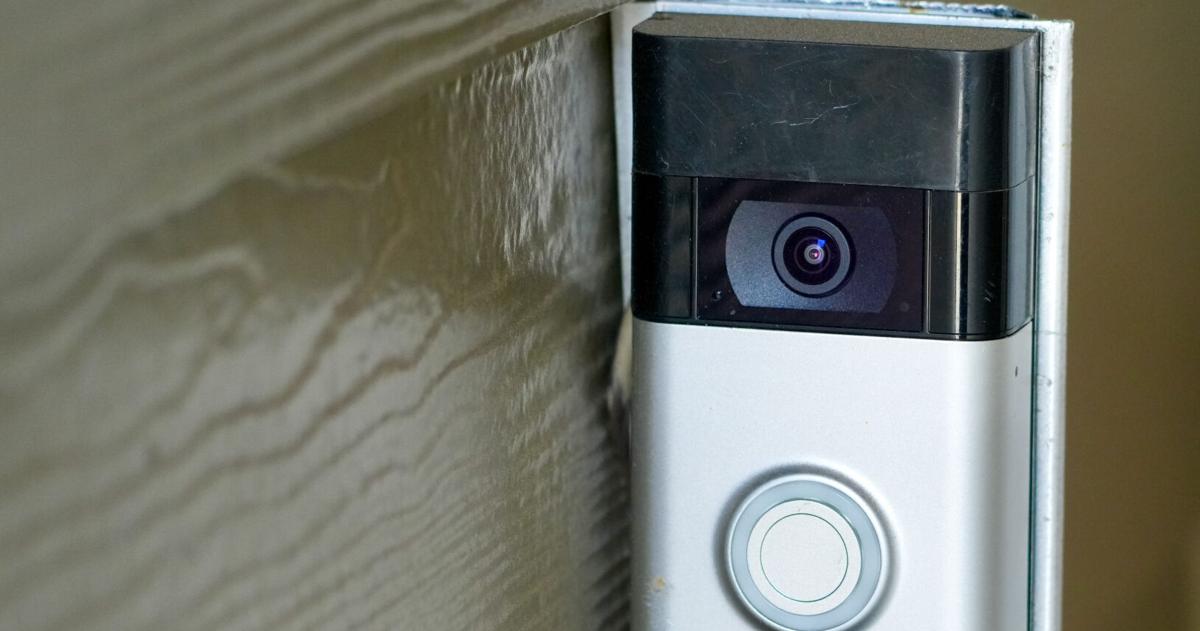
A Super Bowl ad for Ring security cameras boasting how the company can scan neighborhoods for missing dogs has prompted some customers to remove or even destroy their cameras.
Ring, a subsidiary of Amazon, says its widely installed cameras helped return at least one lost dog per day over the past 90 days since rolling out its “Search Party” feature around the country. The company says camera owners must opt into the program, which uses AI to scan live feeds to compare footage to the missing dog’s photo.
But viral videos online show people removing or destroying their cameras over privacy concerns.
Amazon unveiled the new system at a time when Americans are debating the value of persistent surveillance, which also includes widely used Flock traffic cameras and license plate readers; facial recognition systems used by immigration enforcers; and a growing network of traditional security cameras feeding data for AI analysis.
The company promises its network is purely voluntary, and secured against hackers.
“The AI is trained on tens of thousands of dog videos so it can recognize different breeds, sizes, fur patterns, body features, unique marks, shape, and color. And privacy stays in your control ‒ you decide each time whether to help,” Amazon CEO Andy Jassy said in a Feb. 8 social media post announcing Search Party. “Now we’ve expanded this feature so that anyone in the U.S. can start a Search Party through the Ring app, even without a Ring camera.”
But privacy experts say the doorbell systems could be used for far more than tracking lost puppies, and are ripe for misuse by government officials.
“I think (the commercial) surprised a lot of Americans by revealing just how powerful surveillance networks backed by AI have become,” Jay Stanley, a senior policy analyst with the ACLU, told USA TODAY. “That power may be applied to puppies today, but where else might it be applied? Searches for people wearing t-shirts with certain political messages on them?”
The advantages of remote surveillance
Surveillance systems like Ring and Flock are popular among police departments, who say they provide a powerful new tool to track stolen cars and find criminal suspects.
The cameras can stream live or recorded footage to remote servers, dramatically expanding surveillance opportunities by tracking not just license plates but “a red truck towing a trailer,” according to Flock marketing materials.
Ring has previously said it’s working with both Flock and police body-camera company Axon to share footage for crime investigations. The companies say participation is voluntary and that it can only be accessed by authorized law enforcement.
But media reports from around the country have shown that departments that access data from Flock, for instance, have at least occasionally shared it with federal immigration officers despite local laws against it.
Other data-privacy experts have demonstrated that it can be relatively easy to access such camera systems using credentials found online or in data privacy leaks ‒ even without the consent of the owner.
There’s no question cameras like Ring and Flock have helped solve crimes: Police in Colorado last year used Flock to track the vehicle of a person later charged with setting a Tesla dealership on fire, and Ring cameras are often used to investigate package thefts.
In Illinois, police have now handed out 1,000 Ring cameras to domestic violence victims so they can know who is outside their front door.
In Idaho, footage from doorbell, surveillance and in-store security cameras helped investigators secure a guilty plea in the 2022 murders of four college students.
And now authorities have released photos taken by a Nest security camera at the home of “Today” show host Savannah Guthrie’s missing mother, Nancy Guthrie. Officials recovered the images from an online backup of the camera, which was apparently damaged by an armed intruder connected to her mother’s Feb. 1 disappearance.
Videos show people removing their Ring cameras
Online, videos of people removing or destroying their Ring cameras have gone viral. One video posted by Seattle-based artist Maggie Butler shows her pulling off her porch-facing camera and flipping it the middle finger.
Butler explained that she originally bought the camera to protect against package thefts, but decided the pet-tracking system raised too many concerns about government access to data.
“They aren’t just tracking lost dogs, they’re tracking you and your neighbors,” Butler said in the video that has more than 3.2 million views.
Are civil liberties at risk?
Privacy groups like the ACLU and the Electronic Frontier Foundation say the widespread use of such systems ‒ particularly without a nationwide conversation about how rapidly they’re being deployed ‒ raises serious civil liberties concerns.
Although people legally don’t have an expectation of privacy on public streets, AI-powered systems allow authorities to harvest vast amounts of data they can use to build movement patterns of people going about their daily lives, in many cases in ways the public doesn’t understand.
The ACLU’s Stanley said the public doesn’t fully appreciate just how effective centralized video databases have become, especially when users are able to easily search for key words or descriptions ‒ a far cry from the days when police had to manually view each clip.
Stanley has previously highlighted concerns about camera surveillance, including how police officers in a small Kansas city used license plate readers to track a government critic they suspected of hanging anti-fascist posters on public property. Police did not typically conduct similar searches for people who hung missing-pet posters in that city, Stanley said.
“AI allows vast stores of video to be searchable just as large bodies of texts … and when you combine that with a vast ‒ and just as importantly, cloud-centralized ‒ network of video cameras, the potential for abuse is frightening,” Stanley said.
This article originally appeared on USA TODAY: Why are people disconnecting or destroying their Ring cameras?
Reporting by Trevor Hughes, USA TODAY / USA TODAY
USA TODAY Network via Reuters Connect