
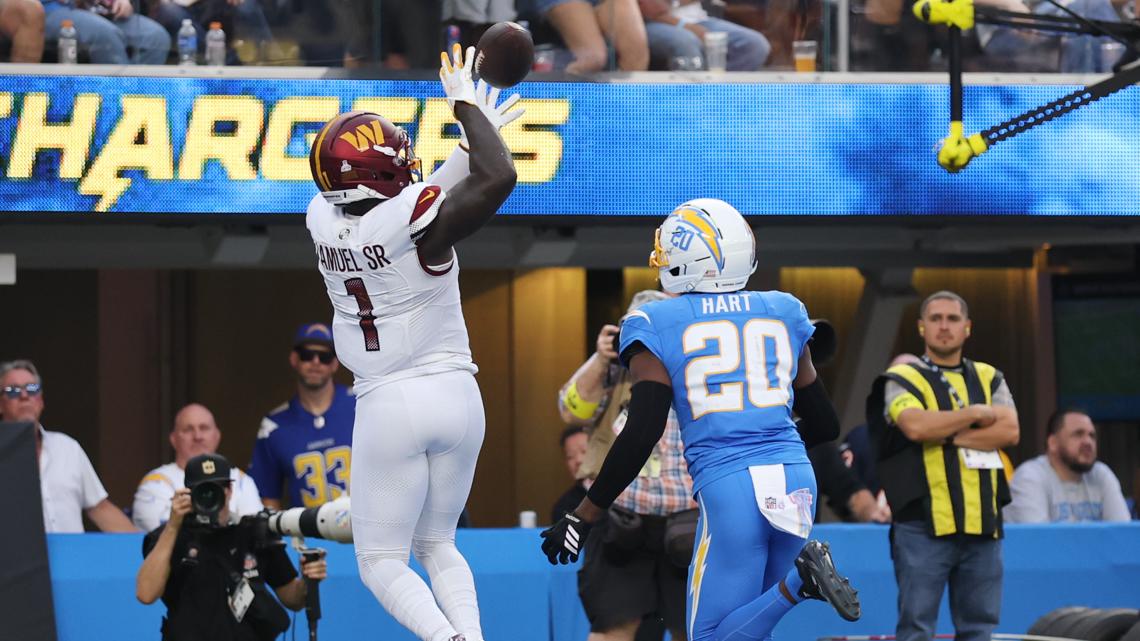
A breakdown of how Deebo Samuel’s contract expiration creates a $12 million dead cap charge and what it means for 2026.
ASHBURN, Va. — When the Washington Commanders traded for receiver Deebo Samuel last season, general manager Adam Peters took steps to make sure just around $5 million of his remaining contract counted against his books in 2025. Now, the rest of it has come due.
Someone with knowledge of the contract structure tells WUSA9 that a $12+ million dead cap amount will be locked in come Friday morning when the Commanders open their doors for business, and clarified that this matter is related to accounting for money spent, not that any more money is due to Samuel. This is because of the void years that were added to Samuel’s contract in that restructured deal that lowered his cap hit to under $6 million to begin with.
In their simplest form, void years allow an organization like Washington to extend the period during which it is not accountable for money paid to a player beyond the life of their current contract. For example, a two-year contract with a $20 million bonus would cost the team $10 million per year against the salary cap in bonuses alone. However, the team can add three void years (the total number of real years and void years cannot exceed five) and turn that $10 million per-year cap hit into $4 million.
How void years created the $12M charge
After the first two years, however, if the team and player do not agree to an extension, those void years all count at once as dead cap in the third league year. In our scenario, that would mean $12 million in bonuses would become dead cap, very similar to the amount Samuel will now count against Peters’ books in 2026.
There are multiple impacts of this deadline having arrived without any word on a new deal for Samuel, which would have encapsulated the void year dead money within it, or an agreement between the two sides to extend the deadline, which is typically a positive sign that the player and team are working in good faith toward an extension.
One, it makes it more likely, though not guaranteed, that Samuel will not return to Washington in 2026. It isn’t unheard of for void-year contracts to expire, resulting in dead cap, only to have the player and team agree to a new contract later, but it isn’t the norm either.
That leads directly to the possibility that Samuel will sign elsewhere as an unrestricted free agent, with a current market projection predicting he’ll earn north of $15 million per year on his next deal.
Samuel exit could net Washington a draft pick
If this happens, the Commanders may enter the world of compensatory NFL Draft pick algorithms. Compensatory picks provide additional draft capital to teams who, in this case, lose players who meet the criteria of being Compensatory Free Agents (CFA) determined by both the amount of the contract that the player signs with his new team and any achievements he may earn as an individual at his next location.
For example, if Samuel were to sign for the projected market value with — say — the San Francisco 49ers, then it’s possible the NFL’s algorithm would consider this worthy of awarding the Commanders an extra fourth-round pick in the 2027 NFL Draft. It’s not an exact science trying to project these picks, because the league is very tight-lipped about the algorithm used to determine who gets how many compensatory picks and how high those picks are that are awarded.
But history suggests a deal in the range of $15 million per year outside Washington could return a fourth-round pick to the team.
That would be negated, however, if Peters were to sign a similarly qualified or better free agent himself, as it would offset the loss of Samuel with the arrival of said talent.
Brandon Aiyuk signing wouldn’t hurt comp formula
The kicker here is that only free agents with naturally expiring contracts can count in this equation one way or the other. Since Samuel’s expiring contract is due to it simply running its course, he counts.
A receiver like Brandon Aiyuk, who is expected to be released by the 49ers, would be an unnatural termination of his contract and not be considered when awarding compensatory picks. That means, a team like Washington could sign Aiyuk without any threat to the possibility of losing compensatory pick considerations.
This is because the NFL, in an effort to maintain as competitive a league as possible, aims to compensate teams for losing talent they may have wanted to keep, while not at the same time rewarding those who terminate player contracts prematurely.
Likewise, re-signing or extending your own players does not impact this equation.
On the surface, Samuel’s contract expiring and the void years on the deal becoming dead cap space in 2026 is pretty basic run-of-the-mill business for NFL executives. The ramifications, especially as it pertains to draft capital, however, can have far-reaching impacts depending on whether or not a general manager like Peters sets his sights on protecting that pick or not.
And in that way, the seemingly boring accounting note can become a ripple that impacts not just this year’s Commanders roster, those to come next year, and beyond.