
Will the New York Jets chase another big-name quarterback?
There is plenty of speculation that two-time Pro Bowl signal-caller Kyler Murray, a former first-overall selection, could be traded by the Arizona Cardinals within the next 30 days.
Murray has failed to live up to expectations across seven years in Arizona, and a new coaching staff is on its way into the building. On March 15 (the fourth day of the 2026 league year), Murray’s 2027 base salary ($19.5 million) will become guaranteed.
Given these factors, there is a real possibility that Murray will be traded before the March 15 deadline.
And with the Jets desperately needing an answer at quarterback, they will inevitably be talked about as a potential suitor for the Heisman Trophy winner.
Should the Jets go after Kyler Murray?
Let’s break down the pros and cons of a potential pursuit.
Pro and Con: The contract situation
Murray’s contract situation is both a positive and a negative for potential suitors. In some ways, it makes him appealing to acquire, but the structure of the deal could also cause issues for the Jets’ specific cap situation.
The 28-year-old is entering the third year of a five-year contract extension that he signed in 2022, which runs through the 2028 season. The final year is a club option, so it technically runs through 2027.
However, Murray’s contract includes no guarantees beyond 2026, which makes it a fairly tradeable deal for both Arizona and prospective teams, adding fuel to the trade-rumor fire.
By trading Murray this offseason, Arizona would save $35.3 million in cap space while absorbing $17.9 million in dead money (per Spotrac), which makes it an enticing deal for them to get rid of. The Cardinals would be responsible for paying off Murray’s remaining prorated bonuses ($14.4 million in prorated option bonus money and $3.5 million in prorated signing bonuses), which accelerate onto this year’s cap, but that’s all.
The acquiring team would absorb Murray’s remaining base salaries of $22.8 million in 2026 (which became guaranteed on the fifth league day of 2025) and $19.5 million in 2027 (which becomes guaranteed on the fifth league day of 2026), plus a $17 million roster bonus in 2026 ($13.965 million guaranteed). The base salary and roster bonus will combine to give him a $39.8 million cap hit in 2026.
That’s a lofty number to fit into a single-season cap sheet. The somewhat good news is that if Murray’s new team wants to cut ties after 2026, they would only be on the hook for the $19.5 million base salary in 2027, which isn’t the worst penalty for a starting quarterback (consider that the Jets will be on the hook for more money to dump Justin Fields this offseason).
Murray has a $14.2 million roster bonus for 2027, but that isn’t due until the fifth league day of 2027, so his team can get out of it by releasing him before then.
Round all of the pieces together, and this is the bottom line: acquiring Murray entails a commitment of at least $39.8 million in 2026 and $19.5 million in 2027.
So, the good news is that Murray can be acquired on a tryout basis with a substantial long-term commitment. The bad news, especially for the Jets, is that $39.8 million is a hefty number for one year.
New York is already due to pay at least $57 million in dead money to two quarterbacks in Aaron Rodgers ($35 million) and Justin Fields ($22 million, if released). They can release Fields with a post-June 1 designation to slice that hit to $13 million in 2026 and kick $9 million down the road to 2027, but the money is getting paid either way.
Tossing Murray into that pot means the Jets will be paying a minimum of $87.8 million to three quarterbacks on their 2026 cap sheet. If they release Fields with a post-June 1 designation, they will also be on the hook for $28.5 million between Fields and Murray in 2027.
That is, if Murray’s deal is traded as-is.
If the Cardinals entertain trade offers for Murray, prospective teams will certainly be trying to get Arizona to eat some of the 2026 money. If Arizona agrees, they may be able to fetch a better trade package in return.
Ultimately, Murray’s contract is a mixed bag for the Jets. The good news is that they would not have to worry about being stuck with severe cap implications beyond 2026 if things do not work out. The bad news is that they would waste an exorbitant chunk of cap space on three quarterbacks despite desperately needing talent at many positions across the roster.
It’s not something the Jets can’t handle, as they have about $83 million in cap space this offseason. Suffice to say, though, it is not the wisest allocation of resources to invest $87.8 million of cap space in three quarterbacks, especially when two of them are not on your team.
With the contract situation out of the way, let’s dive into the pros and cons of Murray’s on-field track record.
Pro: Proven floor of average-ish play
Not only have the Jets been unable to find a franchise quarterback since Joe Willie Namath, but they’ve been hard-pressed to field even just league-average quarterback play.
Across 48 seasons since Namath’s final season in New York (1976), there have only been 13 in which the Jets had a quarterback who posted a passer rating above the league average (min. 300 pass attempts). It’s only happened four times since the turn of the century, and Chad Pennington is responsible for three of those. The last player to do it was Josh McCown in 2017.
Simply put, the Jets franchise would be thrilled to have a quarterback who is merely average. At the very least, Murray should be able to deliver that.
Murray has a negative reputation because he has certainly underwhelmed relative to the expectations of a No. 1 overall pick, especially given the hype he generated after an unbelievable Heisman-winning season in 2018. Nonetheless, he is a solid NFL starter.
For his career, Murray has completed 67.1% of his passes for 121 touchdowns and 60 interceptions, averaging 7.0 yards per pass attempt. His 92.2 passer rating is slightly above the 2025 league average (91.4).
Murray offers elite impact with his legs, averaging 36.7 rushing yards per game with 32 touchdowns. His athleticism translates to sack avoidance, as he has taken a better-than-average sack rate of 6.2% in his career. He also takes pretty good care of the football, especially for a mobile quarterback, coughing up just 13 lost fumbles in 87 starts (2.5 per 17 starts). Overall, he’s produced 153 touchdowns to 73 turnovers.
If Murray plays at his career-average level in 2026, he would immediately be the Jets’ best quarterback since at least Chad Pennington.
Now, does that justify the cap space and trade compensation it would take to acquire him? And should the Jets covet league-average quarterback play just because it would be stellar by their franchise’s low standards? Those are fair questions.
But in a world where Sam Darnold just rode the teacups at Disneyland on a Monday in February, it is clear that megastar quarterbacks are no longer necessary to win championships. You just need someone who can get the job done, and Murray is capable of doing that.
Pro: Ceiling of elite play
Speaking of Darnold, it was not until his eighth NFL season that he won his first playoff game (and a Super Bowl).
That’s the same year Murray is entering.
And, to date, Murray has shown a much higher floor than Darnold did before his late-career breakout. It speaks to the ceiling that Murray still offers.
Darnold exemplifies a reality that many franchises in today’s NFL are unwilling to embrace: some quarterbacks do not reach their peaks until much later in their careers.
Murray’s career has been a roller-coaster. He made two Pro Bowls in his first three seasons, saw an injury-ravaged decline in the middle of his career, and briefly rebounded in 2024 before free-falling again in 2025.
But the ceiling he has displayed is exciting. At his best, Murray has looked like one of the most electric quarterbacks in the NFL.
Nearly halfway through his third season (2021), Murray had the Cardinals sitting at 7-0 with an average of 32.1 points per game, and he was listed as the MVP favorite at some sportsbooks. Then, he suffered an ankle injury, causing him to miss three games, and he didn’t look the same for the rest of the year. Injuries hampered significant chunks of his next two seasons as well.
In 2024, Murray played a fully healthy season for the first time since 2020 and began to climb back toward his elite potential. He finished with the ninth-best QBR in the NFL (63.4), one spot behind Patrick Mahomes and one ahead of Jalen Hurts. Top-10 quarterback play is the stuff that Jets fans who are too young to have watched Pennington have only seen in their wildest dreams.
Murray’s stretches of elite play have never lasted for too long, but they’ve been there. Darnold, too, had stretches like that; think back to the final four weeks of his 2018 rookie year, or his three-game win streak in 2019.
Who is to say that Murray does not still have a Darnold-esque late-career leap in him? Especially given that he has arguably shown both a higher floor and a higher ceiling than Darnold did before 2024? After all, at least Murray had half-season stretches of flashes; Darnold’s usually did not last for more than three or four games.
The team that acquires Murray is not just getting a reliable floor, but also a slim chance that he could still have an ascension to stardom in the tank.
Pro: Scheme fit with Frank Reich
In our analysis of free agent quarterback Malik Willis, we broke down why Willis does not project as an ideal fit in the scheme of Jets offensive coordinator Frank Reich.
It’s a different story for Murray. In a few ways, he actually seems like a solid fit in Reich’s offense, based on the tendencies we saw from Reich at his most recent NFL coaching stops.
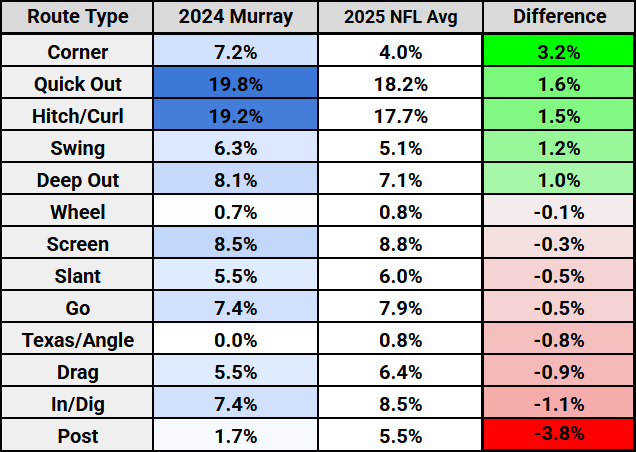
To understand what works for Murray, let’s analyze some of the Cardinals’ offensive tendencies from the 2024 season. That year, Murray posted a career-high 63.4 QBR, placing ninth-best in the NFL, directly between Patrick Mahomes and Jalen Hurts. So, it provides a solid idea of what works best for Murray.
Here is a breakdown of the route types that Murray targeted in 2024 (percentage of total pass attempts). The route types are sorted based on Murray’s target rate differential compared to the 2025 NFL average.
Data via FTN Fantasy
Now, let’s compare those numbers side-by-side with the rates accumulated by Reich’s teams from 2021-23.
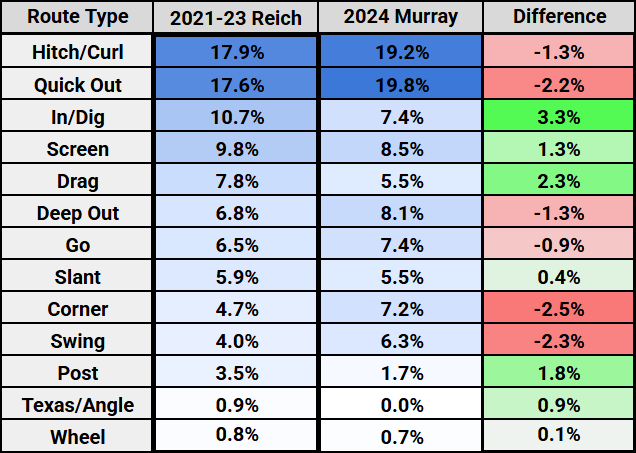
It’s not identical, but the route distribution looks fairly similar across the board. While minor differences can be seen, there are no route types in which Murray’s 2024 tendencies were drastically different from Reich’s 2021-23 schemes.
The most notable similarity is the lack of vertical shots. Reich’s teams targeted go and post routes at low rates, and Murray’s 2024 season aligned with that style.
Murray targeted go and post routes on a measly 9.1% of his attempts (once every 11 attempts), similar to Reich’s 10% from 2024-25 (once every 10 attempts). The 2025 league average was 13.4% (once every 7.5 attempts).
It shows that Reich’s offense is predicated on the short-to-intermediate game, and the same went for Murray during his successful 2024 campaign. The most common route types were slightly different—Murray particularly loved corners, quick outs, and hitches, which all break out or toward the quarterback, while Reich preferred digs and drags, which break over the middle—but the overarching intention was the same: prioritizing short and intermediate throws over deep shots.
Perhaps Reich and the Jets will see Murray as an ideal fit for the offense they want to run.
Con: Durability
A conversation about Murray cannot be had without bringing up his durability.
Murray has started just 87 out of a possible 117 games in his seven-year career. That’s just 74.3% of games, and an average of 12.6 starts every 17 games.
Just as concerning as the games missed is the effect that injuries have had on Murray’s play.
As previously mentioned, a 2021 ankle injury caused a night-and-day shift in Murray’s play. He had a 7-0 record and was the MVP favorite through seven games, but after missing three games, he posted below-average numbers the rest of the way, finishing with a 2-4 record and a blowout playoff loss.
In 2022, Murray dealt with a wrist issue in training camp that caused him to miss significant practice time, and he ended up having a poor start to the season (81.8 passer rating through six games). After Murray’s play finally began to pick up over the next three games (98.7 passer rating), he was sidelined for two games with a hamstring injury.
In his second start after returning, Murray tore his ACL. He missed the remainder of the 2022 season and the first nine games of 2023 with the injury. Murray understandably struggled over his first five games after returning (78.4 passer rating), but he finished 2023 strong once he got his legs back under him, posting excellent numbers over his final three games (108.3 passer rating).
That success carried into 2024, where Murray played a full season for the first time since his second year.
In 2025, Murray suffered a foot injury in Week 5, which cost him the remainder of his season. It has been speculated that the injury was used as an excuse for a “soft benching,” however, as Murray’s season was off to an underwhelming start.
Murray has only been at his best when fully healthy, and, unfortunately, as a 5-foot-10, 205-pound quarterback with a mobile playstyle, he is not healthy very often.
Con: Personality fit in New York
Murray’s leadership ability has been a constant discussion topic throughout his NFL career.
From an “independent study” clause in his contract (which was later removed) to criticism from his former teammates, Murray is not exactly the poster child for a pillar of an NFL organization.
Former Cardinals cornerback Patrick Peterson, who played with Murray from 2019-20, offered these scathing comments about the quarterback in October 2025:
“To me, it starts with body language. As a quarterback, a lot of guys on the team look to see how you carry yourself,” said Peterson.
“If he’s continuing to not have good energy and (not) cheering his teammates up, the team is going to continue to look the way that it’s looking. I’m sorry to say that. I know fans hate to hear me talk about Kyler Murray, but these are the things we need to see to see the team turn around, and it starts with him.”
Murray has spent his entire career in the Phoenix area, which isn’t quite the same demon as the feisty New York media market. If Murray could not stand tall as a leader in Arizona, will he be able to pull it off under the brighter lights of the Big Apple, with the pressure of a 15-year playoff drought looming over his shoulders?
Murray to New York?
Kyler Murray is a complex target for the Jets. There are some extremely appealing reasons to pursue him over other options, and there are some daunting red flags that could scare them away.
On the positive side, when it comes to on-field production, Murray is arguably the highest-ceiling and highest-floor option among the quarterbacks that New York could realistically acquire this offseason, including both the draft and the veteran market.
Murray has played like a league-average quarterback across seven NFL seasons, so the Jets can trust him to at least be a competent starter, which would be a major upgrade over their 2025 room and most of their starting quarterbacks over the last 50 years. He also offers a high ceiling as a former first-overall pick who has shown extended stretches of elite play when healthy.
For the Jets, it is promising that Murray seems to be an ideal fit in Frank Reich’s offense.
Contract-wise, it is nice for New York to know that Murray would not impose significant long-term ramifications.
The contract is problematic, though, due to the Jets’ commitments to Aaron Rodgers and Justin Fields. Without all of that dead money, Murray’s contract situation would be appealing, but it is undeniably rough to commit over $80 million in cap space to three quarterbacks in one season. The Jets would have to try to get Arizona to take on a large chunk of the money, which may also force them to give up a more valuable trade package than they’d like.
Additionally, while Murray’s on-field production is appealing when healthy, there are legitimate concerns about whether the Jets will get enough out of him to justify the investment. He is injury-prone and has not shown he can play well without pristine health.
There is also the question of whether the pressure of the New York market would be a poor fit for his personality, hampering his play and the team’s performance as a whole.
It’s tough to say which direction the Jets should lean. On one hand, the gamble could be worth it, as they have little to lose in 2026 and would not have to absorb the type of long-term risk that would prevent them from starting over again in 2027. On the other hand, there are certainly safer routes to take, which would require significantly less capital, drama, and uncertainty.
It is important to consider the situation of Jets head coach Aaron Glenn. He’s coaching for his job, and he knows it; his recent staff decisions showed as much. Glenn seems to be taking over defensive play calling, while his offensive hires leaned toward the safer, more experienced route.
Glenn clearly wants to win games from the moment the ball kicks off in Week 1. He knows an 0-4 start could be all it takes to end his head coaching run.
In that case, could Glenn lean toward an aggressive push for someone of Murray’s caliber instead of settling for a safer but less inspiring journeyman?
The Jets’ handling of the veteran quarterback market will tell us a lot about their mindset heading into 2026.