
We don’t know precisely what Frank Reich’s offensive scheme will look like with the New York Jets.
However, we can use Reich’s previous NFL stops as a guide to his philosophies as an offensive mind. His historical play-calling and schematic tendencies could indicate the skills he prioritizes in his players.
Recently, we dove deep into Reich’s coaching tendencies with the Colts and Panthers. There were plenty of fascinating takeaways, ranging from his favored run-blocking concepts to the route types that he preferred to target.
We’re going to use some of those signs to identify free agents whom Reich may encourage the Jets’ front office to pursue.
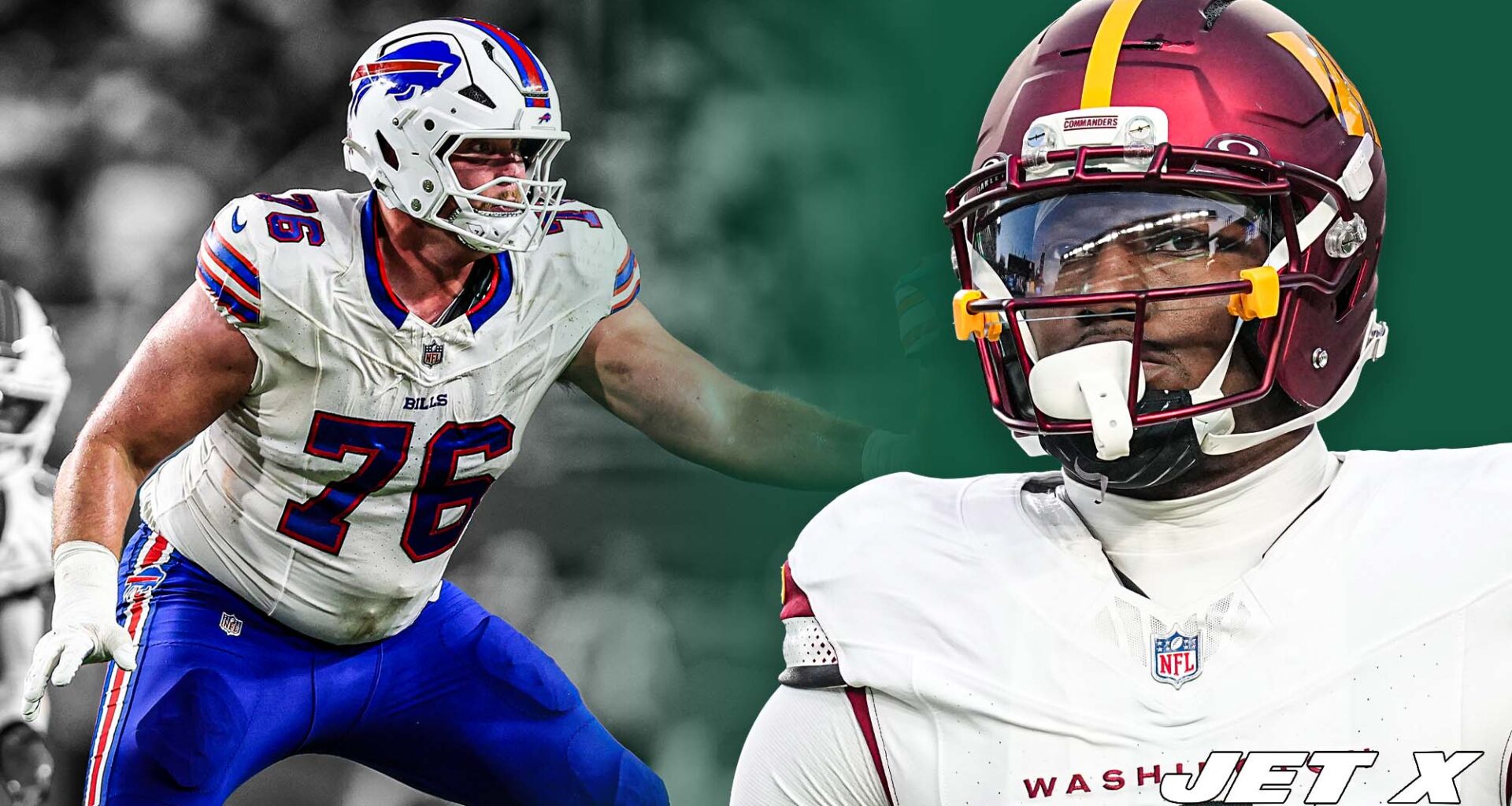
Bills G David Edwards
The Jets need at least one starting guard at the moment. Left guard John Simpson is headed for free agency after a down year.
Meanwhile, the Jets could stand to improve at center, which opens the possibility of handing the job back to Joe Tippmann, who was intended to be the starting center until Alijah Vera-Tucker’s injury forced him to right guard. That would open a hole at right guard.
Whether they target one or two starting guards, the Jets must ensure that any new additions to their offensive line have a skill set that fits in Reich’s run scheme.
At his past two stops, Reich leaned heavily on between-the-tackles run concepts. The 2022 Colts and 2023 Panthers both utilized inside zone and man/duo at high rates, while using outside zone at a rate well below the league average.

Per FTN Fantasy
That could prompt the Jets to try to poach David Edwards from their division rivals.
Edwards, who will turn 29 in March, was the starting left guard for the Rams’ 2021 Super Bowl-winning team. He spent the last two seasons as the Bills’ starting left guard, enjoying plenty of success. His production in Buffalo’s scheme is a good sign for his fit under Reich.
In 2025, the Bills’ starting running back, James Cook, led the NFL with 206 rushing attempts on either inside zone or man/duo concepts, representing 66.7% of Cook’s total carries (far above the 45.5% NFL average). Those attempts led to league-leading totals of 1,131 yards and 10 touchdowns.
Edwards was a key cog in leading Cook to his elite production. His 69.0 run-blocking grade at Pro Football Focus ranked eighth-best among left guards (min. 500 offensive snaps).
The veteran has proven he can succeed as a run blocker in an offense that prioritizes the same run concepts that Reich has historically preferred. That makes him a perfect target for the Jets, especially when coupled with his solid pass protection (73.0 pass-blocking grade in 2025).
Cowboys RB Javonte Williams
The Jets’ free agency approach at running back will depend on their handling of Breece Hall.
If New York decides to let Hall walk, they will need reinforcements in the backfield.
Javonte Williams would be a good fit.
In 2025, Williams was one of the NFL’s best backs on inside zone and man/duo carries. Between those two concepts, Williams racked up 134 carries for 605 yards (4.5 per attempt) and five touchdowns. His 11.5 EPA (Expected Points Added) on those carries was fourth-best among running backs.
Williams will not produce much as a receiver, which is a need the Jets will have to fill if Hall walks, given Reich’s historical preference for utilizing running backs in the pass game. However, the 220-pound thumper is a great fit to accumulate carries as an early-down runner in Reich’s between-the-tackles run game.
Steelers RB Kenneth Gainwell
In four of his last six NFL seasons—including each of his three most successful years in that stretch (2018, 2020, and 2021)—Reich’s offense threw at least 20% of its targets to running backs. For perspective, the 2025 NFL average was 18.2%.
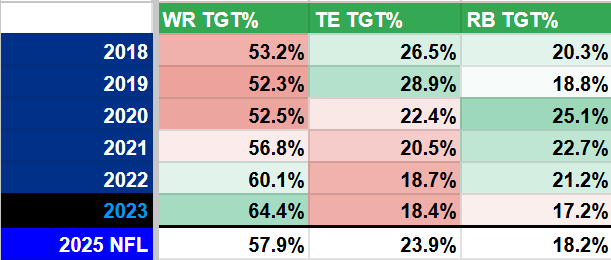
If Hall walks, the Jets’ roster will sorely lack a track record of proven receiving ability at the running back position. A player of Williams’ ilk would not fill the void, so the Jets could look to a free agent like Kenneth Gainwell to specialize as a receiver out of the backfield.
In his five-year career with the Eagles and Steelers, Gainwell has collected 41% of his career scrimmage yards through the air. This past season, that number was 48%, as Gainwell rushed for 537 yards while adding 486 as a receiver (fifth among running backs).
Over the last three seasons, Gainwell has 119 receptions and three drops, giving him an outstanding drop rate of 2.5%. His reliable hands would make a valuable piece under an offensive coordinator who likes throwing a high rate of passes to running backs.
Colts WR Alec Pierce
Alec Pierce is best known for his abilities as a vertical threat, but the Cincinnati product also developed an improved intermediate game in 2025. It was the difference that helped him improve from a player who made his impact almost solely on deep bombs to a well-rounded 1,000-yard receiver.
In 2025, Pierce caught 11 of 17 targets on dig routes for 207 yards (per FTN Fantasy). His 10 first downs on dig routes tied CeeDee Lamb, Ja’Marr Chase, and Jakobi Meyers for 14th among wide receivers.
This would bode well for him in Reich’s offense.
Across his three most recent seasons as an NFL coach (2021-23), the dig route, aka the “in”, was Reich’s favorite relative to the NFL average, based on how frequently his teams targeted it.
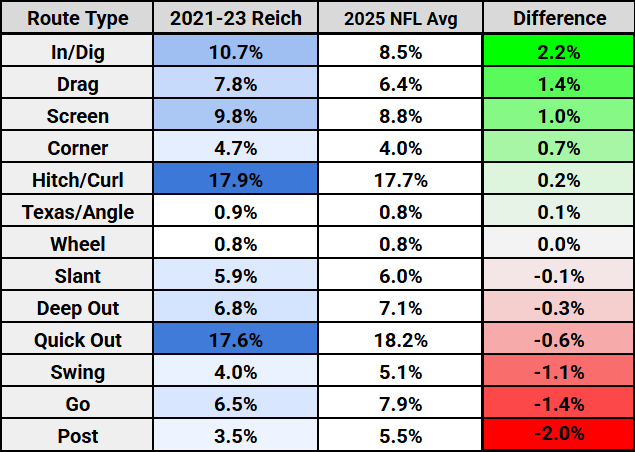
Pierce has also been successful on drag routes, which were the second-favorite route of Reich’s last three teams. In 2025, Pierce caught all six targets on drag routes for 89 yards and five first downs (tied for eighth among wide receivers). He averaged an impressive 7.5 yards after catch per reception on these plays.
Reich’s teams did not like throwing the ball vertically (go or post routes), which is Pierce’s primary strength; he was third in the NFL with 491 yards on go or post routes in 2025. This is a fair concern regarding his fit under Reich.
However, it’s not as if Reich’s teams never threw those routes. Pierce could be the Jets’ primary source of vertical offense whenever Reich does call a vertical shot, and in between those shots, his ability to win on dig and drag routes over the middle of the field would allow him to sustain a consistent impact.
The respect that Pierce commands as a deep threat is what opens up space for him to work in the short-to-intermediate area. Once corners sit on that—which is bound to happen, given how often Reich’s offense targets the middle of the field—Pierce can win with a double-move over the top.
This is the type of multi-faceted production from the WR2 spot that Garrett Wilson has never played with in the NFL.
Commanders WR Deebo Samuel
After digs and drags, Reich’s third-most favorite route type was screens. His last three teams targeted them on 9.8% of total pass attempts, a full 1% above the 2025 league average. That means Reich was calling screens about once every 10 passes.
No active receiver has done more damage on screens in their career than Deebo Samuel.
The 30-year-old is well past his days as an all-around star at the wide receiver position, but he is still one of the league’s most reliable playmakers on designed touches. In 2025, he led wide receivers with 24 targets on screens, catching 23 of them for 182 yards (7.6 yards per target).
Even at his age, Samuel remains a premier threat to make defenders miss; he ranked sixth at his position with 17 missed tackles forced in 2025. Samuel also ranked eighth with 471 yards after catch. Just don’t expect him to do much damage through the air; he was 74th with 256 yards before catch.
But the Jets wouldn’t need Samuel to be the dynamic weapon he once was. In New York’s offense, Samuel could find his niche handling the hefty diet of screens that Reich is likely to call, with a few downfield shots mixed in to keep defenses honest.
The Jets likely need three starting-caliber receivers under Reich. He has heavily relied on 11 personnel packages (1 RB/1 TE/3 WR) throughout his career. Reich’s last six teams had an average 11 personnel usage rate of 72%. At his two most recent stops, that rate ballooned to 82%.
A trio of Wilson, Pierce, and Samuel would be ideal for running Reich’s offense in line with his historical preferences. Wilson is the all-around WR1, Pierce is the deep threat who mixes in middle-of-the-field production, and Samuel is the “gadget guy” out of the slot.
Even if the Jets don’t add the exact combination of Pierce and Samuel, this model offers a sense of what Reich may want his wide receiver depth chart to look like.