
When it comes to hiring Black head coaches for its six revenue-producing teams sports, the University of Texas isn’t any better than most of the other SEC schools, according to a study conducted by the American-Statesman.

But then again, the SEC isn’t any better — or much worse — than most of the other power conferences, says Leonard N. Moore, an American history professor at the University of Texas who has written extensively on the intersection of race and collegiate athletics.
Article continues below this ad
Among the 95 coaches in the SEC at the six revenue-producing team sports during the 2025-26 school year, only 10 are Black. That makes up 10.5% of those coaching positions.
Football: 0
Volleyball: 2 (Rashina Reed, Alabama; Tonya Johnson, LSU)
Men’s basketball: 2 (Dennis Gates, Missouri; Lamont Paris, South Carolina)
Women’s basketball: 5 (Larry Vickers, Auburn; Kenny Brooks, Kentucky; Yolett McPhee-McCuin, Ole Miss; Dawn Staley, South Carolina; Joni Taylor, Texas A&M)
Baseball: 1 (Kerrik Jackson, Missouri)
Softball: 0
“Is there progress? Not really,” Moore said. “And it’s not an SEC issue; it’s a college (athletics) issue.”
But the numbers down South do stand out:
• Texas is one of eight athletic programs in the 16-school SEC that doesn’t have a Black head coach in football, volleyball, men’s basketball, women’s basketball, softball or baseball.
Article continues below this ad
• Two sports in the SEC — college football and softball — don’t have a single Black head coach.
• And Missouri and South Carolina are the only SEC schools to have more than one Black coach heading a revenue-producing team sport.
The numbers are especially glaring in football and men’s basketball, the two team sports that have a majority of Black players at a national level. According to a study by The Institute for Diversity and Ethics in Sport cited by the Associated Press in 2025, 52.1% of players at the FBS level of college football were Black or identified with two or more races. The split in men’s basketball at the Division I level was 59.6%.
Article continues below this ad
In contrast, only eight of the 68 football teams that make up the Power Four conferences have a Black head coach, or 11.8%. That number rises to 20.2% in the Power Five conferences of men’s college basketball, although Missouri’s Dennis Gates and South Carolina’s Lamont Paris are the only two Black head coaches of a men’s program in the SEC.
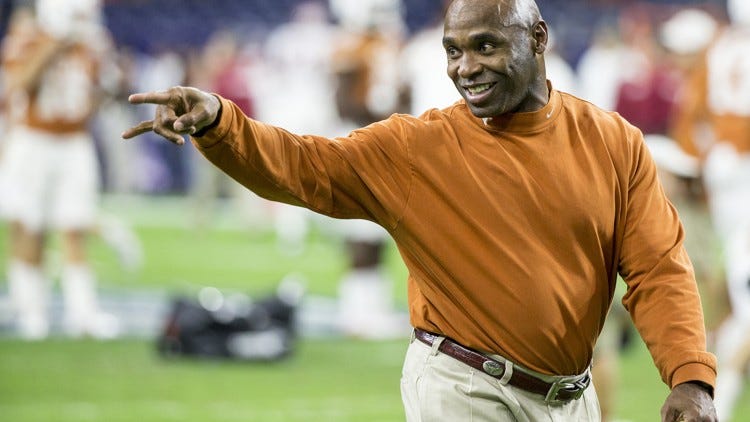
Texas Longhorns Head Coach Charlie Strong waves to a Texas Longhorns fan during pregame against Arkansas in the NCAA college Advovare Texas Bowl football game at NRG Stadium Saturday, Dec 29, 2014. (RICARDO B. BRAZZIELL / AMERICAN- STATESMAN)
Austin American-Statesman
UT professor: Booster money impacts coaching hires
Moore teaches an undergraduate course at Texas called “History of College Football” as well as a graduate-level course, “College Football and American Culture,” He’s working on his next book project called “The Ghosts of Bear Bryant: A Black Professor’s Journey Inside Big-Time College Football.”
Article continues below this ad
According to Moore, the lack of Black head coaches specifically in college football is directly tied to the impact of free-spending boosters. And it’s not a symptom of just the NIL era, either, said Moore.
“This was an issue going back to the 1900s with Princeton, Yale and Harvard,” Moore said. “I think (the boosters) have too much power. Some of them can’t get an NFL team, and they think they have some ownership at the college level. If you make a program all about the money, that’s what happens.”
That certainly seems the case considering Texas’ history when it comes to football hires. Red McCombs, one of the most prodigious benefactors in UT history who gave more than $100 million to the school’s athletic programs before his death in 2023, famously criticized the hiring of former head football coach Charlie Strong in 2014. Strong is the only Black head football coach ever hired by Texas and one of just four Longhorns Black head coaches — along with Shaka Smart and Rodney Terry of men’s basketball and Rodney Page of women’s basketball — of a revenue-producing sport.
McCombs told a radio station in his hometown of San Antonio shortly after Strong’s hire that “I don’t have any doubt that Charlie is a fine coach. I think he would make a great position coach, maybe a coordinator. But I don’t believe (he belongs at) what should be one of the three most powerful university programs in the world right now at UT-Austin. I don’t think it adds up.”
Article continues below this ad
McCombs went on to say that “we have boosters that have a lot of knowledge about the game. When we decided to go get (former Texas coach) Mack (Brown). … we had a lot of input before we went after him.”
Strong went 16-21 in his three seasons from 2014-16, the worst winning percentage of any coach in program history.
TEXAS PLAYER TRACKER: Who’s in the transfer portal, who’s declared for NFL draft
Texas Longhorns head coach Rodney Terry speaks to his team as the Texas Longhorns prepare to take on the Crimson Tide at the Moody Center, Feb. 11, 2025.
Sara Diggins/American-Statesman
Could Rooney Rule ever work in college athletics?
So, how can Texas and other schools across collegiate athletics increase the number of Black head coaches, both in football and the other revenue sports? Moore says incremental steps will help.
Article continues below this ad
According to Moore’s research, Black head coaches roughly get paid the same as their white counterparts but often lack the “behind-the-scenes” support such as increased spending for recruiting and player contracts as well as competitive salaries for support staff.
Moore also likes a collegiate athletics version of the NFL’s ”Rooney Rule,” which requires teams to interview at least one Black candidate for any head-coaching opening. But Moore understands that such decisions can only come from school presidents and “encouraged” by league commissioners, such as Greg Sankey of the SEC.
Currently, the West Coast Conference’s “Bill Russell Rule” stands out as the only such program in college athletics, said Richard Lapchick, the founder of The Institute for Diversity and Ethics in Sport at the University of Central Florida. The WCC does not compete in football.
Article continues below this ad
When it comes to football, Moore said the dearth of Black coaches at the coordinator level may be the biggest reason for the lack of head coaching opportunities.
“Black dudes aren’t getting coordinator jobs anymore,” Moore said. “And that’s the quickest way to a head-coaching job. Let’s have a level playing field and let the best man win the job. But African American coaches aren’t getting that.”