

In some recent milestone moves across state lines from major players like the Kansas City Chiefs and Lockton, Johnson County has seemed to come out on top.
Though the Chiefs’ new $3 billion domed stadium is going to Wyandotte County, the team’s training center and headquarters complex is slated to come to Olathe, near College Boulevard and Ridgeview Road.
On top of that, insurance brokerage Lockton plans to leave its longtime home on the Country Club Plaza for a new space in Leawood near College Boulevard and State Line Road.
But these moves and others, experts and local leaders suggest, threaten the stability of a truce that sought to end the economic border war in the Kansas City metro area, which for years before its institution in 2019 saw Kansas and Missouri forgo millions in tax revenues to incentivize the relocation of mostly existing jobs within the region.
The stakes are high for Johnson County and its cities, as winners in recent incursions, who have the most to gain — or the most to lose — if the truce is off.
Experts warn such infighting within a metro area like Kansas City’s is unlikely to benefit either state. In fact, it could harm the long-term economic growth that the region has shared in over the life of the truce.
“I don’t know who it benefits if we’re moving from one city to another,” said Stephanie Meyer, Leawood Chamber of Commerce president and CEO. “I do think the back and forth gets a little bit counterproductive.”
At the same time, as local leaders lament the crumbling of the six-year border war truce, some of those same officials are positioning their communities as the right place to do business.
Economic “border war” cost KS and MO $330M+ in tax revenue
 The HCA Midwest Health corporate office in Overland Park. Photo credit Kaylie McLaughlin.
Before the 2019 truce, major employers and corporate headquarters frequently relocated back and forth between Kansas and Missouri, primarily in metro communities close to the border, including Johnson County.
For instance, movie theater giant AMC relocated from Kansas City to Leawood, Waddell & Reed pledged to leave Overland Park for a new downtown Kansas City office building (though a subsequent merger scuttled those plans), and HCA Midwest moved its offices just a few miles from Kansas City to Overland Park.
During that period in the 2010s, the Hall Family Foundation found the two states had forgone around $330 million in tax revenue in all that wooing, which resulted in few, if any, new jobs and little to no real economic growth.
Before the two states formalized the truce in 2019, Kansas and Missouri’s years-long economic border war in the metro area made national headlines.
It was even mentioned in a 2017 episode of HBO’s “Last Week Tonight” as a particularly egregious example of faulty economic development schemes that did little to benefit the communities that offered them. The segment pointed out that as the two states were luring businesses in the metro back and forth across the state line with subsidies intended to support job creation, but had the practical effect of simply relocating existing jobs within the metro.
“That isn’t creating jobs anymore than moving your couch from the bedroom to the living room is creating f***ing furniture,” comedian and host John Oliver said.
Expert calls wooing deals “wasteful, inefficient and ineffective”
 State Line Road near 97th Street in Leawood. Photo credit Kaylie McLaughlin.
Multiple attempts to call a truce were unsuccessful over the years, including a Missouri-led attempt in 2014 that Kansas ultimately did not reciprocate.
Eventually, in 2019, an agreement was reached, designed to stop the use of state-level incentives for luring corporations from one state to the other in the Kansas City area, and led by two relatively new governors from opposing political parties: Kansas Gov. Laura Kelly, a Democrat, and Missouri Gov. Mike Parson, a Republican.
At the time, national experts like Amy Liu, a scholar from Brookings Metro — the local-focused policy program at the nonpartisan Brookings Institution think tank — referred to the truce as a common-sense approach to regional economic growth.
Now, as the truce shows signs of crumbling and cross-border competition heats back up, Liu warns that there’s more to lose than to be gained.
“Using tax breaks just to move a sports team or a company back and forth across the state line has no net benefit to the region’s economy,” she told the Post in early 2026. “It’s just well understood that tax subsidies for attracting businesses are wasteful, inefficient and ineffective because that is not how an economy grows.”
She said, if the region wants to be situated to attract growth and opportunities in a changing economy with evolving industries, it should be careful how it spends its economic development energy.
“The metropolitan area needs to think about how it’s situated in the U.S. economy, and therefore it needs to spend more time thinking about how it competes, perhaps against other U.S. regions or international economies, versus trying to compete against itself,” she said. “It’s a waste of energy to fight across a state line.”
At the same time, Liu said the private sector bears some of the responsibility, too.
“The private sector should not be pitting governments against each other to gain more tax benefit when they … were going to stay in the region anyway,” she said, referencing corporate offices that have bounced back and forth across the state line over the years.
Officials from the Olathe Chambers of Commerce declined the Post’s request to comment.
Economic border war tensions have been heating up
 Mayor Quinton Lucas (center) of Kansas City, Missouri, greets attendees at a 2024 World Cup kickoff event in Overland Park. Photo credit Leah Wankum.
All that said, the 2019 truce agreement itself may very well be dead following a series of events late last year.
Missouri’s part of the deal — enacted by the state legislature — came with a 2025 expiration date, which came and went last year without a renewal. Subsequently, the Kansas City City Council voted unanimously to repeal its consent to the truce in September, ending that city’s participation in the formal agreement.
(On the Kansas side, Gov. Kelly enacted the truce agreement through an executive order, and it did not require the approval of the state legislature.)
In the background of all of this, economic border war tensions seemed to heat back up in 2024 and 2025 as Kansas and Missouri vied for the favor of the two professional sports teams.
Ultimately, Kansas convinced the Kansas City Chiefs to move to the Kansas side with a special incentive package that’s poised to pay for an estimated 60% of a new multibillion-dollar development project, including a $3 billion domed stadium in Wyandotte County and a $300 million training facility in Olathe. (The fate of the Royals’ search for a new home for a future ballpark is still unclear, though the prospect of the team coming to Kansas looks increasingly unlikely.)
Additionally, Lockton announced its plans to make the jump across the state line to Leawood’s Hallbrook North development from its current home at the Country Club Plaza in Kansas City, Missouri, buoyed by a historic $150 million incentive package from Leawood that includes the first-ever promise of a Tax Increment Financing district in that city.
Ron Lockton, the brokerage’s CEO, cited a need for more space to grow as the company looks toward its future, among other factors, that led to the decision to move to Leawood’s Hallbrook North development at State Lane Road and College Boulevard.
Shortly after the move was announced, Kansas City Mayor Quinton Lucas said he was “disappointed by the misplaced confidence many of us had” in the border war truce.
 A conceptual rendering of a new Lockton headquarters at Hallbrook North in Leawood, on the northwest corner of College Boulevard and State Line Road. Image courtesy Lockton.
“Regionalism cannot be one sided. The region will only thrive when we look to grow the pie, not rearrange pieces on the chess board,” he said.
Later, in a subsequent interview with the Post, he said he sees the Chiefs deal, like the Lockton move, as a violation of the original truce agreement, though Kansas officials have denied that the Chiefs and Royals were ever part of the truce.
“There are people that can make money from moving entities around,” Lucas said. “I think it’s up to the body politic to decide the extent to which they want to support or not that type of behavior.”
Lucas said he sees the way some people or businesses can benefit from these sorts of deals — through financial gain and even political favor in particular — is part of why “it’s been very hard to root out this type of behavior” that has the two states competing with each other in their shared metro area.
“It’s a competitive space, and I’ve generally always had the view Kansas City, Missouri, has to try to be the best place to do business, whether it’s competing with somebody who is across the street, across the state or across the world,” Lucas said. “We’re all going to make sure that we live within that reality and ensure that we’re all ready for what is a long-standing competition.”
“You’re just moving the puzzle pieces”
 Stephanie Meyer, CEO and President of the Leawood Chamber of Commerce. Photo credit Kaylie McLaughlin.
Meyer, from the Leawood Chamber of Commerce, said the realities of an economic border war can be challenging for communities right on the state line, particularly smaller cities like Leawood.
“It’s something that we interact with every day,” she said.
However, she stressed that her organization is focused on “a strong community competitive value, and not just shifting jobs across the state line one way or another.”
She said Lockton’s decision to move to Leawood was not about one metro city taking a big employer from another, but instead keeping a company with long-rooted connections to the Kansas City area in this region.
“I think they were perhaps looking for a place where they can have a little more control over their future in terms of their growth,” Meyer said. “I wouldn’t be surprised if that included some outside of the Kansas City metro locations.”
(Meyer said her organization didn’t approach Lockton about leaving their current home in Kansas City, Missouri, nor did the city of Leawood.)
So, from her perspective, the company’s planned move is good for the region.
“We were able to keep one of the best, brightest, largest companies in Kansas City, in the metro area, and I think that that really benefits everyone,” she said.
Meyer, who previously served on the Shawnee City Council, said she remembers a time when cross-border wooing of corporate headquarters and major employers was “problematic.”
“I think that’s a tough game to get into when you’re just not really creating new net jobs, but you’re just moving the puzzle pieces as it were,” she said, which is why she supports a truce, formal or informal.
As for the Chiefs’ deal, which moves the team to Kansas with a new Wyandotte County stadium and an Olathe headquarters and training center, some worry that it might be good for Kansas but bad for the region.
“It’s a big get to bring the Chiefs over to Kansas, and I think it will have positive economic impacts for the state as a whole, despite us giving up quite a bit,” said Kansas House Rep. Rui Xu, a Westwood Democrat. “I think for the region, it’s unquestionably bad.”
For one thing, the new location doesn’t make much of a difference for his constituents in northeastern Johnson County, who are likely to have about the same drive time to the new stadium as they do to Arrowhead Stadium in Jackson County, Missouri.
“It’s just really bad practice to use tax incentives to, especially across state lines, to lure companies to one side or the other,” Rep. Xu said. “It’s just kind of a race to the bottom in terms of offering more and more tax incentives to draw over companies, and that doesn’t benefit anybody, least of all the taxpayers.”
Liu from Brookings Metro agrees that such moves aren’t usually a benefit for an entire region. In a metro such as Kansas City’s, where the two states have virtually equal geographical footing and derive around half of their respective economic outputs from this area, competing with each other like that is nonsensical, she said, since there’s a “shared interest in seeing the Kansas City region economy grow.”
“The way a regional economy grows is not by moving jobs and investments around a region, but to grow the economic pie,” she said.
Still, local officials in Johnson County feel it’s only natural that some businesses will still want to move from one side of the border to the other based on their specific needs. In Johnson County Chair Mike Kelly’s eyes, that doesn’t need to change anything.
“We don’t seek Missouri businesses out particularly, so regardless of the actions that may or may not have been taken across State Line, it’s business as usual in Johnson County,” he said. “I think as a result of so much economic success, that it stands to reason that some companies do want to look at Johnson County as an investment location for their company’s future.”
Now what?
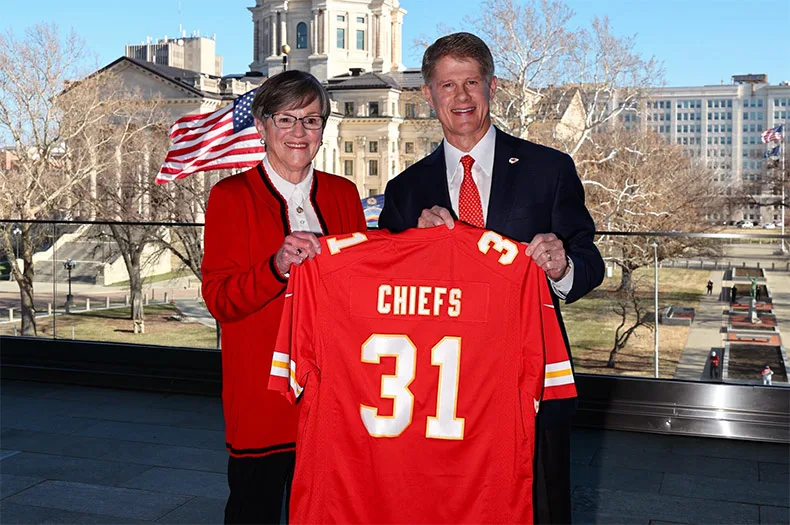 Kansas Gov. Laura Kelly and Chiefs owner Clark Hunt in Topeka on Monday, Dec. 22, announcing the team’s move to Kansas. The “31” on the jersey represents the year 2031, when the team is expected to being playing games at its new home stadium. Photo courtesy Gov. Kelly’s office.
Even though Missouri’s half of the truce agreement has ended — and its state lawmakers have shown little interest in renewing it — a spokesperson for Kansas Gov. Kelly’s office said she “intends to stand by the parameters.”
“Governor Kelly recognizes the truce’s positive impact on the entire Kansas City metro region, and Kansas has transcended it by attracting international business investments from companies like Panasonic,” the statement continues.
Even Mayor Lucas from Kansas City said he wants to see the spirit of the truce remain intact, even if the formal agreement is now dead.
“We can separate on some of the issues; business attraction and some of the politics surrounding it,” he said. “But, look, I still believe that Kansas City is a region that works together regardless of the laws that have been changed or the taxpayer giveaways that are kind of shifting commercial activity from one end of the metro to another and back.”
He’s hoping regionalism can still win out in the end.
“We need a strong core city to ensure that this region can grow long term,” Mayor Lucas said. “We need to make sure that we’re all growing. We need to make sure that this region recognizes that every one of its parts needs to be on a crescendo towards greater progress.”
Liu offered a similar assessment, pointing out that if the core city is weakened, surrounding cities can still grow but can expect to see that growth plateau.
“Even suburban Johnson County is really dependent on the health and vitality of the core city,” she said. “The cities and suburbs have a lot of stake in ensuring each other’s success.”
County Chair Mike Kelly agrees, pointing out that none of these communities “exist in a vacuum.”
“The success that we’ve seen in Johnson County is dependent upon a successful Kansas City, Missouri and vice versa,” he said. “This is a metro region that rises and falls together, and I think that still remains everybody’s focus.”
Keep reading: ‘The numbers are just not credible’: Kansas used flawed math to estimate economic impact of Chiefs relocation, experts say