
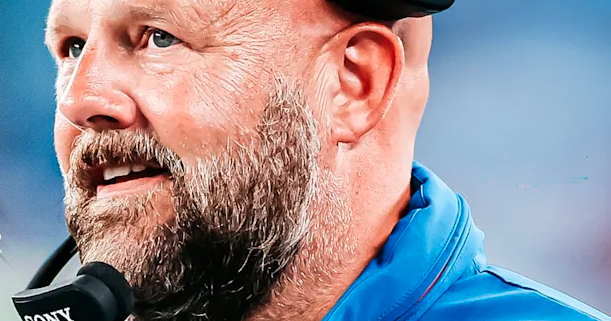
The Tennessee Titans have turned to a veteran offensive mind in hopes of jump-starting their offense: Brian Daboll.
Daboll brings more than two decades of coaching experience and a track record of developing quarterbacks. For a Titans team building around quarterback Cam Ward, that background could prove critical.

Brian Daboll
Photo: Tennessee Titans
Daboll began his NFL career in 2000 with the New England Patriots under Bill Belichick. During two separate stints in New England, he was part of multiple Super Bowl-winning staffs. Rather than running a rigid system, Daboll built his reputation on tailoring game plans to personnel.
He went on to coordinate offenses in Cleveland, Miami and Kansas City before spending the 2017 season at the University of Alabama. There, he helped guide the Crimson Tide to a national championship.
Daboll’s most notable NFL success came with the Buffalo Bills. As offensive coordinator from 2018 to 2021, he played a huge role in the development of quarterback Josh Allen.
When Allen entered the league, he was viewed as a raw but physically gifted prospect with accuracy concerns. Daboll and the Bills built an offense that emphasized Allen’s strengths: designed quarterback runs, deep play-action shots and simplified reads that allowed him to play fast.
By 2020, Allen had become an MVP candidate and Buffalo boasted one of the league’s most explosive offenses. Daboll was named the Associated Press NFL Assistant Coach of the Year that season.
That experience is particularly relevant for Ward.
Like Allen coming out of college, Ward entered the NFL known for his arm talent, creativity and off-script playmaking ability. He thrives when extending plays and attacking downfield. But like many young quarterbacks, he will face an adjustment period as defenses become faster and more complex. Daboll’s history suggests he can help smooth that transition.
One of Daboll’s strengths is building structure around a quarterback without detracting from his natural instincts. In Buffalo, he gradually expanded Allen’s responsibilities while keeping the offense aggressive. In New York, during his time as head coach, Daboll leaned into Daniel Jones’ mobility and used movement-based concepts to simplify reads and create defined throwing windows.
For Ward, that could mean an offense that uses play-action, simpler reads and designed rollouts to take advantage of his strong arm. Daboll often uses motion before the snap and different formations to create better-than-otherwise matchups, which can help a young quarterback to read a defense and make quicker decisions.
Daboll’s hiring also pairs him with new head coach Robert Saleh, who is widely regarded as a defensive-minded leader. Saleh built his reputation on the defensive side of the ball, most recently as the San Francisco 49ers’ defensive coordinator. His background differs from Daboll’s offensive focus, creating a complementary dynamic on the Titans’ staff.
With Saleh overseeing the defense and overall culture, Daboll can devote his full attention to developing Ward and shaping the offense. The contrast in their expertise could provide Tennessee with balance on both sides of the ball.
The Titans have traditionally leaned on a physical run game, but the modern NFL requires explosive plays and efficient quarterback production. Daboll’s arrival signals a potential shift, one centered on adaptability and development at the game’s most important position.
If he can replicate even part of what he accomplished with Allen in Buffalo, Tennessee’s offense, and Ward’s trajectory, could look drastically different in the years ahead.