
While Cleveland prepares for life with an NFL stadium in the suburbs, a city less than 200 miles away provides a roadmap of what that will be like.
CLEVELAND — To Al Wolf Jr., football isn’t just a sport — it’s a timeline of memories.
“This area is a very strong professional football base,” he says. “Believe it or not, I go back to Jim Brown, (Gene) Hickerson, (John) Wooten, Bernie Kosar. You know, that’s my era.”
Now, the city he calls home — just 18,000 people — is preparing for a transformation: A $2.4 billion domed stadium for the Cleveland Browns will soon rise in Brook Park, only a stone’s throw from Wolf’s backyard.
“There’s going to be minor glitches, you know?” he admits. “But I feel overall, it’s going to be a good thing for everybody.”
For fans like him, the game-day atmosphere is coming closer than ever. But for downtown Cleveland, the shift marks the start of a very different reality.
Bracing for change
A city less than 200 miles away — Buffalo, New York — already knows what it’s like to have an NFL stadium in the suburbs.
With the home of the Buffalo Bills having stood in Orchard Park since 1973, Bills fans have already lived the stadium-in-your-backyard experience for decades. Kim Kaliszewski, a self-described “die-hard,” knows it well.
“It’s electrifying. Everybody on my street has Bills flags around,” Kaliszewski said. “The atmosphere of living here is energetic.”
Her home is walking distance from Highmark Stadium, where tailgating stretches as far as the eye can see.
“I can’t sleep because … I can’t wait to get to the stadium,” she said.
Kaliszewski’s experience shows that living next to a stadium is not just about football — it’s about community, family, and day-to-day planning.

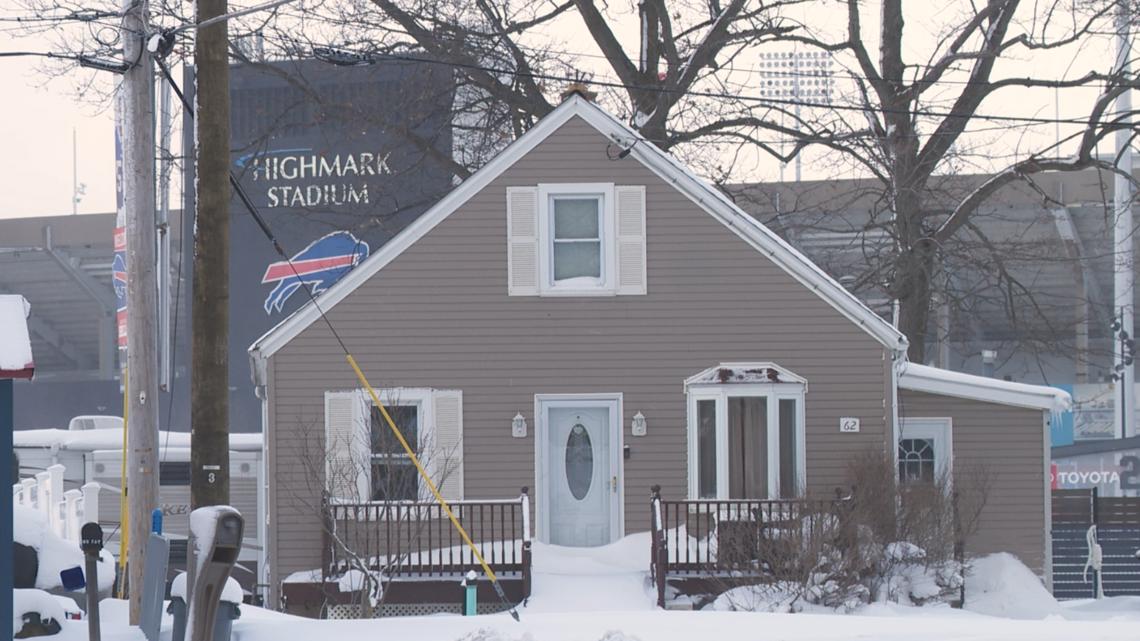
“You have to figure out traffic, pedestrian flow,” she explained. “It’s a big adjustment.”
On Jan. 4, the Bills played their final game at their current home, but will move into a brand-new, $2 billion Highmark Stadium just across the street beginning with the 2026 season. Orchard Park Town Supervisor Joe Liberti has been part of planning discussions for the facility and addressing fan concerns, namely traffic and noise.
“When there’s a game day, try to do everything beforehand, because traffic, it’s heavy,” Liberti told 3News. “What we try to do is hedge that off with our local police and the sheriffs as well to help kind of mitigate traffic, the noise …. I don’t know what we can do about the noise, because our fans are loud.”
Still, Liberti believes it’s all worth it.
“I think we’re blessed to have a(n) NFL stadium right in our backyard,” he said. “There’s not a lot of towns that can say that.”

A guide for Brook Park
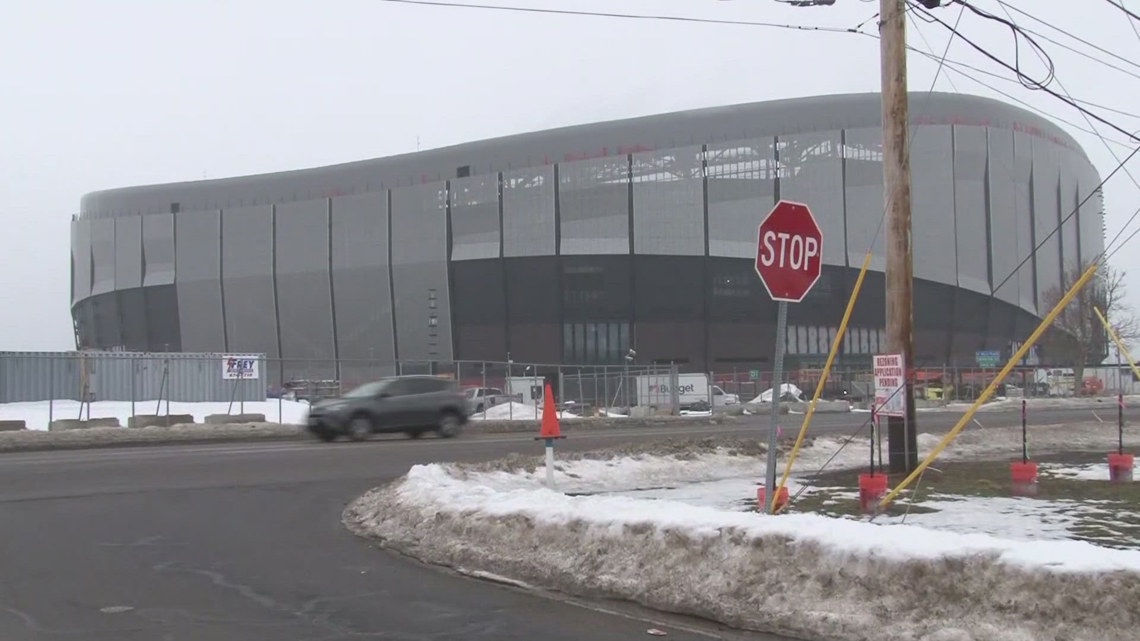
Over in Cleveland’s west-side suburbs, Brook Park Mayor Ed Orcutt is preparing for that same reality, and taking note of how other communities are handling it.
“We’ve met with the folks in Orchard Park, New York; Foxborough, Massachusetts (where the New England Patriots play). We’ve been with the folks down in Glendale, Arizona (where the Arizona Cardinals play), so there’s been a lot of collaboration,” Orcutt said in an interview. “It’s been exciting for us to be able to be a part of this, but a lot of work.
That work also includes planning for the traffic, with six proposed projects including widening roads and keeping residents who live close by (like Al Wolf Jr.) in mind.
“We will be blocking off some streets so that there will be no cut-through traffic there,” Orcutt explained. “We’re also going to work on amending laws when it comes to parking on the streets. We don’t need people in our neighborhoods parking and then walking to the stadium.”
PHOTOS: February 2026 renderings of new Cleveland Browns enclosed stadium in Brook Park
A new era for downtown
Back in Cleveland, Mayor Justin Bibb has said a $100 million settlement with Haslam Sports Group will help push lakefront redevelopment forward and clear the way for a new direction — including plans to demolish the current Huntington Bank Field. For downtown restaurants and bars, however, losing those games will leave a gap.
“Browns Sundays are huge for us,” Noble Beast Brewing Co. owner Shaun Yasaki said. “(It’ll be) a big loss for all business owners down here in the near term to lose that.
If downtown Cleveland is wondering what life after the stadium will look like, Buffalo offers a roadmap.
The Bills left Buffalo proper for Orchard Park more than 50 years ago, and while a new downtown stadium was considered, it never happened. With the NHL’s Sabres being the only major sports team downtown, local businesses have had to learn to survive — and even thrive — without the NFL crowds.
“When we’re busy down here, we’re really busy down here,” said longtime downtown Buffalo business owner Jay Manno. “We’re very event-driven.”
Manno admits its “not as easy as it used to be,” but even without the Bills, Buffalo’s downtown didn’t die. Rather, it adapted.
“Without the arts, the sports, and the cultural stuff, we would be lost,” Manno added.
“Fill up your downtown and (do) everything you can do between now and then, right? Use it as much as you. You know, use it or lose it.”
“Make the most of what you have. Fill up your downtown, use it as much as you can. Use it or lose it.”
Two cities, two different approaches
As Brook Park looks ahead to 2029, there’s excitement building. As Orcutt says, it’s a comeback for the city.
“It’s everything. It’s who we are as a community,” the mayor said. “Brook Park’s a proud town.”
“There was a time when you said you lived in Brook Park, you didn’t say it very loud,” Wolf told us. “Now you go, ‘I live in Brook Park!'”
And as Cleveland charts its next steps and prepares for a gap, Buffalo shows that a city’s heart can keep beating — even without an NFL stadium — through culture, events, and community.