
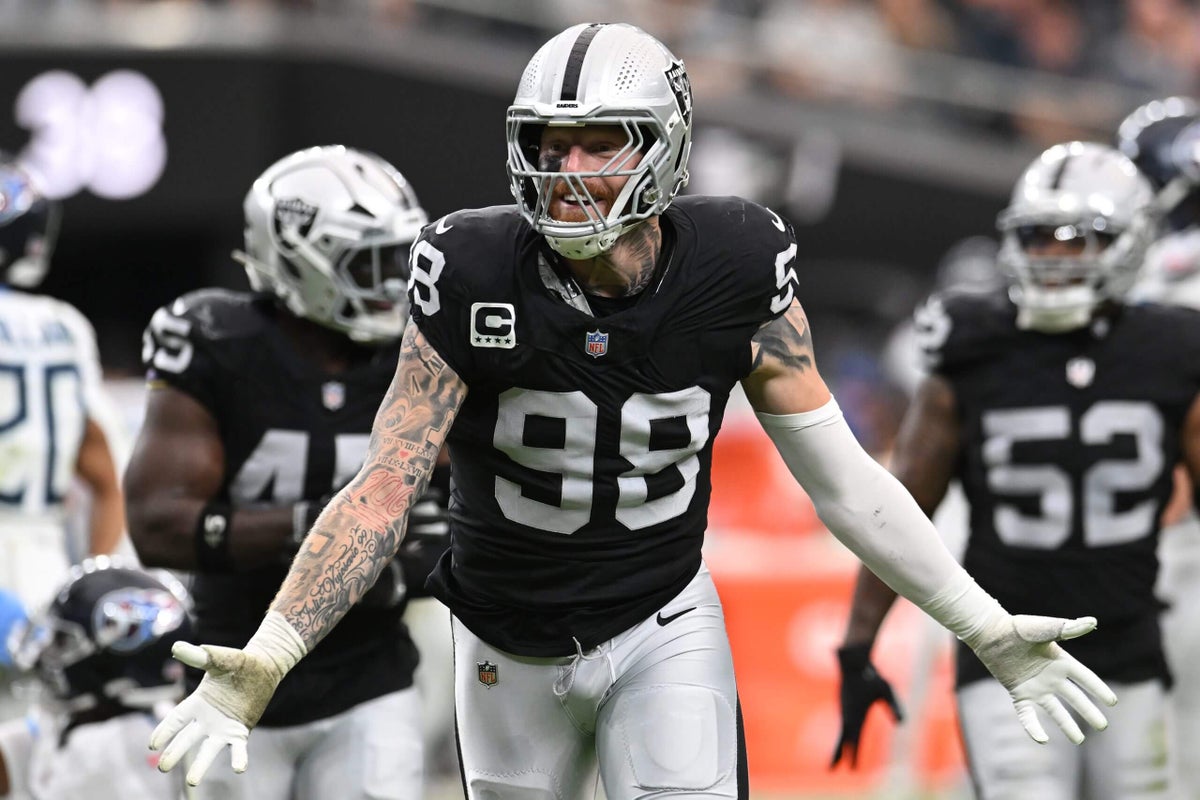
Cincinnati Bengals legend Andrew Whitworth relayed his message to his former team clearly on the “Fitz & Whit” podcast this week.
“Go get Maxx Crosby at all costs!” he said.
Sounds great, right? The grand prize of the offseason should be on every team’s radar, and specifically one rebuilding one of the worst defenses in the NFL over the last three seasons.
These plans and dreams are what February is for in the NFL. Add a star to the biggest point of frustration on the team and take a bow.
Cincinnati has cap space and a quarterback who has said he’s willing to restructure his contract. The price for acquiring Crosby would be significant. Remember, the Green Bay Packers sent two first-round picks and Kenny Clark to the Dallas Cowboys for Micah Parsons right before the 2025 season. Parsons would be a level above the 28-year-old Crosby as a player, but not by enough to go much below that cost.
The Bengals make one of the most interesting cases for Crosby because of where they are organizationally, positionally and financially.
There’s also an intriguing case to be made to not do such a deal. Here’s a deeper look at the argument both for and against acquiring Crosby.
For
Turn on the tape. Witness the energy. Check the analytics. Listen to him talk.
What’s not to like?
Every defense and team dreams of a player like Crosby. He never wants to come off the field, loves winning, is loyal to his teammates and leaves every ounce of effort on the field. His relentless play style immediately earns the respect of opposing coaches and influences all those around him.
How could a young player like Shemar Stewart slack in practice when watching the effort Crosby brings every day? De facto GM Duke Tobin said he’s seeking pass rush and leadership this offseason, and Crosby lives at the top of the list for both.
Tee Higgins and Ja’Marr Chase were both recruiting him on media row during the Super Bowl.
The excitement his presence would bring to the team, building and fan base would be unmatched by any potential move this offseason.
In terms of production, he’s the complete package. Crosby ranks sixth in total sacks (44.5) over the last four seasons. He also leads the NFL in tackles for loss (excluding sacks) over that span with 49. The next highest number from a defensive lineman is Myles Garrett with 34.
Compare that factor with Trey Hendrickson, who could rush the passer and close games as well, if not better, than anyone in the NFL (wildly valuable, obviously), but that’s where his splash plays ended.
Sacks & TFL (excluding sacks)
Year
Crosby
Hendrickson
2022
12.5 & 12
8 & 2
2023
14.5 & 9
17.5 & 4
2024
7.5 & 10
17.5 & 3
2025
10 & 18
4 & 0
TOTAL
44.5 & 49
47 & 9
Crosby racked up twice as many TFL excluding sacks this past season as Hendrickson did the last four years combined.
His down-in, down-out effort and production against both the run and pass adds another element of disruption that Hendrickson never tapped into, even if Hendrickson was a better pure pass rusher in terms of win percentage and pressure rate over the course of his time in Cincinnati.
How many games would the Bengals have won last year with Hendrickson or a presence like him? Their inability to finish games was the difference. Crosby would allow the Bengals to turn back the clock on that skill at only 28 years old, compared to Hendrickson, who turned 31 this past December.
It would probably require the draft’s No. 10 pick to make this happen. If there were ever a year to make that sacrifice, this would be the one. There are few true blue-chip prospects, so the idea of using that valuable asset to acquire a game-changer like Crosby in a win-now season for this regime makes more sense than most years.
Crosby projects to have more impact over the two years remaining on his contract than anyone the Bengals would take at No. 10.
Want to go all-in for 2026 and send a message to the rest of the team — specifically, the big three of Joe Burrow, Chase and Higgins — that this is a team dedicated to a Super Bowl run in its prime? That’s the move.
Against
One of the big mistakes of the 2025 season was a failure to deal Hendrickson and use the trade compensation and freed-up money to acquire starting players across every level of a rebuilding defense. The Bengals never raised the floor. Thus, they reached in the draft to fill spots, played two rookie linebackers next to each other, and when that one valuable piece got injured midseason, the Bengals were ill-equipped to slow a professional offense.
In many ways, the same task remains in front of them this offseason. They must find starting players at every level of the defense. They need a dependable safety, veteran linebacker and multiple pass rushers.
If the Bengals went after Crosby, they could be making the same mistake as last season, only in reverse. Rather than holding onto the player at the expense of depth across the defense, they would be acquiring one at the expense of depth across the defense.
If the team were willing to do something it has never done (restructure a contract for cap space) and still add depth at all three levels while acquiring Crosby, that would be a different story.
The broader point is that ensuring starting-level additions across the defense must be the top priority. There needs to be concern about raising the floor more than the ceiling. Feel free to do both, but the Bengals can’t go forward with bargain replacements in the starting lineup, trotting out Barrett Carter and Demetrius Knight again or not finding an interior pass-rush complement.
There’s extreme value in adding complementary pieces to this group, along with the potential growth of a collection of young draft picks around them. That’s the method they used in 2020 and 2021 to successfully build the defense. The path is available to do so again.
There’s clear danger in leaning further into a top-heavy roster, which the Bengals experienced last year with one of the most top-heavy in the NFL. They already have $101 million in 2026 cap space (33 percent) tied up in their top three players. None of the top teams from last season were built that way.
Eight teams employed a player who counted at least $40 million against the cap. One made the postseason (Rams, Matthew Stafford).
Last year, the Bengals employed four players with a cap hit of at least $23.5 million (Burrow, Higgins, Chase, Hendrickson). The final four teams in the playoffs combined for just two: Stafford and Denver’s Mike McGlinchey ($23.8 million).
Keeping a focus on a more reasonable second tier while adding more defensive draft picks (including 10 overall) adds insurance against one or two injuries crushing a team’s plan, as well as spreading a higher talent level across each position group.
There are few moments in the season of an NFL fan better than the acquisition of a premier player, especially if it came out of character, as this would for the consistently conservative Bengals. That doesn’t mean it would deliver what matters most: A better defense and a championship.
There’s value in a less sexy, more calculated approach, given where the Bengals are in the defensive roster build. The same way that there’s value in the excitement, juice and leadership that would arrive if the Bengals made a big move like this for Crosby.
It’s important to understand the argument for both as the critical month of March approaches.