
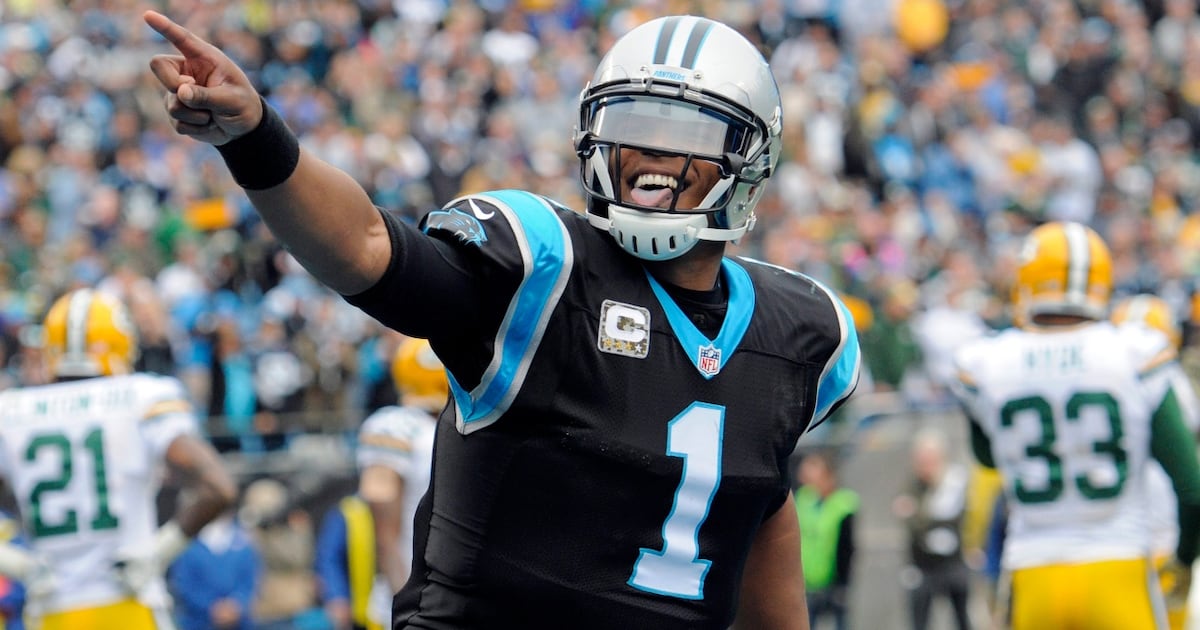
CHARLOTTE, N.C. — The energy Cam Newton brought on Jan. 10, when he was introduced before the Carolina Panthers’ first playoff game at Bank of America Stadium since the 2015 Super Bowl season, was a reminder of all he embodied during his NFL career.
Loud. Proud. Over the top.
The boisterous response of the crowd, from the time Newton struck the “Keep Pounding” drum to when he did his trademark Superman celebration, was a reminder of just how much he meant to the city, region and league for most of his 11 seasons.
Newton is the most iconic quarterback in Carolina history, and for many years he was the trendsetter in the NFL. As Mark Anthony Green, the former “style guy’’ for GQ Magazine, said during Newton’s 2015 MVP season: “Cam’s [clothing] style is a lot like his style of play. … It’s brash.’’
The question is whether Newton’s brash style as a dual-threat quarterback will translate into being selected for the Pro Football Hall of Fame in 2027, his first year of eligibility, or soon after that.
There is no doubt in the mind of the coach who made Newton the No. 1 pick of the 2011 draft.
“The biggest thing is he transformed the way quarterback is played by the athletic-styled QBs,’’ said former Carolina coach Ron Rivera, now the general manager at Cal.
“What I mean is it just wasn’t our RPOs [run pass options] or zone-reads that we ran with Cam. We incorporated a lot of pro-style, as well. You look at his first seven seasons, and his success was as comparable as Aaron Rodgers or Drew Brees. Unfortunately, we didn’t win the Super Bowl, and he hurt that shoulder.’’
Rivera hit on two of the three drawbacks to Newton’s HOF candidacy. The Panthers lost Super Bowl 50 to the Denver Broncos in large part because Newton was strip-sacked twice, leading directly to 14 points in the 24-10 loss. On the second fumble, Newton didn’t attempt to jump on the ball, something the 6-foot-5, 245-pound player said he had “no excuse’’ for.
Then there was the shoulder injury suffered in December 2016 that ultimately shortened his career to eight productive seasons. He wasn’t effective after 2018 and played his last down in 2021, Carolina’s final playoff appearance before last season.
The third drawback is Newton’s overall record. He was 69-63-1 as a starter during the regular season, 3-4 in the playoffs.
There is still a strong case to be made for Newton going into the Hall of Fame. He won Offensive Rookie of the Year in 2011, NFL MVP in 2015 and reached the Super Bowl that season.
He is one of nine players to win an MVP and Rookie of the Year (offense or defense), according to ESPN Research. All six who are eligible — running backs Marshall Faulk, Emmitt Smith, Barry Sanders, Marcus Allen and Earl Campbell as well as outside linebacker Lawrence Taylor — are in the Hall. Running back Adrian Peterson will be eligible with Newton on the ’27 ballot. Former Atlanta quarterback Matt Ryan will be eligible in 2028. The six who are in the Hall also reached a Super Bowl. Four won one.
Newton was the first NFL rookie to pass for more than 4,000 yards. His 75 career rushing touchdowns rank second among quarterbacks, trailing Josh Allen (79) of the Buffalo Bills. Newton’s 5,628 career rushing yards are the third most by a quarterback, trailing Lamar Jackson (6,522) and Michael Vick (6,109). He is one of two players with at least 30,000 passing yards and 5,000 rushing yards. The other is Russell Wilson, who has 46,966 yards passing and 5,568 rushing.
“Winning league Rookie of the Year and winning NFL Player of the Year are all huge accomplishments,’’ Rivera said. “He did it at a time when people didn’t understand who he was for the league.
“He was definitely a trendsetter and somebody that people wanted to emulate. We’re seeing that now in Josh Allen, and how he plays’’
As for not winning the Super Bowl, there are plenty of notable quarterbacks in the Hall who didn’t, including Dan Marino, Fran Tarkenton, Dan Fouts, Warren Moon and Jim Kelly in the modern era.
Statistically, they generally surpassed Newton in longevity, passing, volume and efficiency.
But Newton’s 75 rushing touchdowns are only 12 fewer than the rushing TDs Marino, Tarkenton, Fouts, Moon and Kelly had combined.
Losing the Super Bowl and having a shorter career will influence voters, but it didn’t stop Carolina linebacker Luke Kuechly from making the Hall this year in his second year of eligibility.
Kuechly, who was a part of the Panthers’ Super Bowl loss, played eight seasons, retiring in the prime of his career due to ongoing health concerns over concussions.
Ultimately, his play and résumé — NFL Defensive Rookie of the Year in 2012, NFL Defensive Player of the Year in 2013 and seven Pro Bowl selections — were enough. Kuechly got into the Hall ahead of former Carolina wide receiver Steve Smith Sr., who has been eligible since 2021 and was a top-15 finalist this year.
Kuechly has declared Newton an “absolute legend’’ and couldn’t say enough about all he “loved’’ about his former teammate recently on Johnny Manziel’s “Glory Daze” podcast.
“I don’t think I ever saw Cam yell at somebody, get mad at somebody, call somebody out in a negative way,’’ Kuechly said. “I don’t think he ever blamed anybody, and I always appreciated that.’’
But what Kuechly’s loved most was Newton’s “relentless’’ competitive nature.
“The toughness that Cam had was something that doesn’t get talked about enough,’’ he said. “He didn’t always need to say things, but if you just watched how he treated people and watched how he worked and watched how he would get hit and get back up, and watch him run through defenders to get first downs, you kind of understood toughess for us [wasn’t] negotiable.’’