
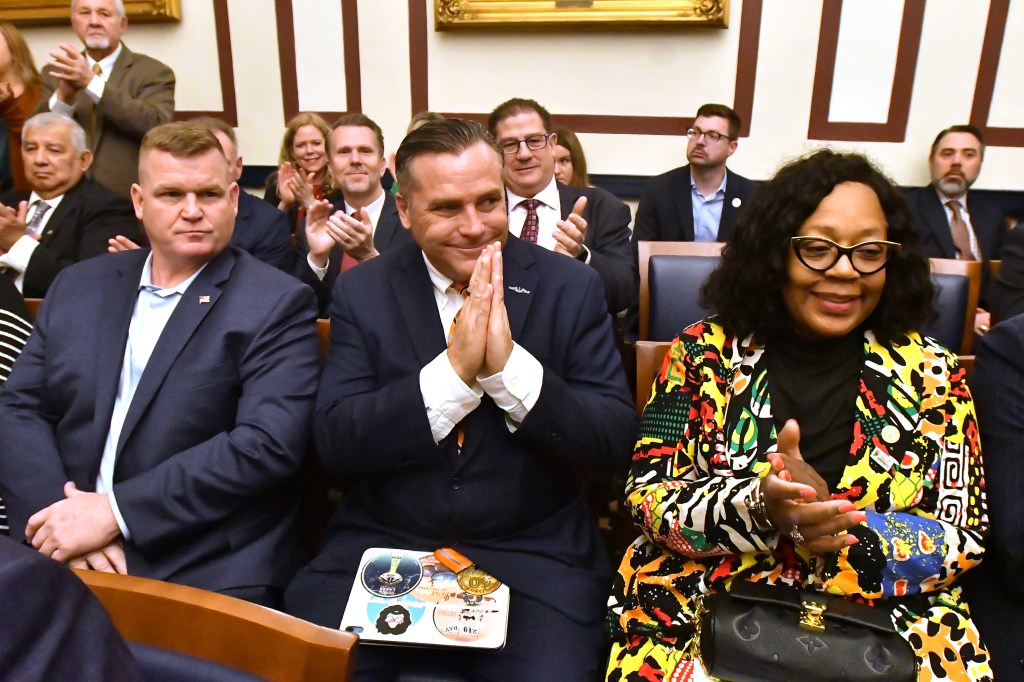
Northwest Indiana political and business leaders filled a House Ways and Means committee hearing room Thursday as an amended bill to fund a potential Chicago Bears stadium in Hammond was unveiled and passed unanimously.
Hammond Mayor Thomas McDermott called the proposed stadium at Wolf Lake an opportunity for Hammond, Northwest Indiana and the state in his testimony.
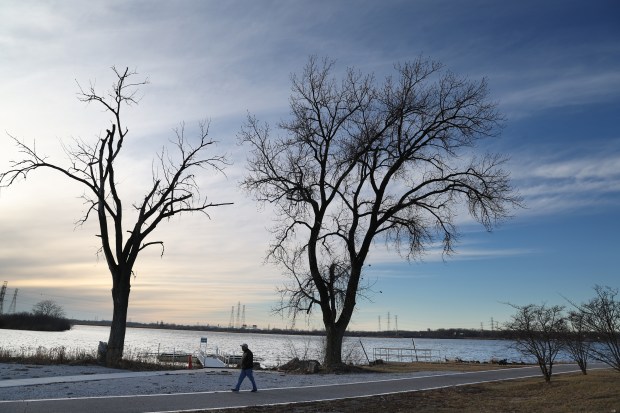 A man takes a walk in Wolf Lake Memorial Park in Hammond, Indiana, on Jan. 13, 2026. (Terrence Antonio James/Chicago Tribune)
“It’s fitting that we’re sitting here on 219 Day, a day that’s all about Northwest Indiana, talking about a transformational project in Northwest Indiana,” McDermott said, referencing the annual “Region Reunion” that’s in its 10th year.
McDermott highlighted Northwest Indiana’s history in steel production as well as the region’s natural resources, entertainment industry and residents.
“Now, we have the chance to add something else, the Chicago Bears. This is a once-in-a-generation opportunity,” McDermott said.
Hammond is a 20-minute drive from Soldier Field, McDermott said. The Hammond mayor was one of 12 leaders from Northwest Indiana, including Lake County Commissioner Michael Repay and Lake County Council members Christine Cid and Randy Niemeyer, to testify before the committee. Porter County Council President Andy Vasquez, R-4th, and Vice President Red Stone, R-2nd, were also present. All of those who testified said they supported the bill, and many shared memories of growing up Chicago Bears fans.
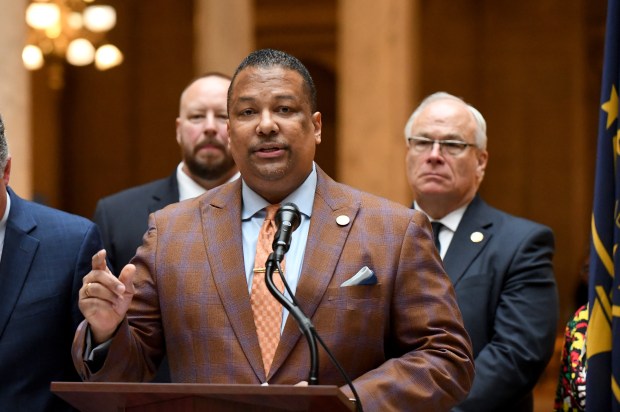 State Rep. Earl Harris, D-East Chicago, speaks during a press conference following the House Ways and Means committee passing Senate Bill 27, a stadium authority bill that will create the financial structure for a Chicago Bears stadium, at the Indiana State House in Indianapolis, Indiana, Thursday, Feb. 19, 2026. The bill still needs to be heard and passed by the whole House, which could happen as early as Tuesday. (Andy Lavalley/for the Post-Tribune)
When the Colts moved to Indianapolis from Baltimore, it transformed Central Indiana, McDermott said, and the Chicago Bears has the potential to do the same for Northwest Indiana. Hammond is ready to partner with the Chicago Bears, he said.
“Basically, Hammond will do whatever it takes to help make this project a success. Hammond is uniquely positioned for this moment,” McDermott said.
During a press conference Thursday afternoon in Hammond, McDermott mentioned that the proposed stadium design would include a space for a practice facility. When asked if the practice facility would eliminate the need for Halas Hall, the Bears headquarters and practice facilities, McDermott said “that’s absolutely correct.”
“They are talking about Halas Hall, everything,” McDermott said. “That’s breaking … Oh no, the lawyer is coming.”
The lawyer stood up and said the press conference would end after one more question.
House Speaker Todd Huston, R-Fishers, presented Senate Bill 27, a stadium authority bill that will create the financial structure for a stadium for the Chicago Bears, stating the team has selected a site near the Wolf Lake area in Hammond as a potential stadium.
The Chicago Bears are willing to invest $2 billion in the stadium, Huston said. The state will invest around $1 billion in the stadium through various financing avenues.
The state will issue a bond for the construction of the stadium, which will be repaid through the City of Hammond’s admissions tax, once the city passes it, and a Professional Sports Development Area specialized tax district, Huston said.
The state used a similar approach to finance the Lucas Oil Stadium in Indianapolis, Huston said. The state appropriates within its budget to ensure bondholders know the state has the money, but the state hasn’t had to use that money because the admissions tax and PSDA has funded the bond, he said.
To further support infrastructure costs, Huston said the state will renegotiate its lease with the Indiana Toll Road. The state has also asked Lake and Porter counties to adopt a 1% food and beverage tax and for Lake County to pass a 5% innkeepers tax, Huston said.
The amended bill passed 24-0, with applause from the committee and those in the audience after the vote. The bill moves forward for consideration by the House, where it could pass as early as Tuesday.
In an interview with the Post-Tribune, McDermott said the stadium “could result in the elimination” of the Lost Marsh Golf Course, which was built in 2002 atop a former slag heap on land donated by BP. But, that would have to be approved by the city council, he said, since the city owns the land the golf course is located on.
The golf course is operational for about five months of the year in a good year, McDermott said, while a stadium could offer more economic growth.
“As difficult of a decision it would be, this is the greater good,” McDermott said.
Porter County Councilman Red Stone is thrilled for Hammond and thinks McDermott did an excellent job courting the Bears, but he doesn’t feel banding together with Lake County in negotiations is appropriate.
“No, we’re our own county. We have our own constituents,” he said. “If this amendment goes through, I want to make sure it gets built by our people,” he added, saying those people should be union labor. “We’re not going to have people coming in from Tennessee.”
Porter County Councilman Andy Vasquez doesn’t see the food and beverage tax as “that much of an ask,” Vasquez said.
State lawmakers and the Bears were initially asking for a 10% innkeepers tax, but Vasquez told them Porter County already has a 5% innkeepers tax and is unwilling to raise it. He said the county would get a lot out of that 1% tax.
“I’m not an engineer, but it’s a big building and they’ll have to tear some buildings down, so there’s some work,” he said of potential jobs to come of a new stadium in the region. “It’s going to be the biggest thing that happened to us since our steel mills went down.”
During the press conference following the hearing, State Rep. Earl Harris, D-East Chicago, said the stadium proposal “is a once-in-a-generation opportunity” for Hammond, Northwest Indiana and the whole state.
“The relocation of the Chicago Bears to northwest Indiana is about creating a new partnership which benefits both team and state,” Harris said.
The project would generate construction jobs followed by permanent jobs in hospitality, public safety, transportation and retail, Harris said. Further, local governments will see an increase in revenues through the economic growth the stadium would create, he said.
Northwest Indiana is “uniquely positioned” for an NFL stadium because of its access to highways, railroads and the Gary/Chicago International Airport, Harris said. Harris’ father, who was a state legislator for 33 years, and McDermott’s father worked hard to attract the Bears to Northwest Indiana.
“This is also personal because we are the second generation and we moved this forward that our fathers worked on back in the mid-90’s in terms of bringing the Bears over,” Harris said.
Further, Harris said the Chicago Bears have a history in northwest Indiana as George Halas, who founded the Chicago Bears, began his professional career in Hammond playing for the Hammond All-Stars.
Gary Mayor Eddie Melton, who had advocated for three potential stadium sites in the Steel City, admitted to feeling mixed emotions on Thursday.
“While I would be less than honest if I said there isn’t some level of disappointment, I am encouraged to see meaningful progress in this process,” Melton said in his statement. “Major decisions like this require movement, clarity, and commitment — and today represents a step forward for Northwest Indiana.”
Moving forward, Melton said his primary concern is ensuring that previously committed funding, including innkeeper’s tax revenue, designated for the Lake County Convention Center is protected and honored. He believes it’s important to safeguard investments for long-term growth and sustainability, according to the statement.
Portage Mayor Austin Bonta was excited for Hammond on Thursday despite the Bears not choosing Portage’s Halas Harbor stadium proposal announced last week.
“Congratulations to the Chicago Bears on selecting Hammond, Indiana to become the site of their new proposed stadium. This is huge news and this day is a huge day in the history of Chicagoland’s football team,” Bonta said.
“Bears fans in Portage and across our entire region are excited about seeing this next chapter of our team’s story commence, and we’ll be following the progress with excitement as the Bears move on to doing their due diligence on the site and work with the state of Indiana on finalizing an official deal. Hopefully, we will one day step into the stadium for the first game there,” he said.
Lou Weisbach, the financier behind Portage’s Halas Harbor proposal, isn’t ready to throw in the towel. Weisbach, like all Bears fans, knows how the team has come from behind in the second half to win games this past season. That could be true of Portage’s proposal, too.
“People in general play their cards to their own financial benefit. These are still cards being played,” he said.
Even as the Indiana General Assembly is greasing the wheel for a taxpayer-funded stadium, Weisbach said public opinion is against it.
“Online chatter, it’s almost 100% the way people feel. People online don’t feel they should be taxed for extremely wealthy people,” he said.
State Sen. Ryan Mishler, R-Mishawaka, the author of the bill, said the amendment to Senate Bill 27, the financial elements presented by Huston, reflected the conversations state leaders have had with the Chicago Bears.
“I think everyone out there knows, just crossing over the line into Indiana saves companies millions of dollars and that’s due to our tax stature and our business environment. I just look forward to this continued partnership with the organization,” Mishler said.
Indiana Gov. Mike Braun said in a statement after the hearing that Indiana’s “pro-growth environment continues to attract major opportunities like this partnership with the Chicago Bears.”
“We’ve identified a promising site near Wolf Lake in Hammond and established a broad framework for negotiating a final deal. The amendment to Senate Bill 27 puts forward the essential framework to complete this agreement, contingent upon site due diligence proceeding smoothly,” Braun said.
During the hearing, the Chicago Bears released a statement stating that the passage of Indiana’s Senate Bill 27 “would mark the most meaningful step forward in our stadium planning efforts to date.” The team confirmed its commitment to moving forward with due diligence on building a stadium near the Wolf Lake area in Hammond, according to the statement.
“We appreciate the leadership shown by Governor Braun, Speaker Huston and Senator Mishler and members of the Indiana General Assembly in establishing this critical framework and path forward to deliver a premier venue for all of Chicagoland and a destination for Bears fans and visitors from across the globe. We value our partnership and look forward to continuing to build our working relationship together,” the Chicago Bears said in the statement.
State Rep. Carolyn Jackson, D-Hammond, who attended the House Ways and Means committee, said in a statement after the hearing that the Bears moving to Hammond would increase the city’s revenue and boost tourism in the area.
“Over the past few years, we’ve made significant improvements and additions to the Region, and a National Football League team, especially one as historic as the Chicago Bears’ franchise, would be a fantastic addition to that work,” Jackson said.
Senators Rodney Pol Jr., D-Chesterton, Mark Spencer, D-Gary, Lonnie Randolph, D-East Chicago, and David Niezgodski, D-South Bend, issued a joint statement expressing their excitement for the proposed stadium.
“We are extremely thrilled that our region of the State is getting the recognition it deserves as an economic driver of Indiana,” they said in the statement. “While this bill continues to move through the process, we will continue to advocate for the Hoosier taxpayer to benefit and for their interests to remain at the forefront.”
Lake County Council President Christine Cid, D-5th, said a football stadium in Northwest Indiana would be “transformational” because it would increase economic growth for the region and the state.
“I truly believe this initiative represents a defining moment for Northwest Indiana, one that generates opportunity, strengthens our community and delivers lasting impact across the state,” Cid said.
Valparaiso Mayor Jon Costas said that Northwest Indiana will see economic benefits from the proposed stadium as the Chicago Bears brand is “far-reaching.”
“It is a once-in-a-lifetime opportunity to raise the entire region’s economic future to new heights,” Costas said. “This project will create a magnitude of jobs in both the construction and hospitality sectors and highlight Indiana as a place where opportunity proliferates because common sense rules and life is good.”
Costas said the 1% food and beverage tax “is a modest ask by the legislature to make this deal work.”
Randy Palmateer, with the Northwest Indiana Building and Construction Trades Council, said the U.S. Department of Energy cancelled a hydrogen hub project last year involving the BP Whiting Refinery, which would’ve brought 11,000 construction jobs to Northwest Indiana. But a potential stadium would be a boon for the area’s trades.
“We needed to fill that void … and this one will definitely do that,” Palmateer said.
Freelance reporter Doug Ross and Shelley Jones contributed.