
Green Bay Packers general manager Brian Gutekunst doesn’t think his cornerback room needs wholesale changes.
Even so, Gutekunst might have his eye on the incoming crop of cornerbacks when he and his personnel staff descend upon Indianapolis this week for the 2026 NFL Scouting Combine.
Keisean Nixon, who turns 29 in June, is coming off his first full season as a No. 1 outside cornerback and has one year remaining on his contract. There are differing opinions inside (seemingly positive) and outside (overwhelmingly negative) the building about how he played last season, but Nixon might ask for a raise this offseason regardless, since his current contract pays him like a nickel cornerback. Carrington Valentine, a 2023 seventh-round pick, is also entering a contract year. The Packers have a decision to make on 2025 free-agent signing Nate Hobbs, too, after he had a disappointing and injury-riddled first season in Green Bay. In short, there’s uncertainty both now and in the future surrounding the Packers’ cornerback group that Gutekunst will likely address in this year’s draft.
“We had some injuries there,” Gutekunst said recently when asked if he needs to start over at cornerback. “Obviously, Hobbs was missed for most of the season, never really got going. I thought Carrington stepped in and did a great job. … He’s a young player who’s still getting better. Keisean had a very, very good year. I think he was in the top three in (pass breakups) and did some really good things. Do we need wholesale changes? No. I do think it’s an area — those guys can get hurt. They’re the smaller guys on the field. We ask a lot of those guys in run support. The depth there, for me, is important that we have answers.”
Beyond Nixon, Valentine and Hobbs, who was benched in favor of Valentine during the season, the Packers don’t have much. Shemar Bartholomew and Jaylin Simpson played in the meaningless regular-season finale against the Minnesota Vikings, but the Packers likely won’t rely on them for meaningful snaps in 2026. Kamal Hadden was No. 4 on the depth chart, but he’s recovering from a gruesome leg injury suffered in Week 17 against the Baltimore Ravens.
According to Over The Cap, the Packers rank No. 23 in cap space at about $1.6 million over the cap. They might not be able to splurge on a cornerback in free agency, even if they wanted to. The top names on the open market at the position in The Athletic’s top 150 free agents are the New Orleans Saints’ Alontae Taylor (No. 18), the Seattle Seahawks’ Riq Woolen (No. 26), the Kansas City Chiefs’ Jaylen Watson (No. 33), the Chicago Bears’ Nahshon Wright (No. 46) and the Las Vegas Raiders’ Eric Stokes, the Packers’ 2021 first-round pick whom they let walk last offseason (No. 47). How many of those players would be a clear-cut upgrade over Nixon, and would the Packers be able to afford the player(s) who fit that criteria?
Gutekunst might be more likely to address the position in the draft. Complicating the Packers’ need at cornerback is the absence of a first-round pick since that belongs to the Dallas Cowboys from the Micah Parsons trade. Gutekunst’s best option to upgrade the position will be on Day 2 (barring an unlikely trade back into the first round), when he could add a player who would likely provide depth as a rookie before potentially growing into a starter after that, especially if Nixon, Valentine and/or Hobbs aren’t long for Green Bay given their respective contract situations. While Nixon and Valentine are entering contract years, Hobbs has three years remaining on his deal. However, releasing him with a post-June 1 designation or after June 1 would free up approximately $8.8 million late in the offseason, per OTC.
Who are some of those Round 2 or 3 options whom Gutekunst might watch in Indianapolis? Currently with picks Nos. 52 and 84 in the second and third rounds, the Packers will have the chance to see/meet nine cornerbacks at the combine who are ranked from No. 33 to No. 96 (the picks in Rounds 2 and 3) in Dane Brugler’s latest top 100. They are as follows, accompanied by Brugler’s brief scouting report on each.
Chris Johnson, San Diego State (No. 38, 6 feet and 195 pounds): Johnson is a sticky cover man, both in man and zone. He plays with clean pedal mechanics to mirror and match in press man and flashes a burst to regain phase down the field. He can get “big-boyed” at times by bigger receivers and in the run game, but he doesn’t go down without a fight.
D’Angelo Ponds, Indiana (No. 40, 5 feet, 9 inches and 173 pounds): Ponds has been the smallest player on the field since pee-wee ball, which has created a permanent chip on his shoulder — and sharpened his skills in other areas. Using quick-twitch footwork and body control, he has the cover talent to play tight in man-to-man or bait and drive from depth. He defends with a confident swagger, although bigger athletes will have an unquestioned advantage against him.
Brandon Cisse, South Carolina (No. 41, 6 feet and 190 pounds): Cisse is an interesting prospect. He has no trouble staying hip to hip in man coverage because of his explosive athletic talent (his vertical and 40-yard dash at the combine should be exceptional), but there are holes in his game that create some doubt about his pro transition.
Davison Igbinosun, Ohio State (No. 50, 6 feet, 2 inches and 195 pounds): With prototypical size and speed for outside work, Igbinosun can carry routes vertically and stay in phase to contest passing windows. Teams must be comfortable with his aggressive physicality — he was flagged a combined 16 times in coverage over the past two seasons (although that number decreased from 12 in 2024 to just four in ’25).
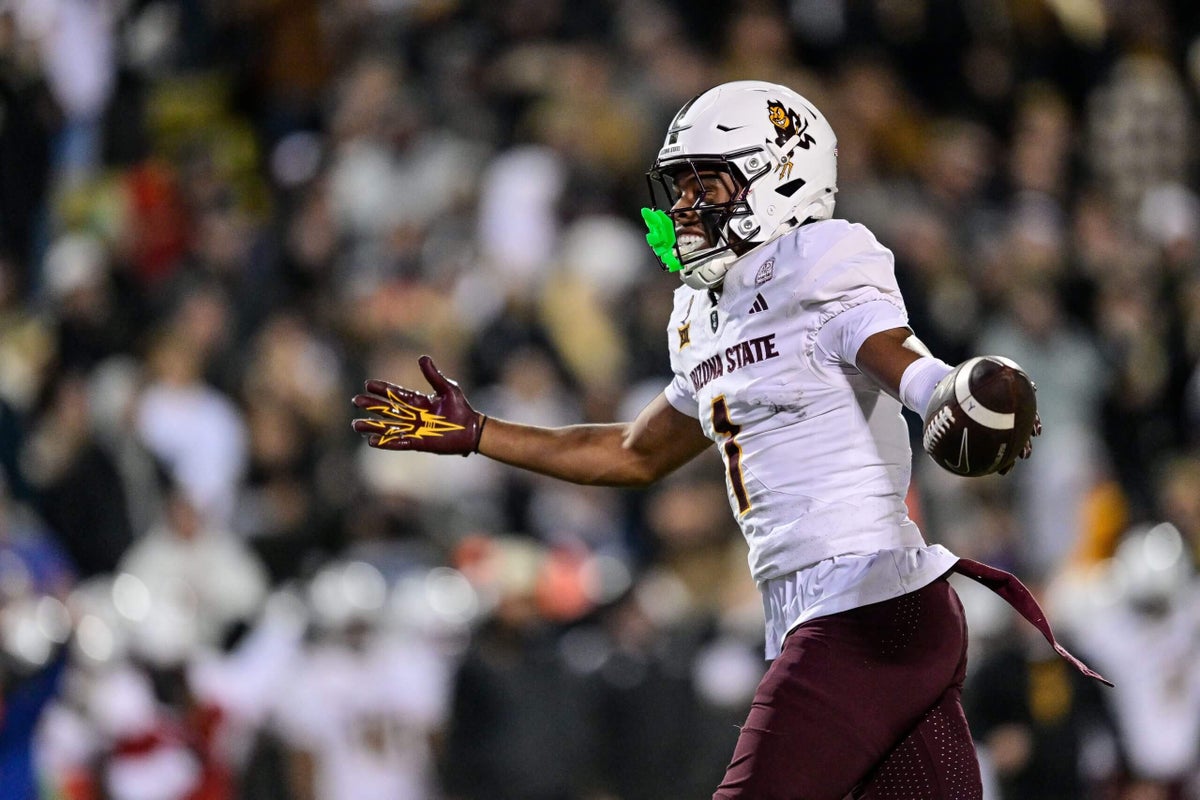
Keith Abney II, Arizona State (No. 59, 6 feet and 190 pounds): Abney has only average size but plays bigger (and more competitively) than he looks. He is a little bit of a wild defender, which NFL route runners will take advantage of while he matures. But his fluid change-of-direction skills help him play sticky in coverage.
Devin Moore, Florida (No. 73, 6 feet, 3 inches and 198 pounds): An impressive size-speed athlete, Moore didn’t have the college career many expected, primarily because of injuries. However, his presence grew on the NFL radar during a healthy 2025 campaign. He plays with patience and control to stay on top of routes, both underneath and vertically.
Treydan Stukes, Arizona (No. 77, 6 feet, 2 inches and 200 pounds): A former walk-on and late bloomer, Stukes got better each season in college, while playing mostly in a nickel role. He has outstanding instincts and toughness — and put some “wow” interceptions on film.
Chandler Rivers, Duke (No. 88, 5 feet, 10 inches and 185 pounds): Rivers turns you off with his size, but then immediately draws you back in with his on-field play. He transitions cleanly in press-man coverage to stay in phase, annoy receivers and position his body to contest throws. He is a missile in run support, too, although his lack of size severely limits his margin for error as a tackler.
Malik Muhammad, Texas (No. 90, 6 feet and 188 pounds): Muhammad is a good-sized athlete who isn’t shy about throwing his hands into receivers to jam at the line. He doesn’t have top-tier speed, but he can mask that with smooth transition skills and the coverage confidence to stay within arm’s length of receivers.
After releasing longtime No. 1 cornerback Jaire Alexander last offseason, Gutekunst didn’t fill his spot externally and instead relied on what he already had. Nixon, Valentine and Hobbs turned in mixed results for that gamble. The Packers probably need better from whatever combination of rookies and veterans who fill the room if they want to adequately complement a Parsons-led pass rush and legitimately contend for a Super Bowl. Might one of the nine names above offer a solution? The Packers will search for that answer this week.