
It’s NFL Scouting Combine Week — the annual job fair for NFL prospects hoping to make their professional dreams a reality.
As things kick off in Indianapolis over the next few days, we’re expecting to hear from Lions GM Brad Holmes, coach Dan Campbell, offensive coordinator Drew Petzing and defensive coordinator Kelvin Sheppard. There will be plenty to talk about, as the Lions look to pick up the pieces after a 9-8 season.
Here are some of the burning topics that will surely be discussed in Indianapolis, as well as a few positions to watch.
Question for Brad Holmes:How big of a priority will improving the trenches be?
The Lions desperately need to revamp their offensive line. That’s not exactly new information, but it’ll almost certainly be a topic Holmes is asked about this week.
With Taylor Decker mulling retirement, the hope is that the Lions receive an answer before the start of the new league year on March 11. If Decker does retire, it could free up nearly $12 million in cap space for the Lions to use at their discretion. Tackle would immediately rise to the top of the list of needs — the Lions don’t have another proven, starting-caliber tackle on the roster. If Decker announces his return, the Lions could — and should — still prioritize the tackle position with youth in the draft. He’ll be 33 at the start of the 2026 season and will have watched several close friends and fellow linemen on the team hang it up. Not to mention the physical and mental toll his shoulder injury has had on him.
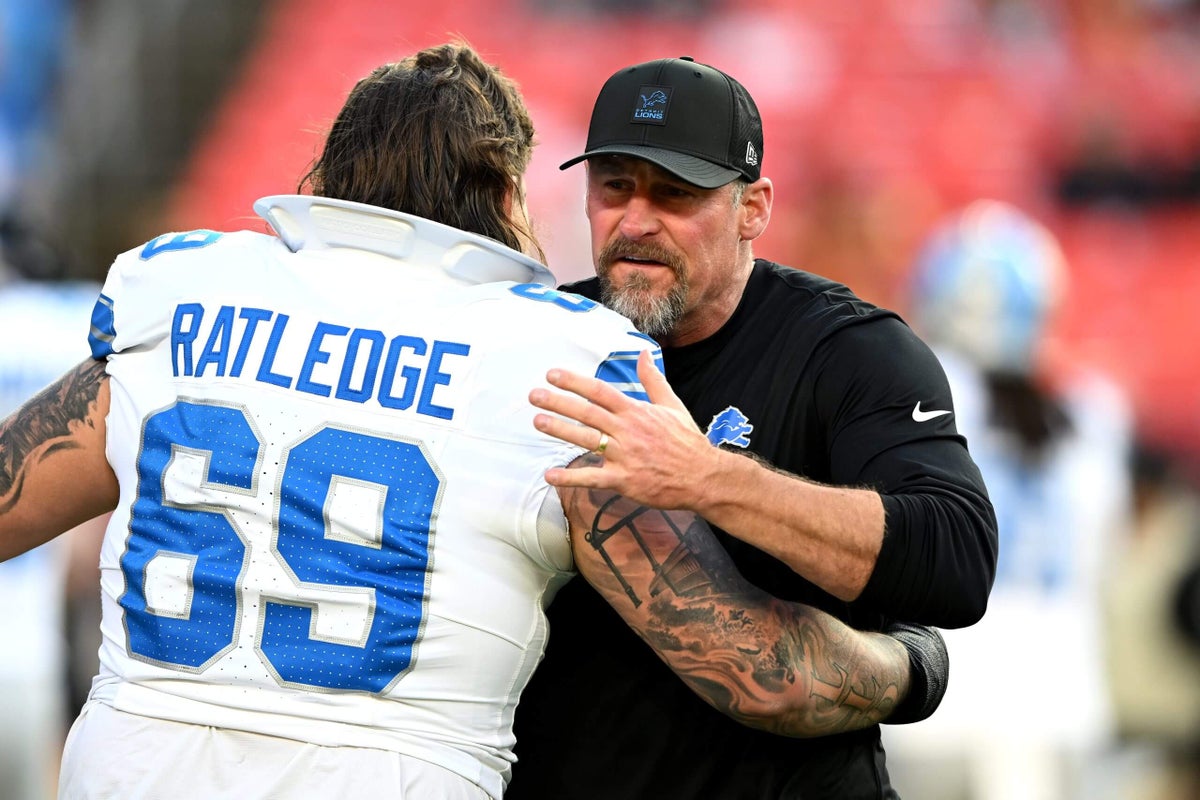
Elsewhere along the offensive line, Detroit should be in the market for a new center. Graham Glasgow is entering the final year of his contract, and could become a cap casualty or retirement candidate at this stage of his career. The Lions have flirted with the idea of moving Tate Ratledge to center, but that carries its own risk as a young player who’s never played the position. Free agency or the trade market makes the most sense, but don’t rule out a Day 3 center. Guard could also be an area the Lions address to bring in competition for Christian Mahogany and Miles Frazier.
Let’s flip to the other side of the ball, where help is also needed. The Lions could again be in the market for a long-term edge to play opposite Aidan Hutchinson — as they have for a few years now. It hasn’t materialized the way the Lions would’ve hoped — Holmes worked the phones with edge rushers in mind last year — but it could this year.
This is a deep edge class, with something for every team on the hunt for pass rushers — speed rushers, edge setters, versatile pieces who can rush inside and out. The Lions should have options. Now, what they do in free agency could impact the way they approach the draft. But this could be the year the stars align, so it’ll be fascinating to hear Holmes’ thoughts on the class and the characteristics he looks for in an edge prospect.
Question for Dan Campbell:How did you land on your 2026 coaching staff?
This will be our first chance to hear from Campbell about the changes he’s made to the offensive coaching staff, after the team parted ways with offensive coordinator John Morton.
Campbell, to his credit, cast a wide net during his search. Some of the reported interviewed candidates included Mike McDaniel, Zac Robinson, Arthur Smith, Mike Kafka, Tommy Rees, Jake Peetz, Tee Martin and David Blough, to name a few. In the end, he landed on former Cardinals OC Drew Petzing, while still adding Kafka for a high-ranking offensive assistant role.
What did Campbell see in Petzing that allowed him to stand out? How does he see Petzing and Kafka working together? Was the plan to add two offensive minds all along, or did it materialize this way as the process unfolded? What did Campbell think of McDaniel? How about the promotion of assistant offensive line coach Steve Oliver to tight ends coach?
Additionally, the defensive staff remained unchanged — signaling a belief in the coaches in place. After a self-scout, did Campbell determine that injuries were the culprit for Detroit’s 22nd-ranked scoring defense? What positions does Campbell feel need competition? Will the Lions be more aggressive during key upcoming player-acquisition periods like free agency and the draft to re-shape their defense or get a bit younger and faster? He might not reveal everything in Indy, but Campbell usually offers a fair amount of insight compared to his peers. It’ll be a useful session.
Positions and prospects to monitor in Indy
Center: The Lions were left with Glasgow and Ratledge as their top center options when Frank Ragnow retired in June. They pulled the plug on Ratledge less than a week into training camp, and Glasgow was a below-average center in his age-33 season. They can’t roll the dice here, given the quick pressure allowed and inability to create interior running lanes last season. A proven center in free agency or the trade market makes the most sense, but there are intriguing Day 2 and Day 3 center options like Auburn’s Connor Lew, Florida’s Jake Slaughter and Kansas State’s Sam Hecht.
Offensive tackle: As previously discussed, Decker could retire this offseason. Regardless of whether Decker is back or not, the Lions must find his successor this offseason. Giovanni Manu has yet to develop into a reliable NFL player and the Lions will need game-ready depth in the event Decker returns and has to manage the pain from a shoulder injury that hasn’t healed. A couple players worth monitoring: Georgia’s Monroe Freeling, Utah’s Caleb Lomu, Arizona State’s Max Iheanachor, Clemson’s Blake Miller and Alabama’s Kadyn Proctor.
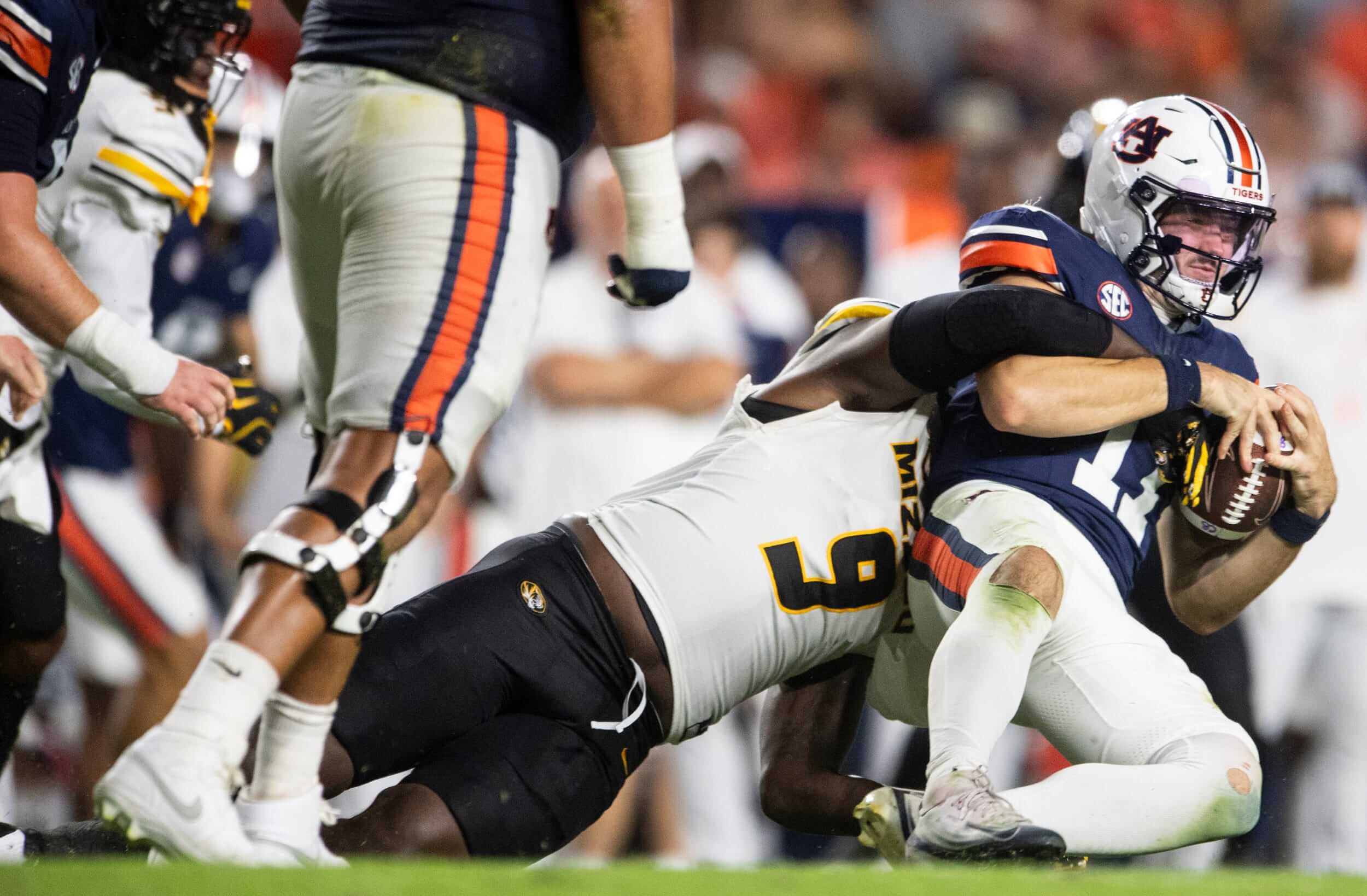
Missouri’s Zion Young totaled 16.5 tackles for loss season and 6.5 sacks, including this one of Auburn QB Jackson Arnold. (Jake Crandall / Imagn Images)
Edge: The Lions received above-average production from Al-Quadin Muhammad last year, after he was initially signed to be a reserve pass-rush specialist. He recorded 11 sacks and 53 pressures in 2025 — both career highs. But the Lions ranked eighth in defensive rushing success rate when he wasn’t on the field, and recorded a defensive rushing success rate that would’ve ranked 24th in the league when he was on the field. Not to mention he’ll be 31 and will no longer come at a bargain of $1.4 million — projected to earn a two-year, $18 million contract in free agency, per The Athletic’s Daniel Popper. With that in mind, the Lions might need to move on. Grabbing a veteran while also drafting an edge on Day 1 or 2 would make sense. Miami’s Akheem Mesidor, Auburn’s Keldric Faulk, Clemson’s TJ Parker and Missouri’s Zion Young could be targets.
Safety/nickel: Barring an unforeseen early recovery, the Lions will be without Brian Branch when the season starts, after the Pro Bowl safety suffered a torn Achilles in December. Entering a contract year, the Lions might not have enough information to be comfortable signing Branch to an extension. Some insurance at the position feels necessary — especially when you factor in uncertainty about Kerby Joseph’s future, as he tries to manage a lingering knee issue that forced him to miss 11 games in 2025. Adding a safety who could also play nickel would give the Lions flexibility when Branch returns, and that player could replace soon-to-be free-agent nickel Amik Robertson. Oregon’s Dillon Thieneman and Toledo’s Emmanuel McNeil-Warren could be high-end options, or the Lions could go with a player like Miami’s Keionte Scott or LSU’s A.J. Haulcy on Day 2.
Linebacker: Five-time team captain and starting linebacker Alex Anzalone is a free agent, and at 31, the Lions could look to go younger here. Targeting a young will or sam linebacker in the draft would make sense, depending on where they want to slot Derrick Barnes. This is a strong linebacker class, so they should have options. The first round might be a bit rich for them, but there are intriguing Day 2 options like Pitt’s Kyle Louis and Arizona State’s Keyshaun Elliott.
Tight end: Petzing used a ton of 13 personnel with the Cardinals, and if he wants to replicate some of those looks in Detroit, he’s going to need bodies. Sam LaPorta is coming off a back injury and will need time to recover. His absence was felt. Brock Wright isn’t much of a receiving threat and is entering a contract year. Detroit doesn’t have a reliable third tight end at the moment. Texas A&M’s Nate Boerkircher, Alabama’s Josh Cuevas and Stanford’s Sam Roush could all be fits, depending on what the Lions are looking for.