
Read Later
Email this article to yourself for future reading.
Dr. Donald Shelbourne and other Boilermaker medical professionals changed how NFL teams gather prospects’ medical information during the predraft process
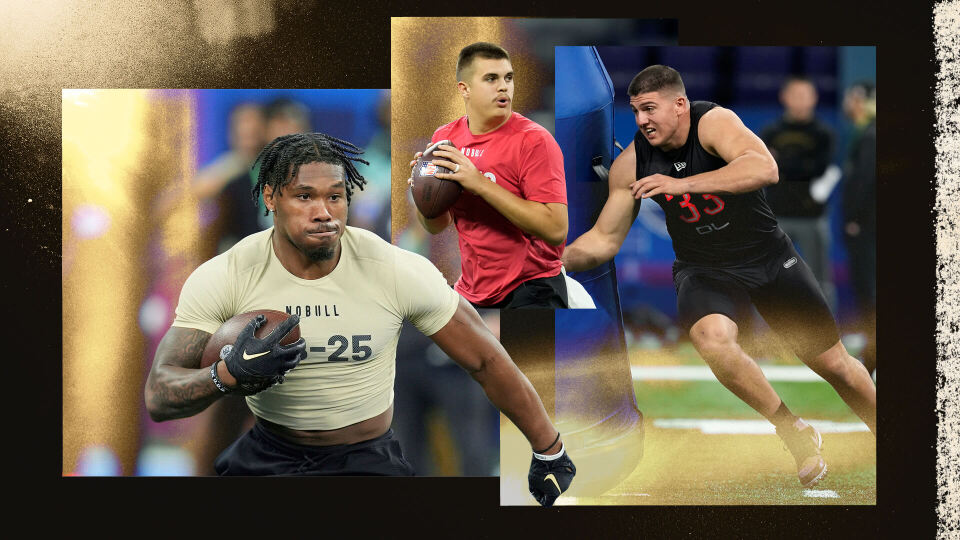
As the pro football community descends upon Indianapolis this week for the NFL Scouting Combine, media, fans and league personnel will obsess about draft prospects’ eyebrow-raising times in the 40-yard dash, quarterbacks’ hand sizes, and which players display the most impressive athleticism in leaping and agility drills.
But those attention-grabbing diversions are not why team representatives and 300 of the league’s top prospects started gathering in the Circle City in the first place. No, if you’ve ever wondered why this circus has visited Indianapolis annually for the last four decades, start with Dr. Donald Shelbourne, the longtime Purdue team doctor who convinced the NFL to bring it there.
“Nobody else can do medically what we can do: seeing 100 players each day and getting X-rays, MRI scans, CAT scans and bone scans, and getting everybody that day seen and read and dictated and transcribed and giving it to the doctors,” says Shelbourne, who was head team physician at both Purdue and with the NFL’s Indianapolis Colts when the combine arrived in Indianapolis in 1987. “Our hospital, Methodist, is a huge hospital, and they bent over backwards to accommodate me and to get the combine to come here. And once it came here, the NFL thought it was kind of a no-brainer to keep it up.”
Shelbourne had just started in his role with the Colts when he attended the league’s first centralized combines in New Orleans and Phoenix from 1984-86. The medical examination process had been so disorganized and insufficient in those early iterations that Shelbourne voiced his annoyance to an NFL executive, making a claim that changed the event forever.
The competitive and financial stakes are significant with each player a team selects in the draft, Shelbourne told him. And for doctors whose reputations are at stake.
“I can’t be wrong,” Shelbourne says. “If I tell the team they’re OK and they draft them with the No. 2 draft choice and the kid comes in and is a bust because of a preexisting condition, I’m gone.”
He argued that each team’s medical representatives should have access to the prospect’s full medical history, plus the results of a battery of medical testing and imaging, before conducting the combine examination where they assess his physical readiness to compete. That’s not how it went in New Orleans and Phoenix, and Shelbourne insisted Indy personnel could handle this important responsibility much better.
The combine director’s response? “He says, ‘Well, if you think you know how to run this better, you go ahead and do it,’” Shelbourne recalls.
And so he did.
Nearly 40 years later, it’s still in Indy — in large part because of Shelbourne’s early leadership.
As a pioneering knee surgeon who repaired thousands of torn ACLs and helped patients accelerate their recovery, Shelbourne’s medical legacy is secure, says Scott Lawrance, Purdue’s director of athletic training education. But the NFL combine is also a big part of Shelbourne’s story, and Lawrance believes it’s one that more people should know.
“He’s such an accomplished surgeon and physician, but I’m not sure that he gets the recognition he deserves in the medical community for what he’s done with the combine,” Lawrance says of Shelbourne, who served as team doctor for the Colts from 1984-98 and for Purdue from 1982-2018. “He was integral in those early combines here in the city, and he’s a big part of the reason that it’s stayed in Indianapolis for so, so long when there have been lots of cries to move it to other cities.”
But he’s also not the only medical professional from Purdue who influenced how NFL teams handle their predraft medical evaluations. Many other Boilermakers have made an impact in the league after graduating from Purdue’s revered athletic training program — which will be able to accommodate more students than ever before when it expands to Indianapolis in fall 2026.
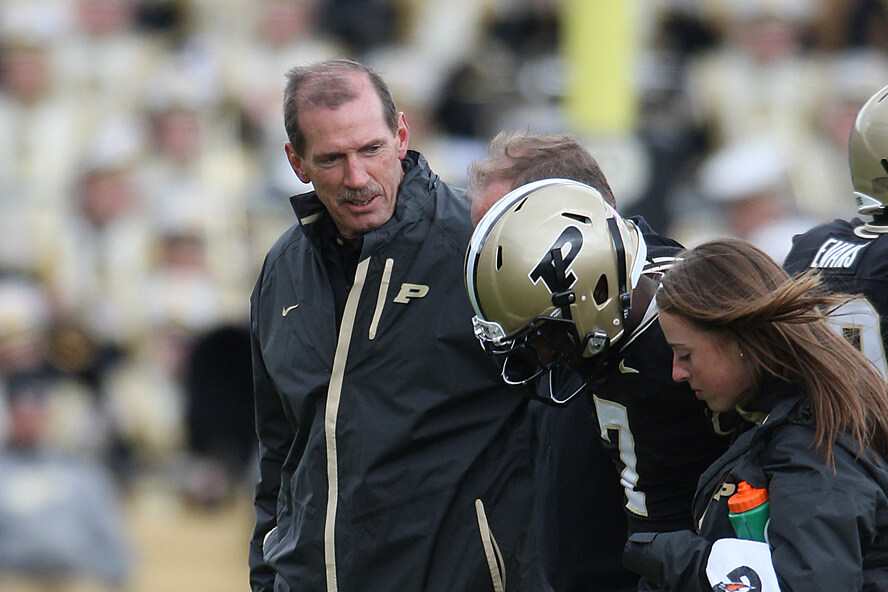
The reason (the NFL combine has) been in Indianapolis is because nobody else can do medically what we can do.
Dr. Donald Shelbourne
Head team physician at Purdue (1982-2018) and with the Indianapolis Colts (1984-98)
A massive undertaking
Leon Hess, the New York Jets owner, was unhappy — and he had every reason to be displeased.
In 1977, Hess’ team had used a second-round draft pick on Wesley Walker, an All-American receiver from the University of California, Berkeley. There was just one small oversight that seems nearly unimaginable in this modern era where each NFL prospect faces maximum scrutiny.
Let Pepper Burruss (BS health and kinesiology ’76), the Purdue alum who that year accepted a position as the Jets’ assistant athletic trainer under fellow Boilermaker Bob Reese (BS physical education ’70), explain the discovery that occurred shortly before he joined the club.
“It wasn’t long after the draft when the rookies came in and they were doing physicals,” Burruss says. “There were stations where they see the doctor here and flexibility here and do the eye chart in the racquetball court. And an athletic training student, Ed Dobrzykowski from Purdue, came into the room and said to Bob Reese, ‘We’ve got a guy in there who can’t see the eye chart.’
“Bob said, ‘What? What do you mean?’ Ed said, ‘He can’t see the chart with his left eye.’ Bob asked, ‘Who is it?’ He said, ‘Wesley Walker, our second-round pick.’
“Turns out he had a congenital cataract in his left eye,” Burruss says. “He was legally blind in his left eye.”
That’s right — the Jets were unaware that they had drafted a player who was half-blind. While Walker eventually developed into one of the best receivers in franchise history, his selection nonetheless exposed a severe flaw in the team’s evaluation process that Hess was determined to fix. And it fell on the two Boilermaker athletic trainers to lead the charge.
The following year, if the Jets’ scouts or player personnel executives were interested in a prospect, it was Reese and Burruss’ duty to bring them in for a full physical evaluation and facilitate their transportation. Oil magnate Hess — founder of the Hess Corp. and one of the world’s wealthiest people — would foot the substantial bill.
“Our scouting department gave us a list, and Bob and I divided them up. In 1978, we brought in 103 athletes to New York,” Burruss recalls. “We’d call up their school and tell them, ‘Any day you want to come in,’ and they’d fly into LaGuardia Airport. A lot of times, I would pick them up, and that was before cellphones, so it was crazy. I would meet them in a green van from the Jets and drive them to Lenox Hill Hospital in New York City. The doc would see him, take a couple X-rays; then I’d drive him back to the airport, give him his per diem, give him a hat and a T-shirt, and he’d fly off. We were doing that day and night.”
Some of Reese and Burruss’ fellow athletic trainers around the league were amused by the logistical nightmares and steep financial costs associated with shuttling so many prospects in and out of town for physical evaluations. But Hess was undaunted. In 1979, the Jets brought in more than twice as many players — 220 — as they had the year before.
“We really stepped it up, and we literally made weekends of it,” Burruss says. “We’d fly him in, put him up at the Marriott, have a bus, take him down to the hospital.”
In hindsight, today’s comprehensive combine physicals are directly linked to the protocols that Reese and Burruss established in those days. They represented the first mass predraft physical screenings ever conducted in league history.
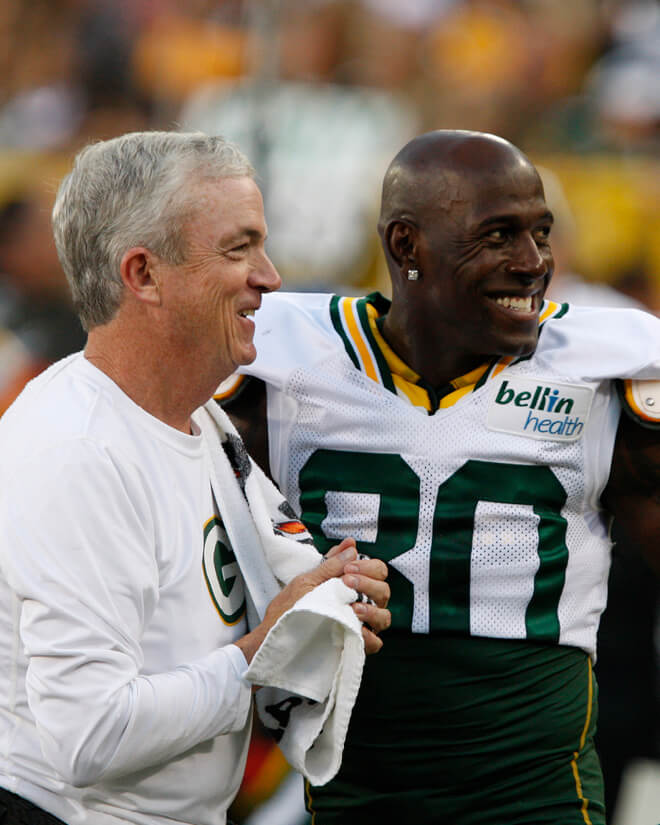 Longtime Green Bay Packers athletic trainer Pepper Burruss shares a laugh on the sidelines with former Pro Bowl receiver Donald Driver. (Photo courtesy of the Green Bay Packers)
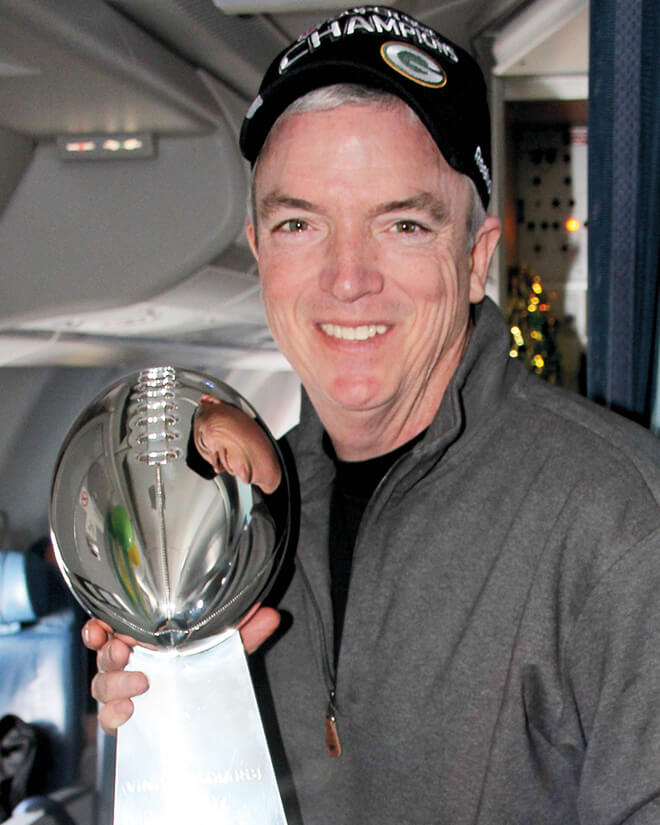 Pepper Burruss holds up the Vince Lombardi Trophy, which the NFL awards to the Super Bowl champion. Burruss’ Green Bay Packers won two Super Bowls during his 26-year tenure. (Photo courtesy of the Green Bay Packers)
The combine’s Indiana home
In the ensuing years, some NFL teams chose to pool, or combine, their resources and evaluate prospects en masse — an approach that evolved into the first leaguewide combines that took place in New Orleans and Phoenix in the early ’80s.
“Some teams got together and said, ‘Hey, look, if you’re doing that and I’m doing that, why don’t we just do it together and save some money?’” Shelbourne says. “And so a few teams did that and then the NFL kind of got wind of it and said, ‘Well, if eight teams are going to do it, why not just have it where all the teams are involved?’ So then they decide, ‘OK, we’re going to start an NFL combine.’”
Even then, the primary purpose of the event was to conduct mass medical evaluations. Which is why Shelbourne offered up his team’s city as a host site after observing how inefficiently the early combines were being run.
When NFL leaders were receptive to the idea, Shelbourne took it to Methodist Hospital leaders Sam Odle and Frank Lloyd, who agreed to commit the resources necessary for the effort to succeed. Shelbourne’s hospital colleagues assisted with around-the-clock testing and imaging work so that each prospect would report to his combine checkup with the information doctors would need to make confident assessments.
“I had to oversee all the therapists and athletic trainers and cardiologists,” Shelbourne says. “I kind of oversaw everything and made sure everything was done. And it worked out so well, they said, ‘Can you do it again?’ Sure. Every year, you do all the work from last year and then try to make it better.”
As time passed, the combine grew from a small, private event that was of little interest to the public to a weeklong media extravaganza that now ranks among the NFL’s most-scrutinized annual attractions. There have been rumblings in recent years about moving the combine elsewhere, mirroring how the league rotates its annual draft location between NFL cities. But thus far Indy has fended off all challengers — largely because of its domed stadium with walkable hotels and restaurants that can house and feed the flood of NFL visitors, plus its unbeatable medical infrastructure.
“Every time they try to move somewhere, they realize they can’t get to medical care as easily,” Shelbourne says.
Boilermaker connections
Years before hiring Burruss as his assistant with the Jets, Reese actually influenced one of the most important decisions Burruss had made in his young life.
As a brainy-but-unathletic youngster in Wappingers Falls, New York, Burruss developed an interest in athletic training far before it was a well-known career path. Bob Rush, at the time the only NCAA Division I football player from his high school, encouraged Burruss to visit him at Boston College and consult with his athletic trainer — Reese — who at that point was the nation’s youngest Division I head athletic trainer.
When Burruss came to visit, his illuminating conversation with Reese revealed where he should attend college if he wanted to become a certified athletic trainer and which person he would need to impress when he got there.
“He said, ‘Go where I went — to Purdue,’” Burruss says. “I said, ‘Where’s that?’ And he kind of pointed west and said, ‘Go that way about 800 miles.’”
Reese also encouraged him to reach out to Purdue’s head athletic trainer William “Pinky” Newell, a longtime leader of the National Athletic Trainers’ Association who today is recognized as the father of modern athletic training.
“So I wrote to Pinky Newell,” Burruss says. “He wrote back and said, ‘You can come to Purdue, but I don’t know if your money wouldn’t be better spent elsewhere. You’re going to be an out-of-state student, and you should go closer to home.’ I wrote back and said, ‘I’m coming.’ And in Pinky’s latter years, he would say that kind of iced it for me. You know, ‘OK, I’m trying to dissuade this guy, and he still said he’s coming.’”
Once Burruss arrived on campus in 1972, he visited the athletic training room and Newell immediately said, “Grab him a shirt,” and put him to work cleaning whirlpools. It was Burruss’ first step in a formative Purdue experience where he worked alongside athletic training icons like Newell and Denny Miller, leading to a legendary career of his own.
Burruss was interning at Lake Forest Hospital near Chicago in 1977 when Reese — newly hired as the Jets’ head athletic trainer after spending the previous five seasons working with the Buffalo Bills as assistant to yet another Boilermaker athletic training alum, Ed Abramoski — instructed Burruss’ Purdue classmate Dobrzykowski to call him. Reese wanted to know if Burruss was interested in working in the NFL.
“I don’t know if I had to clean out my pants or not,” Burruss says. “I do remember being unsure of my words. ‘But, Bob, I’ve got six more weeks of school. Do you want me to quit?’ He said, ‘No, we’ll wait.’”
That season was the first in Burruss’ 42-year NFL career that saw him work for 16 seasons alongside Reese — their team won the inaugural Ed Block NFL Athletic Training Staff of the Year award in 1985 — before accepting his own head athletic trainer position with the Green Bay Packers in 1993. Across 26 seasons in Green Bay, Burruss cared for legendary players like Brett Favre and Aaron Rodgers as they led the franchise to a pair of Super Bowl wins.
His efforts to provide cutting-edge medical care certainly contributed to the franchise’s success and helped him build his own award-winning legacy within his profession.
And he brought a number of fellow Boilermakers along for the ride. Between his time with the Jets and Packers, Burruss was involved with hiring nine Purdue student athletic trainers to gain invaluable hands-on experience at NFL summer camps.
Last year, Burruss joined Reese as a recipient of one of the highest honors in his line of work. The two Boilermakers are among 14 NFL athletic trainers who have been recognized with the Pro Football Hall of Fame Award of Excellence: Reese in 2023 (a year before he passed away at age 75) and Burruss in 2025.
An exciting future
While Purdue is rightfully proud of its status as one of the nation’s first academic athletic training programs, it remains among the leading incubators for well-prepared athletic trainers — with an alumni group that includes Troy Maurer of the NFL’s Miami Dolphins and Pierre Nesbit of the Jets.
Boilermaker athletic trainers complement their educational training with hands-on learning experiences that help them confidently launch careers after graduation.
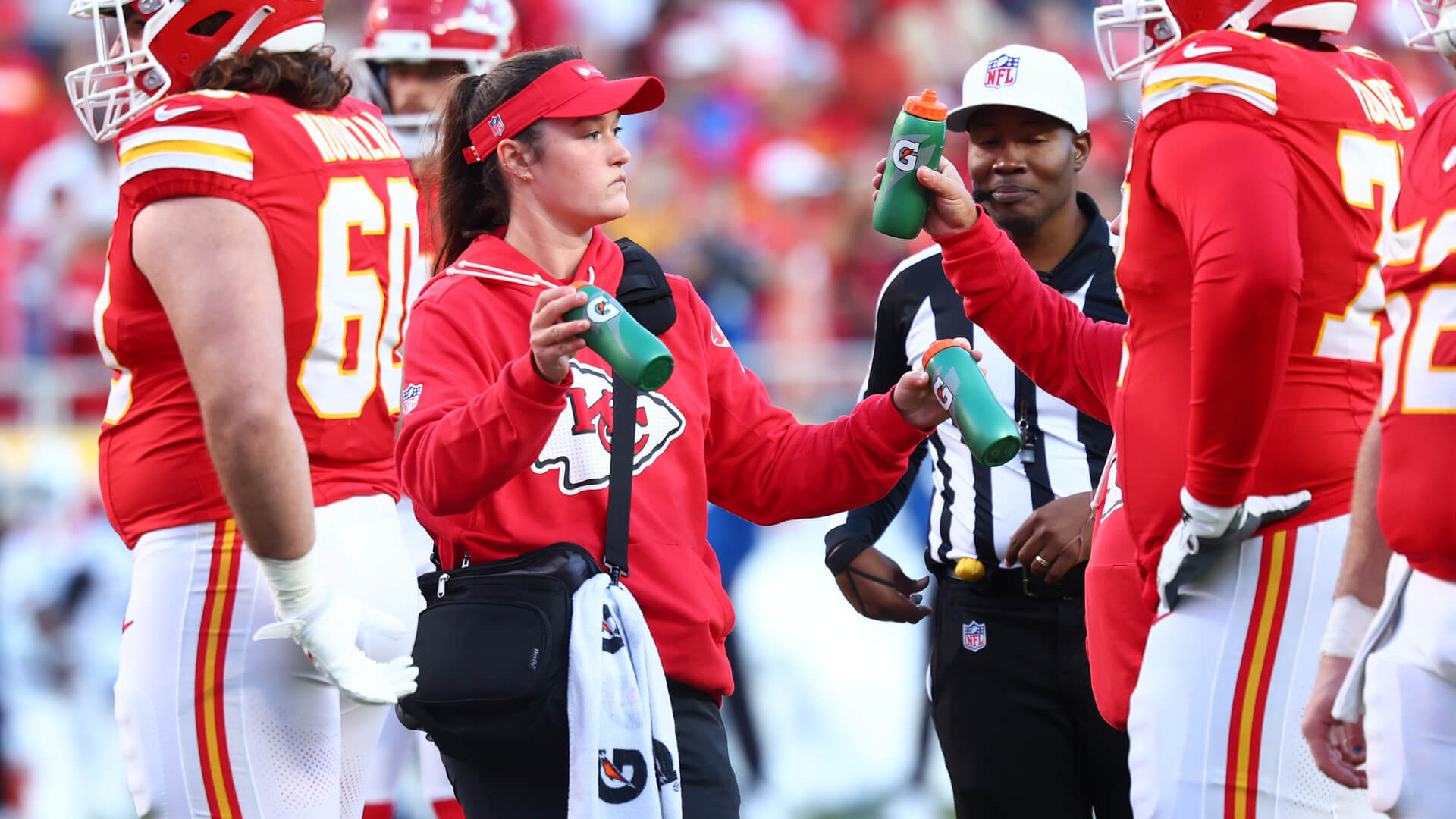 Purdue alum Gabby Poalino has worked for the last two seasons as a seasonal athletic trainer with the NFL’s Kansas City Chiefs and Washington Commanders. (Photo courtesy of Gabby Poalino)
“The best part about my time there was the clinical experiences they allowed us to have, being able to take what we learned in the classroom, as detailed and hands-on as it was, and then actually apply it to athletes or to patients,” says Gabby Poalino (BS athletic training ’22), who spent the last two seasons working as a seasonal athletic trainer with the NFL’s Washington Commanders and Kansas City Chiefs after previously interning with the league’s Tampa Bay Buccaneers. “Because we weren’t always necessarily in a sports environment, I did time at a PT (physical therapy) clinic. I did time working with Parkinson’s patients. Having a plethora of places to apply these skills that we were learning was really a huge advantage to me in my time there.
“So when the time came for me to start working in these more football-specific roles, I wasn’t just applying what I had learned at football,” Poalino says. “I was pulling from all of these other experiences and then able to apply my skills as a clinician to football-specific stuff.”
Program director Lawrance says that was by design, as he and his Purdue colleagues want every Boilermaker athletic trainer to graduate with a growth mindset in which they’re always learning new skills, plus the adaptability to thrive in a variety of work environments.
Soon, those opportunities will be available to a larger group of students than ever before. The Purdue athletic training master’s program is expanding to Indianapolis starting in fall 2026, allowing the program to accept twice as many students as it had the capacity to serve in the past. Once Purdue reaches full capacity, Lawrance believes the program will have one of the world’s largest cohorts of athletic training students.
These new Boilermakers will ensure that the tradition Newell started will continue to thrive, sharing Purdue expertise that keeps patients healthy — whether they’re casual weekend warriors or one of the future NFL superstars participating in the combine.
“You find Purdue grads just about anywhere you go within the realm of athletic training, whether it’s college or the NFL or wherever,” Poalino says. “It’s kind of crazy how small of a community it really is.
“Having a solid background coming from Purdue and coming from a program that is really well known, it carries the weight with it,” she says. “People see that, and I think they are able to have a little trust in your background and where you’re coming from. And it definitely doesn’t hurt that we have other people out there who are succeeding, especially in the league. Those connections help, and it’s really just a tremendous weight that gets lifted off of my shoulders when I’m looking at jobs and people know that they can trust you because of that background.”