
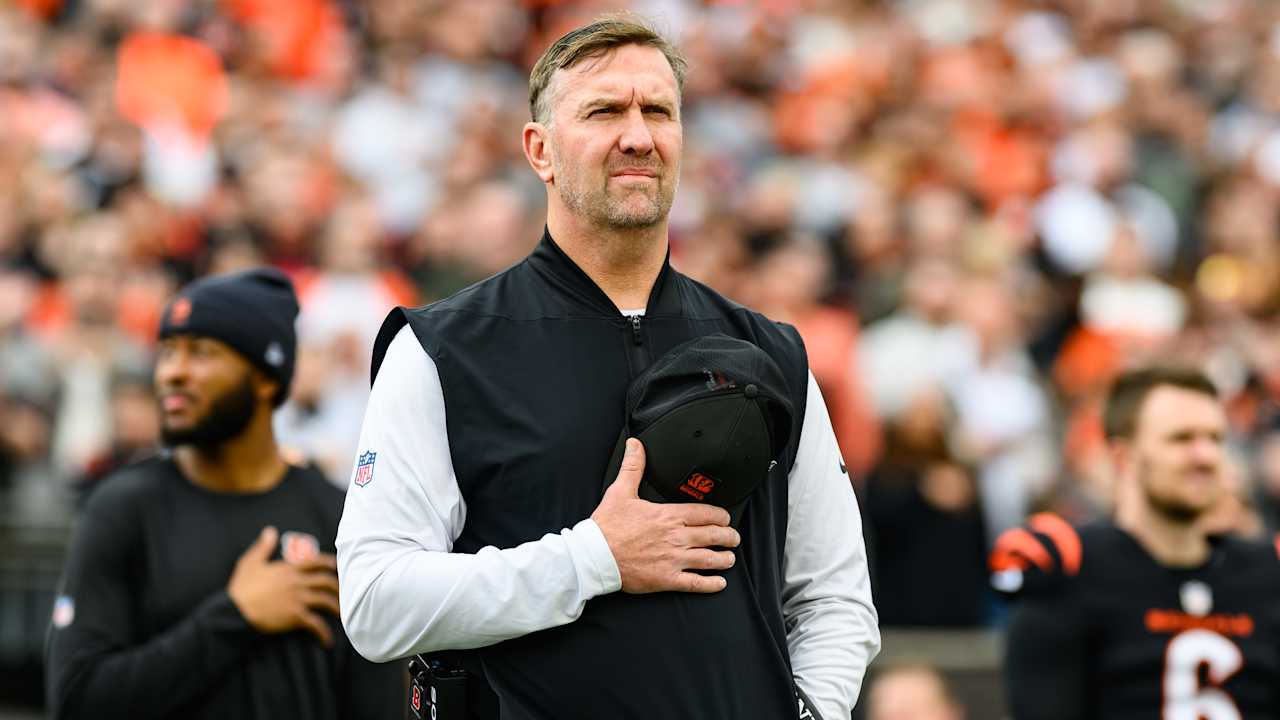
He understands the NFL is a big business and how he’s benefited from it. But he also knows his main task in Indy is to evaluate, and now it’s harder than it was when there were no highlights flashing on the scoreboards and the prospects were called to the 40-yard dash start with a bullhorn. Instead of mingling with a player after an impressive drill, the NFL Network cameras swarm.
“It was a good opportunity to get to know players on a personal level,” Simmons says. “There are fans. That’s not something I enjoy. It limits our accessibility and visibility to the players. It’s more efficient in many ways, but it’s also harder to evaluate.”
You have to remember that before Simmons, 52, joined the Bengals in 2003, he broke in with the Ray Lewis Ravens and was in Carolina when they drafted Steve Smith. He watches all positions but the offensive line, so he saw Bengals all-time receiver Chad Johnson turn to the scouts and coaches on the floor of the RCA Dome and declare, “Draft me.” He watched Delaware quarterback Joe Flacco sizzle into the first round throwing, “rockets.” He documented Heisman Trophy quarterback Joe Burrow’s stunning recall of singular down-and-distances from his final year at LSU.
“I’m watching the quarterbacks because I’m watching the receivers,” Simmons says. “But the only time I really notice them is, ‘Wow, there’s a bad throw.’ So Flacco was noticeable.”
The biggest change in the combine during that span, he says, is the specialization of the drills that fit the changing style of play. For instance, no one used to talk about drafting nickel cornerbacks. Only cornerbacks. Now, Simmons says, in a 4-3 defense the nickel has made the SAM backer nearly obsolete.
“I’m sure the combine in 2003 was different in 1983 as the game evolved,” Simmons says. “I think the drills
that they use are all very position specific to the game now, as opposed to what it may have been back then. The drills that the coaches do are specific to the pattern of the game now. Every drill, I think, ends with a DB catching a ball.
“I think there’s obviously an emphasis on seeing those guys backpedal and change directions. I think it’s more up to date in terms of the quarterbacks and the routes that they throw are more similar to the routes they run today.”
One of the biggest changes is in Simmons’ specialty of specialists. When Simmons emerged two decades ago as the man running those combine drills, it was just him and another coach in charge of punters, kickers, and long snappers. Of course, back then, probably only four punters and four kickers, along with a long snapper, were invited.
“That made it tough on players, and it was very costly for the teams,” Simmons says. “When guys were identified as prospects but weren’t invited, teams scheduled trips to go work them out, and then the prospect had to set up ten different workouts.”