
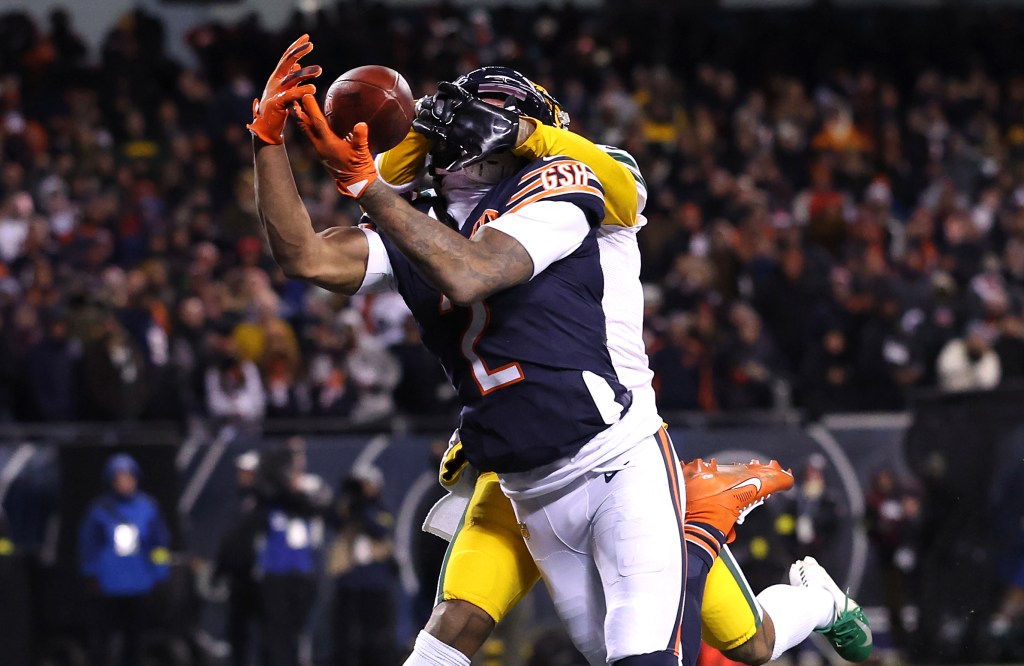
INDIANAPOLIS — The Chicago Bears are starting over at square one. This week is one of the big first steps.
The journey to the 2026 season has begun and the NFL scouting combine is a big stepping stone. This is an important week and one that will help inform the Bears how to proceed over the next few months.
Teams meet with top draft prospects at the combine, but perhaps just as important are the conversations happening behind the scenes with other teams and NFL agents. A lot of what shakes out over the next few months begins with informal conversations at the combine.
Bears general manager Ryan Poles and head coach Ben Johnson spoke with members of the media on Tuesday. The conversation was wide-ranging. Poles said he has fielded initial calls regarding backup quarterback Tyson Bagent’s availability and he said the Bears remain uncertain whether they will receive draft compensation via the Rooney Rule after Ian Cunningham left to become the general manager of the Atlanta Falcons.
Here’s what else stood out on Tuesday.
1. There’s been a lot of chatter about DJ Moore — and Poles didn’t shut it down.
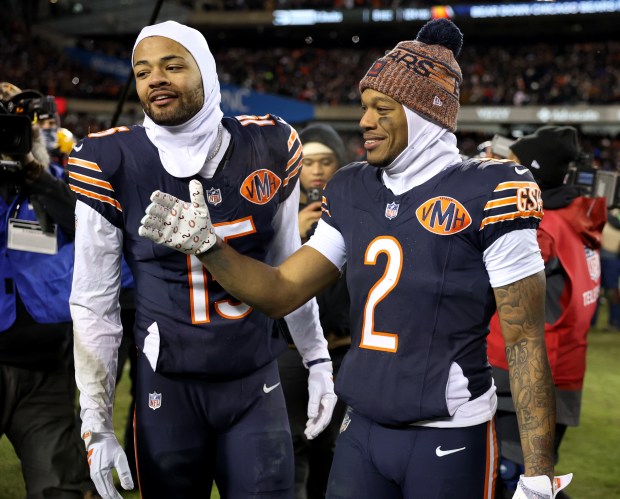 Chicago Bears wide receivers Rome Odunze and DJ Moore celebrate after their victory over the Green Bay Packers in an NFC wild-card game at Soldier Field in Chicago on Jan. 10, 2026. (Chris Sweda/Chicago Tribune)
The Bears are over the salary cap and the offseason has barely started. NFL teams don’t have to be cap compliant until the new league year officially begins in mid-March, but Poles has work to do to bring his team under the bar, and that’s not to mention finding room to make additions in free agency or eventually signing his 2026 draft picks.
Rightfully so, DJ Moore’s name has been a hot topic. Moore’s $28.5 million salary cap hit in 2026 will make him the highest-paid player on the team. Moore totaled 50 catches for 682 yards and six touchdowns last season — respectable numbers, but perhaps not highest-paid-player-on-the-team numbers.
Asked if Moore is part of the plans in 2026, Poles provided a sober, nuanced answer that was far from a definitive yes.
“I have to have conversations to see what, like I said, the best combination of players we can bring in,” Poles said. “We want him here. We think highly of him. He’s a great teammate. He has been productive pretty consistently over the last however many years he’s been here. So I have nothing but great things to say about him. But this is the time now where we have to look at all the different scenarios to see what can allow us to put the best team out there.”
Moore was a key piece in the 2023 trade that sent the No. 1 overall draft pick to the Carolina Panthers and eventually netted Caleb Williams. Poles and the Bears later signed Moore to a four-year, $110 million contract extension ahead of the 2024 season. That new contract begins in 2026, so he remains under team control for four years.
Make no mistake, the Bears love what Moore brings to the locker room. He’s tough and dependable (he hasn’t missed a game since 2020), he’s a leader who teammates look up to and he’s wicked smart on the football field.
“He probably knew all the roles of the receivers better than anybody else we had (at receiver),” Johnson said. “The X, the Z, F, it really didn’t matter. He was a guy we knew we could count on. If guys go down, he can step in. There really wasn’t anything we shied away from in terms of the route tree that he could or could not do.”
But this is a discussion that likely will come down to dollars and cents. Does it make sense for the Bears to keep a $28 million receiver on the roster when he was, at times, overshadowed by first-round draft picks like Rome Odunze and Colston Loveland?
“I know Ben was very intentional with getting him the football to create opportunities,” Poles said. “But when you have Colston start to pop up, Luther (Burden), Cole (Kmet), Rome was going through different (injuries) throughout the season, but started hot early — so a unique situation overall. But I know we were happy with him throughout the entire season.”
2. “We’ve got to make decisions” on Tremaine Edmunds, Jaquan Brisker and others.
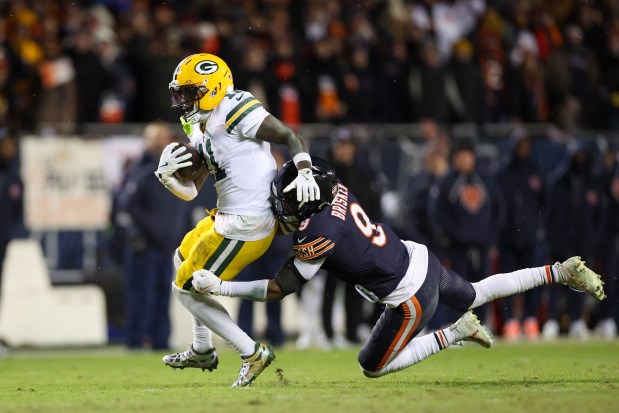 Chicago Bears safety Jaquan Brisker tackles Green Bay Packers wide receiver Jayden Reed during the fourth quarter of a NFC wild-card game at Soldier Field on Jan. 10, 2026, in Chicago. (Armando L. Sanchez/Chicago Tribune)
According to Overthecap.com, the Bears are $4.11 million over the salary cap, even after shedding special teams player Amen Ogbongbemiga’s $2 million salary hit.
The Bears likely won’t be done there. Linebacker Tremaine Edmunds’ potential $15 million in cap savings looms large, but his loss on the field would only exacerbate the Bears’ needs at linebacker — in addition to defensive line, left tackle and safety.
“There’s a couple guys we’ve got to make decisions on,” Poles said. “This is a unique situation where we’ve gotten our roster in a position where we have a lot of talented players, a lot of guys getting paid well, and that puts some constraints on the cap.
“So we’ve got to make some tough decisions.”
The Bears could restructure some contracts to free up more cap space, but deferring money kicks the can down the road.
“At some point you’ve got to pay that bill,” Poles said.
The front office also faces a conundrum at safety, where Kevin Byard III, who earned third career selections to the All-Pro and Pro Bowl teams, and Jaquan Brisker are up for new contracts.
Byard carried an $8.5 million cap number last season, Brisker, $4 million. Both will likely command raises.
“It’s actually four safeties that are not under contract for next year,” Poles said. “Kevin’s a special player. I have no problem saying that’s a player that we would like to have back. But, again, when you add the other safeties into that mix and all the other decisions we have across the roster, with cap restraints and things like that, it’ll be a challenge.”
The Bears could save $8.4 million by cutting or trading Kmet (and be charged $3.2 million in dead money). For running back D’Andre Swift, it would be $7.47 million in savings, $1.33 million in dead money.
But the Bears offense leaned heavily on using Kmet in tandem with fellow tight end Colston Loveland, and they successfully platooned Swift and Kyle Monangai to rank third in the league in rushing (144.5 yards per game).
Poles said they have to weigh the cap benefits against the cost of replacing them.
“We’re working through that,” he said. “I feel pretty good about the guys you just mentioned being here. But again, there’s a lot more calls coming in, interest in these guys, that we have to kind of sequence that out to see how it impacts our team.”
3. Johnson looked outside for an offensive coordinator.
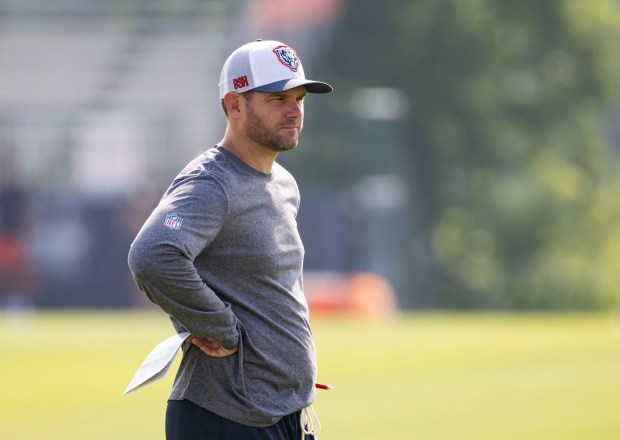 Chicago Bears passing game coordinator Press Taylor watches Wednesday, July 23, 2025, during the first practice of training camp at Halas Hall in Lake Forest. (Brian Cassella/Chicago Tribune)
Johnson said coaching was a calling for new Baltimore Ravens offensive coordinator Declan Doyle, who was Johnson’s offensive coordinator last season.
“If you didn’t know that he was 29 years old, you wouldn’t blink an eye,” Johnson said. “The guy is seasoned beyond his years.
“(He) has a great way of communicating. He’s very clear.”
Johnson added that Doyle is smart and detail-oriented, and he was looking for the same qualities in Doyle’s replacement.
Johnson gave the nod to former pass game coordinator Press Taylor, who previously was Doug Pederson’s offensive coordinator for three seasons with the Jacksonville Jaguars (2022-24).
Who is Press Taylor? Meet the Chicago Bears’ new offensive coordinator.
But Taylor’s ascension wasn’t automatic.
“We interviewed outside of the building,” Johnson said. “Certainly we have a number of guys in the building that I feel very strongly about as well. Not just Press.”
Candidates from Johnson’s staff included assistant head coach and wide receivers coach Antwaan Randle El (who was an assistant with Johnson in Detroit) and quarterbacks coach J.T. Barrett, who was instrumental in helping develop Caleb Williams.
So what stood out about Taylor?
“Press in particular was a guy that checked all the boxes of what I was looking for,” he said. “He did a phenomenal job last year. He’s very smart, very detailed, did some things behind the scenes that people probably don’t realize, and I know he’s got the respect of these players.”
Meanwhile, Johnson heaped praise on former running backs coach Eric Bieniemy, who reunited with the Kansas City Chiefs’ Andy Reid to once again serve as his offensive coordinator.
“We’ll miss (him) a ton,” Johnson said. “I was just blown away from the impact he had not only in that position room, which Swift had probably the best year of his career and then the seventh-rounder Monangai had a hell of a year himself, not just that room but the entire offense.
“He brings a demanding presence. The standard is the standard with Eric Bieniemy and those are big shoes to fill.”
Johnson hired Eric Studesville, who served as the Miami Dolphins’ running backs coach for eight seasons, adding the title of associate head coach for the last four.
“I do feel strongly about Eric Studesville … a guy that I’ve worked with before,” he said. “He’s been a part of really good rushing offenses in the past and I know he’s going to bring a great flavor for us.”
4. Keep your day job, Caleb Williams.
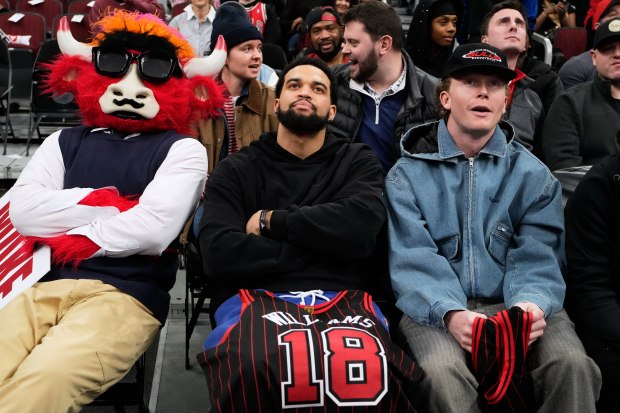 Chicago Bulls mascot Benny the Bull, left, Chicago Bears quarterback Caleb Williams, center, and Chicago Cubs center fielder Pete Crow-Armstrong watch a game between the Los Angeles Clippers and the Chicago Bulls in Chicago, Tuesday, Jan. 20, 2026. (AP Photo/Nam Y. Huh)
The Bears’ sophomore quarterback had a highlight-filled season that included a playoff run, but his athletic hot streak came to a screeching halt in the NBA Celebrity All-Star 3-point shooting contest.
Caleb Williams finished last with a score of 4 — a spot behind comedian Druski.
Johnson stepped forward to take the blame (or credit?).
“I know what everyone’s thinking: Does Caleb have NBA aspirations? And the answer is no,” he told reporters with tongue in cheek. “I think football is his calling.”
Johnson admitted, “I sent him a meme of a guy just missing left and right, like before (the contest), and then when it actually happened, I felt bad.
“Spoke that into existence, didn’t I?”