
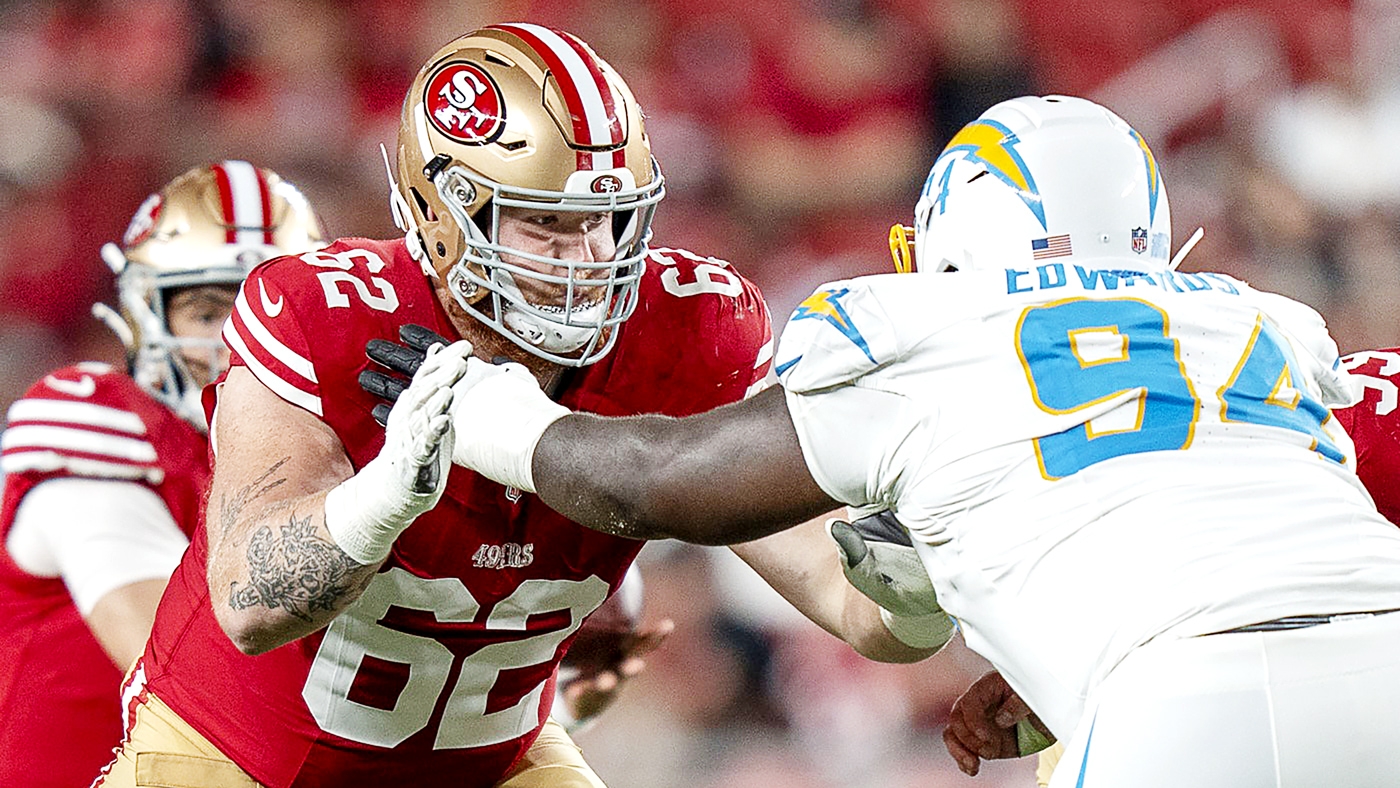

The San Francisco 49ers face a critical crossroads in stalled negotiations with All-Pro and future first ballot Hall of Famer, Trent Williams.
Williams, 38, still an elite protector, has anchored the club’s offensive line and played a pivotal role in Kyle Shanahan’s offensive scheme since 2020. If Williams and the organization cannot reach a contract restructure, the team must explore immediate and long-term succession plans.
Recently, I explored more of the financial implications between Williams and the organization; if you want to read more about that side of things, it can be found here.
Three options for the 49ers to fill the void if Williams doesn’t return next season
The first option for general manager John Lynch and head coach Kyle Shanahan is the upcoming draft. Using a first-round pick on an offensive tackle could serve as a long-term solution. Two impactful prospects that could be within the 49ers’ draft range are Caleb Lomu out of Utah or Kadyn Proctor way of Alabama.
Lomu, a reliable, very athletic pass-blocker, needs to improve as a run blocker. According to Walter Football, some of his strengths are his elite footwork, his ability to block speed rushers, his good performance against bull rushers, and his good ‘get-off.’ Lomu has a ton of upside.
He reacts very well to rushes to the inside and shows impressive balance. As a pass blocker, Lomu does a nice job of maintaining his blocks and sustaining using his hands and length well to stay engaged with defenders. Lomu uses his athletic ability well and stays in front of defenders. For the NFL, Lomu could be a very valuable starting left tackle to protect his quarterback against edge rushers.
Lomu needs to improve as a run blocker. His overall pro comparison is Taylor Decker, who has had a very good career with the Detroit Lions.
As a run blocker, Lomu is not a bull in the ground game. He is not overly strong or physical to blast defenders off the ball and ride them around the field. Right now, Lomu would be better off in a zone-blocking system to use his athleticism due to not packing a serious punch at the point of attack.
Kayden Proctor is a massive man at 6-foot-7 and nearly 370 pounds. He’s a powerful blocker and very athletic for his size. The Draft Network labeled him an athletic anomaly—explosive, fluid, and flexible at a size few humans can manage, let alone move as he does.
He’s a true displacer—an immovable object with natural power. With Proctor, it’s just math. His raw strength, paired with elite athleticism, makes him a dominant force at the point of attack.
There are some concerns.
Proctor can rely too heavily on his size advantage and come off the ball too high-hipped. That upright posture reduces his ability to generate consistent leverage, especially against lower, compact defenders. Improving pad level and bend will be key to fully unlocking his run-blocking potential.
The internal route — Austen Pleasants
Should the 49ers look internally, Austen Pleasants is the most logical candidate, but this would leave quarterback Brock Purdy‘s blindside very vulnerable.
In limited 2025 action during Williams’ absences, Pleasants filled in admirably posted a 95.9% pass-blocking efficiency rate according to PFF, allowing minimal direct quarterback disruption—an encouraging figure on the surface, but a very small sample size. The 49ers would often give Pleasants extra help in pass blocking situations with a tight end staying in to block or using a running back to chip on his size.
While Pleasants excelled in relief duty, it’s noteworthy to indicate that he benefited from scheme protection. Over a full season, his margin for error would likely shrink, and there would be havoc in San Francisco’s backfield more often than not.
What about adding a free agent?
Well, as it currently stands, there just aren’t many options to explore in free agency. This bodes well for big Trent and his representation. Here are a few of the cast of characters expected to be available who primarily play left tackle.
Rasheed Walker (26) is the cream of the crop current UFA at the position. Walker, who, like many young players, struggled at times, particularly early in his career, performed very well last season with the Green Bay Packers.
He ended last season not allowing a sack over the Packers’ final four games and has proven to be very durable, having not missed a game over the past three seasons. Here’s the problem when it comes to the chances of Walker landing with the 49ers.
Spotrac estimates that Walker will earn just over $20 million annually on the open market and garner a four-year deal. Not bad for a former seventh-round draft selection. Pair that with what the organization will need to pay Williams, whether he’s with the organization or not, just isn’t feasible.
Cam Robinson (30) is coming off an atrocious season with the Cleveland Browns. Robinson’s 13 infractions last season were the second most in the league, plus he struggled mightily as a pass protector.
Kelvin Beachum (36) was moved to the right side with the Arizona Cardinals last season and struggled to hold up ranking as a bottom-five option according to PFF in pass-blocking efficiency and pressure rate. Beachum shouldn’t and won’t have any consideration with the 49ers.
D.J. Humphries (32) served as a backup with the Los Angeles Rams, playing just 84 offensive snaps, making just one start last season, all at left tackle. He earned a PFF grade of 41.9, which is not good. Again, fine as a depth player, but certainly not someone to consider as a successor to Williams, even in the short term.
Conclussion
In the end, reconnecting and finding common ground with Trent Williams should be John Lynch’s priority, but drafting a successor with a high pick in the 2026 NFL Draft must also be an important focus.
I wonder about drafting a prospect like Kayden Proctor (if available), utilizing his size and athleticism to lower his responsibilities and kicking him to the left guard position for a year, where he could learn and play beside Williams, then slide out to the tackle position once Williams departs.