
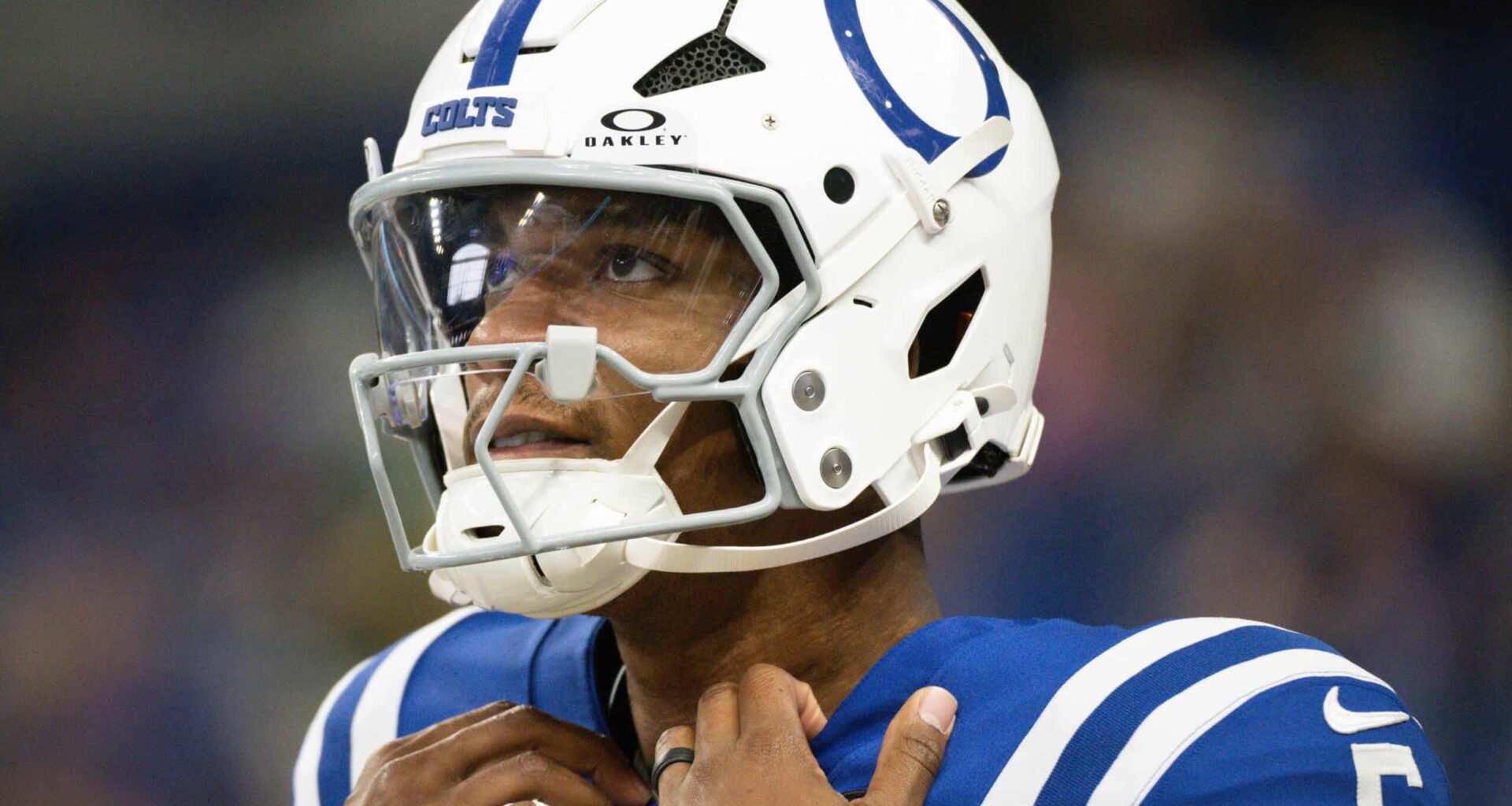
Malik Willis’ story is one of the most inspiring in the NFL over the past few years. A quarterback who was discarded by an AFC South franchise, only to arrive in Green Bay and rebuild his value, revive his career, and reestablish himself as a legitimate starter in the league.
Now Willis is expected to land a free-agent deal worth around $30 million per year — a remarkable turnaround considering where he once stood. And once he moves on, the Green Bay Packers could once again position themselves to write a new Cinderella story — this time, with Anthony Richardson.
Richardson’s NFL career has been up and down from the start. Injuries have slowed his progress, and when he has played, the results have been inconsistent. He posted an 8-7 record as a starter over his first two seasons and completed only 53.6% of his passes, showing flashes without ever fully putting it together.
Here’s where Anthony Richardson ranks in EPA/dropback (doesn’t include his designed runs, mind you) compared to other 1st round picks through 10 starts. Highlighted some notable names. pic.twitter.com/hZEqop65dG
— Steven Ruiz (@theStevenRuiz) October 29, 2024
Last summer, Daniel Jones beat him out for the starting job, and the Indianapolis Colts are reportedly interested in keeping Jones around. Richardson is entering the final year of his rookie deal, and both sides are looking for a fresh start.
Since 2023, the former fourth-overall pick ranks:
41st in EPA per play
42nd in adjusted EPA per play
50th in success rate
54th (last) in completion percentage
53rd in expected completion percentage
54th (last) in completion percentage over expected
Richardson’s efficiency profile is undeniably rough. The accuracy issues, in particular, need significant work. But the arm talent is just as undeniable. In the right structure, that kind of raw ability can become dangerous. It’s a high-variance bet, but one that fits the idea of a reclamation project with real upside.
I honestly miss watching Anthony Richardson play pic.twitter.com/BUVL5pi4gl
— Joe Orrico (@JoeOrrico) February 18, 2026
Anthony Richardson will be only 24 years old when the 2026 season begins. For all the criticism and inconsistency, he’s still younger than many quarterbacks entering the league.
He’s under contract with Indianapolis for one more year. However, the Colts have agreed to trade Richardson this offseason, and it would make sense to get something in return rather than risk losing Richardson for nothing. That’s especially true with how strong the 2027 draft class is projected to be.
Realistically, it would probably take a late Day 2 pick even to start the conversation. Moreover, whichever team trades for him would also be responsible for the final year of his rookie contract — roughly $5.3 million, per Over the Cap.
It’s not entirely fair to compare Anthony Richardson to Malik Willis from a trade-value standpoint. Richardson was the fourth-overall pick, while Willis entered the league as a third-round selection. On pedigree alone, Richardson carries a higher level of investment and perceived upside. Add in the superior physical traits and stronger arm talent, and it’s understandable why Indianapolis would aim higher.
The contract situations are also different. When the Packers traded for Willis in 2024, he still had two years remaining on his rookie deal, giving Green Bay more team control and flexibility. Richardson, on the other hand, has just one year left on his current rookie contract.
Still, from Green Bay’s perspective, it’s difficult to justify surrendering premium draft capital for a reclamation project. It’s hard to envision them offering anything higher than a mid-Day 3 selection. If the price ever dropped into that range, however, it would likely qualify as a low-risk, high-reward swing — the type of calculated bet that has paid off for them before.
Jordan Love has missed time in back-to-back seasons. If Richardson were to come in and perform anywhere close to the level Willis did in Green Bay, he could put himself back on the market for a new deal.
It likely wouldn’t be as lucrative as the contract Willis is projected to command, given the different timelines and circumstances. Still, Richardson could position himself for a meaningful payday in 2027 free agency. From Green Bay’s perspective, that’s where the upside lies.
If things break right, Green Bay could potentially turn a mid-Day 3 pick into an early Day 3 selection — or even a Day 2 pick — depending on Richardson’s performance in 2026 and the value of the contract he signs afterward. In that scenario, it becomes the kind of low-risk, asset-management move that smart front offices look to exploit.
And even if Richardson were only in Green Bay for one year, there would still be a way to justify the trade.
Let’s not forget that the Packers would not have made the playoffs in 2024 without Willis stepping up when needed. Having a reliable backup quarterback matters — especially for a team with postseason expectations.
If they call Richardson into action, his athleticism would allow Green Bay to lean into a similar package to what Willis ran under Matt LaFleur. The mobility, designed runs, and vertical play-action concepts could still function within LaFleur’s offense, even if the passing efficiency isn’t perfect. In that sense, it wouldn’t require a complete schematic overhaul — just a tailored version of what has already worked before.
The fact that Anthony Richardson has only one year left on his contract could ultimately keep Green Bay from pulling the trigger. That limited team control makes it harder to justify even a modest draft investment.
Still, it’s hard not to see the appeal. Richardson’s raw tools, paired with a creative offensive mind like LaFleur, would be fascinating. In many ways, he fits the “doesn’t work but could be fun to fix” broken record player meme — a talent whose traits jump off the screen even if the consistency hasn’t followed.