
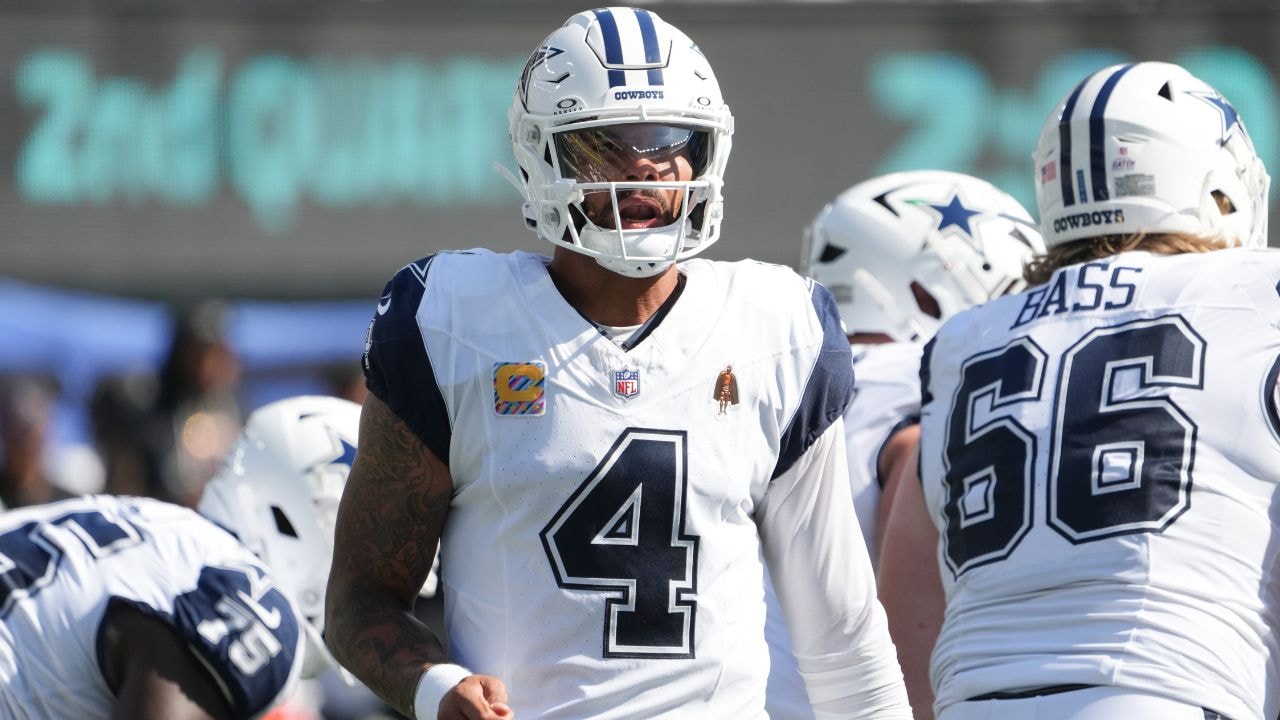
Dak Prescott is still waiting for the one accomplishment that would silence every critic: a Super Bowl appearance, let alone a championship. Ten seasons into his career, the franchise quarterback has piled up statistics, Pro Bowls, and individual milestones. What he has not done is deliver Dallas back to the sport’s biggest stage.
That reality made the Cowboys’ 2025 season even more frustrating. Under first-year head coach Brian Schottenheimer, Dallas finished 7-9-1 after losing four of its final five games, missing the playoffs for the second straight year. Yet despite the disappointing team result, Schottenheimer insists Prescott took a step forward.
“Just that the guy’s curious as anything, man,” Schottenheimer said. “He wants to grow. He wants to get better. He did get better this year, which is crazy. I mean, he did. I mean, you look at the metric, you could see he maybe had his best year as a professional.”
On paper, the numbers support that argument. Prescott completed 404 of 600 passes for 4,552 yards, 30 touchdowns, and 10 interceptions. His passing attempts, completions, and total yards led the NFL. He threw for 300 or more yards six times and recorded four straight games with at least three touchdown passes between Weeks 4 and 7. It was his fourth career 4,000-yard season and statistically one of the most productive campaigns of his career.
But context matters. While Prescott led one of the league’s more explosive offenses, Dallas struggled defensively and faltered late. A 6-5-1 team entering December collapsed down the stretch. For a quarterback of Prescott’s stature and contract value, team outcomes inevitably shape perception more than individual totals.
Schottenheimer believes growth extended beyond box scores. “You could point to certain aspects of his game,” he said, before emphasizing something he views as even more critical. “You know what’s more important than the head coach also play caller relationship with the quarterback? There really isn’t one. That’s maybe the most important relationship you can have in a football team.”
That dynamic was central to Schottenheimer’s first year. Though he had previously served as offensive coordinator without calling plays, he leaned on an existing rapport with Prescott to accelerate the transition.
“I think that’s one of the benefits that I was given having been there and had the relationship with Dak,” he explained. “But I just think how quick we picked up each other’s rhythm. Obviously I was the coordinator for the last couple years, but didn’t call the plays. But there was a rhythm that we got into. We came out of the gates fast and he did have a great year, and there’s still room for improvement.”
Schottenheimer also pointed to schematic adjustments. “I love that we were able to play it more under center and do some more of the play action stuff. I think he’s great at that,” he said. “But the leadership and the command of what that guy brings to our locker room is unique.”
That leadership was evident even in a largely meaningless Week 18 game against the Giants, when Prescott insisted on playing. He went 7-of-11 for 70 yards in the first half, lost a fumble early, then steadied the offense with back-to-back scoring drives before giving way to backup Joe Milton. The decision reflected a quarterback determined to finish what he started after dealing with injuries in prior seasons.
Off the field, Dallas has also moved to protect its investment. Guard T.J. Bass, who impressed in limited action and ranked among the top linemen in pressures allowed during one stretch, is expected to receive a second-round tender worth $5.8 million as a restricted free agent. Retaining depth along the offensive line signals the organization’s commitment to keeping Prescott upright as he enters another pivotal year of his four-year, $240 million deal.
The Cowboys also re-signed quarterback Will Grier to a reserve/future contract, maintaining depth behind Prescott as free agency approaches. With the 12th overall pick in the upcoming draft and cap decisions looming, roster construction will be critical if Dallas hopes to rebound.
The numbers suggest Prescott “did get better,” as Schottenheimer claims. The rhythm between coach and quarterback appears genuine. The offensive production was real. Yet in Dallas, progress is measured differently. Until Prescott delivers a deep postseason run, improvement will always feel incomplete.