
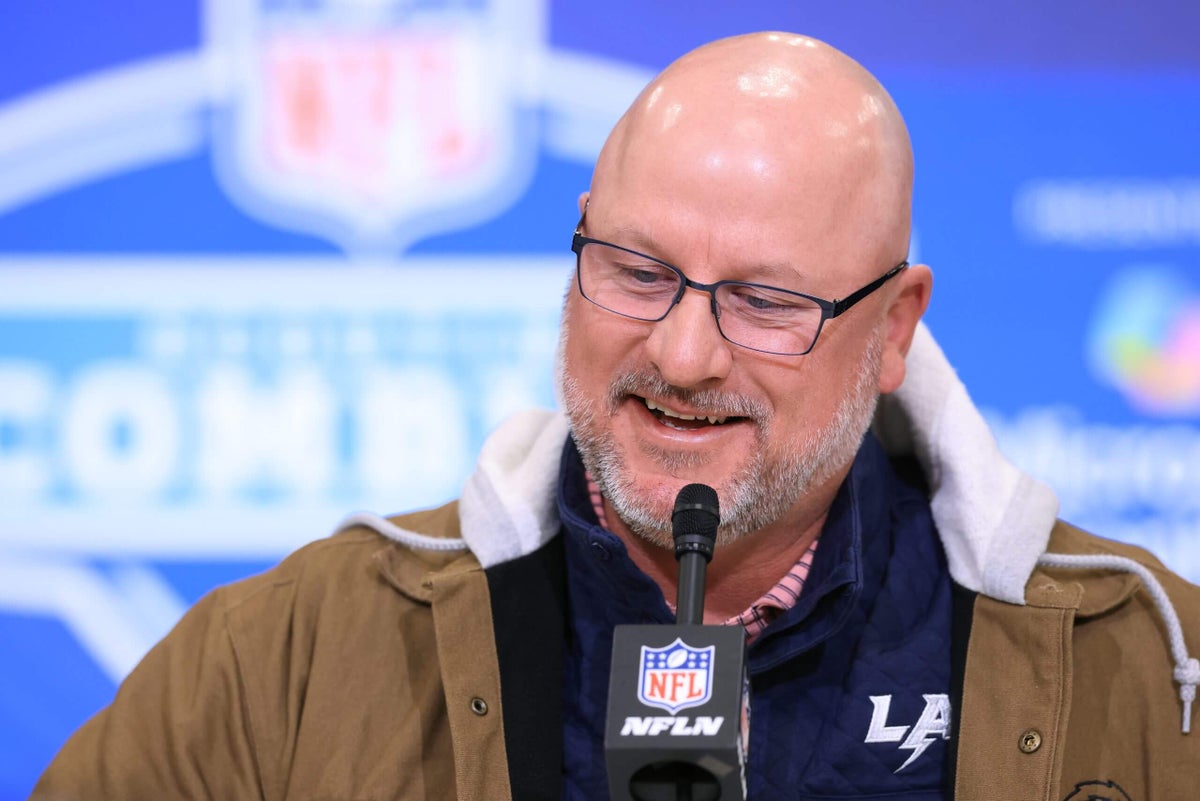
INDIANAPOLIS — Another busy combine is in the books, and after spending a week bouncing around the city, I have Los Angeles Chargers intel to share.
Free agency begins in less than two weeks. The Chargers have cap space to spend and decisions to make on several key internal free agents.
Let’s dive into what I heard and how it all impacts this Chargers offseason.
• Many of the Chargers-related conversations I had in Indy this week revolved around one philosophical question: How adaptable will general manager Joe Hortiz be in his free-agency strategy?
In the past, Hortiz has used words like “responsible” and “clinical” to describe his preferred spending approach, and he has stuck to his principles over his first two Chargers offseasons. In 2024, the Chargers were tight against the cap, and those financial realities forced the organization to hunt for bargains. Last offseason, the Chargers had considerably more space — close to $60 million at the end of the combine. Hortiz did not shop at the top of the market, though. He still focused on finding surplus value.
Through both offseasons, Hortiz has produced an impressive list of free-agent signings who have outperformed their contracts, from defensive linemen Poona Ford and Da’Shawn Hand to cornerbacks Kristian Fulton and Donte Jackson to running back J.K. Dobbins.
At the same time, this is a results-based business. Surplus value in free agency is only meaningful if it leads to wins in the most important games. The Chargers have made two playoff appearances in the two seasons since coach Jim Harbaugh and Hortiz took over. They do not have a playoff win.
The Chargers have the second-most effective cap space in the league, according to Over the Cap. They have the resources to be aggressive and show some urgency in the roster build. Some in the league are watching to see if Hortiz sticks to his philosophy, which he honed over 26 years working in the Baltimore Ravens front office. Or if he adapts. This tradeoff is central to so many of the decisions the Chargers will make in the coming weeks.
• First and foremost, the Chargers will have to decide if they are going to be competitive in the markets for two of their best internal free agents, guard Zion Johnson and edge rusher Odafe Oweh. For my top 150 free-agent rankings, I predicted a $17 million average-per-year contract for Johnson and a $22 million APY contract for Oweh. After conversations this week, I think I might be low on both players.
Johnson is viewed as one of the best guards available in this free-agency period. He has some holes in his game, namely his awareness against stunts and twists. But he is young, athletic and durable. He put the best football of his career on tape down the stretch of the regular season. I expect him to have a robust market, and I would not be surprised if he ends up signing for more than $20 million.
Oweh, too, is young and coming off a great finish with the Chargers after arriving in L.A. via trade in October. He had 10.5 sacks in 13 games for the Chargers, including the postseason. He plays a premium position, and you could argue his best football is still in front of him. There is a scenario in which Oweh’s market reaches $25 million per year, perhaps even higher.
This is the reality of letting good, young players test the open market. The quality in free agency has become thinner and thinner. In turn, players like Johnson and Oweh have become more and more valuable. Teams end up having to pay good players like they are great players when there is considerable competition. Supply is low. Demand is high. The price increases as a result.
I do believe the Chargers want Johnson and Oweh back. The price matters, however. If the markets max out for Johnson and Oweh, I would expect the Chargers to pivot. I do not think the Chargers want to be tied to what would be pretty clear overpays.
• Because of how Johnson’s market is ostensibly shaping up, there is a very real possibility the Chargers will need to find three new starting interior offensive linemen for 2026. Bradley Bozeman retired, and the Chargers have a hole at center. My expectation right now is that the Chargers will be cutting Mekhi Becton before the new league year. Becton started at right guard for the Chargers last season after signing a two-year deal in free agency. The Chargers would save $9.7 million in space by moving on from Becton, according to Over the Cap.
How Hortiz pieces this group together will be fascinating to watch. If all goes according to plan, tackles Rashawn Slater and Joe Alt will return from season-ending injuries and remain All-Pro-level players in 2026. In theory, they should help elevate whichever players end up starting at guard and center. As we saw in 2025, though, theory is not always reality. The Chargers had the same thought last season, and both tackles were out for the season by Week 10.
I believe the Chargers are interested in Ravens center Tyler Linderbaum. Due to Hortiz’s established philosophy, there is no guarantee the Chargers will shop at the top of any market in free agency. However, if they are going to pay up for a player this offseason, I think it would be Linderbaum.
Ravens general manager Eric DeCosta said this week that Baltimore has already offered Linderbaum a market-setting contract. Kansas City Chiefs center Creed Humphrey tops the center market at $18 million per year. To be competitive, the Chargers will have to be willing to pay Linderbaum in the $20 million per year range — and potentially more.
Money spent on Linderbaum is money the Chargers cannot spend elsewhere. That is the give-and-take of roster building. Are the Chargers better off paying up for Linderbaum and settling for lesser pieces at guard? Or are they better off spreading that money throughout the interior for three mid-market players? I can see arguments for both avenues. And, of course, this point could become moot if Linderbaum returns to Baltimore.
• Coming out of the combine, my sense is that edge rusher Khalil Mack will return to the Chargers. He could retire. He could make a bigger salary elsewhere. But at this stage, winning is the priority for Mack, and the Chargers present a very good opportunity to do so. He believes in quarterback Justin Herbert and Harbaugh. He likes living in L.A. He has talked often about his appreciation for executive director of player performance Ben Herbert. I have a hard time believing Mack will hang up the cleats without a playoff win on his Hall of Fame resume. The film says he can still be an impact player.
Keeping Mack and Tuli Tuipulotu together on the edge would put the Chargers in a decent spot. If Oweh walks for a bigger deal, the Chargers could address edge early in the draft, perhaps as high as No. 22. They could then sign a low-cost edge in free agency for depth and competition. The Chargers can save $3.49 million if they move on from Bud Dupree. In this scenario, the Chargers would enter 2026 with an edge room of: Mack, Tuipulotu, first-round pick, low-cost free agent and 2025 fourth-round pick Kyle Kennard. Kennard would have to earn his roster spot in training camp.
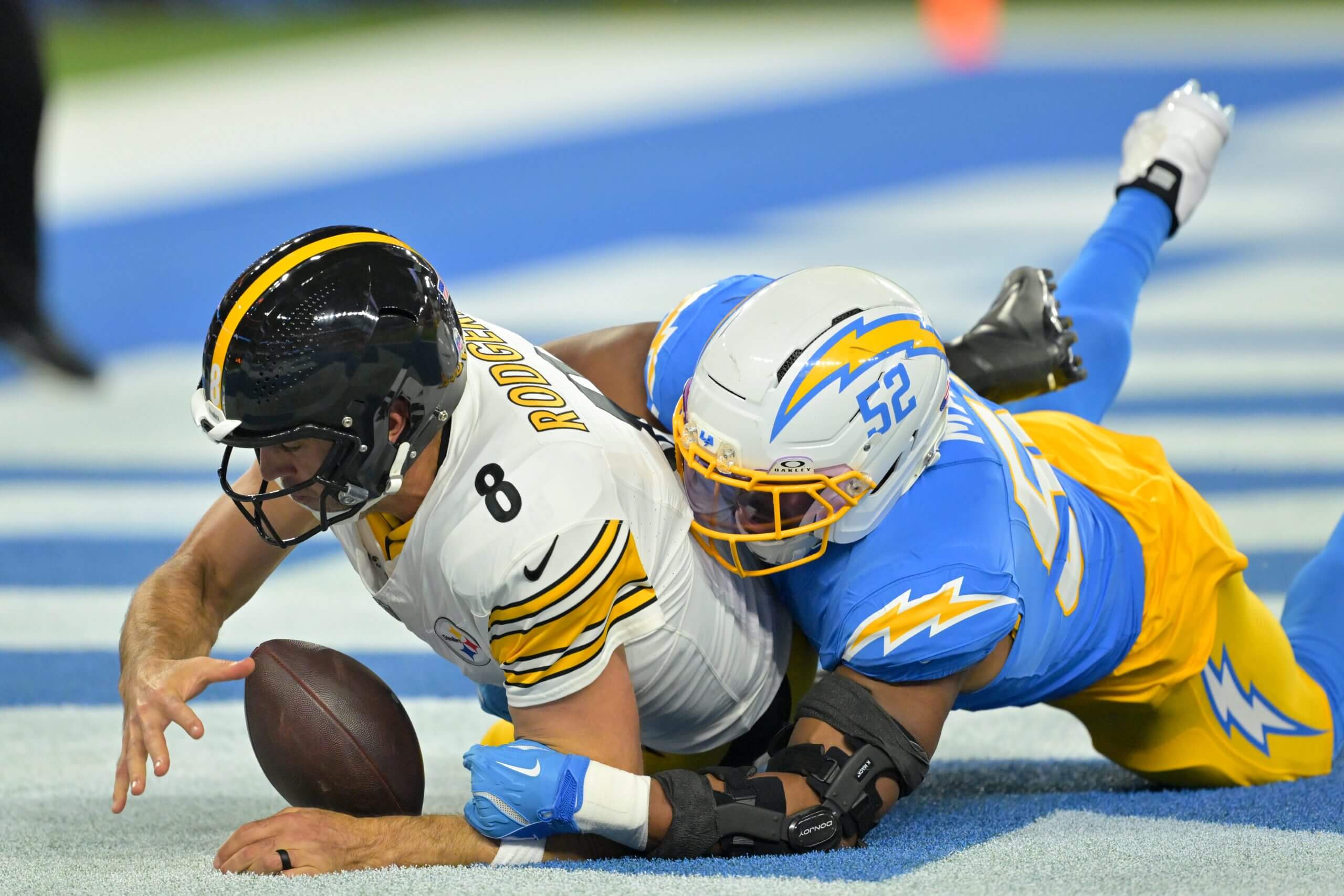
If Khalil Mack returns in 2026, it’s looking more likely that it’ll be with the Chargers. (Jayne Kamin-Oncea / Imagn Images)
• I will be keeping an eye on running back and tight end for the Chargers during free agency.
Running back Omarion Hampton, last year’s first-round pick, returns. Kimani Vidal, a 2024 sixth-round pick, is coming off a career season. He took advantage of his opportunity after injuries to Hampton and Najee Harris. Vidal finished with 779 scrimmage yards. He is an exclusive rights free agent, meaning he can only negotiate and sign with the Chargers as long as Los Angeles tenders him before the new league year begins March 11. I expect Vidal to be back.
The Chargers need a third back, and they will have options in free agency. One interesting name is the Pittsburgh Steelers’ Kenneth Gainwell, who finished fifth among running backs in receiving yards last season. Gainwell is a versatile receiving piece. He is not as dangerous or capable as a runner. But he would be an intriguing fit behind Hampton and within offensive coordinator Mike McDaniel’s scheme. The Chargers could opt for a more established runner to round out the depth in this room, especially considering the injuries they battled last year.
At tight end, Oronde Gadsden proved as a rookie last season that he can impact the game as a receiver. He is lacking as a blocker, however. The Chargers can save $4 million in space if they cut veteran tight end Will Dissly, according to Over the Cap. As the Chargers look at tight ends in free agency, I think they will be prioritizing two traits: blocking and athleticism. The Ravens’ Charlie Kolar is one player who fits this mold.
• One underrated internal free agent for the Chargers is linebacker Del’Shawn Phillips, their best special teams coverage player in 2025. Phillips finished second in the NFL in special teams tackles last season with 24, according to TruMedia. That was the highest single-season mark for any Chargers player in TruMedia’s database, which goes back to 2000. Philips was a difference-maker, and the Chargers should be eager to extend him.