
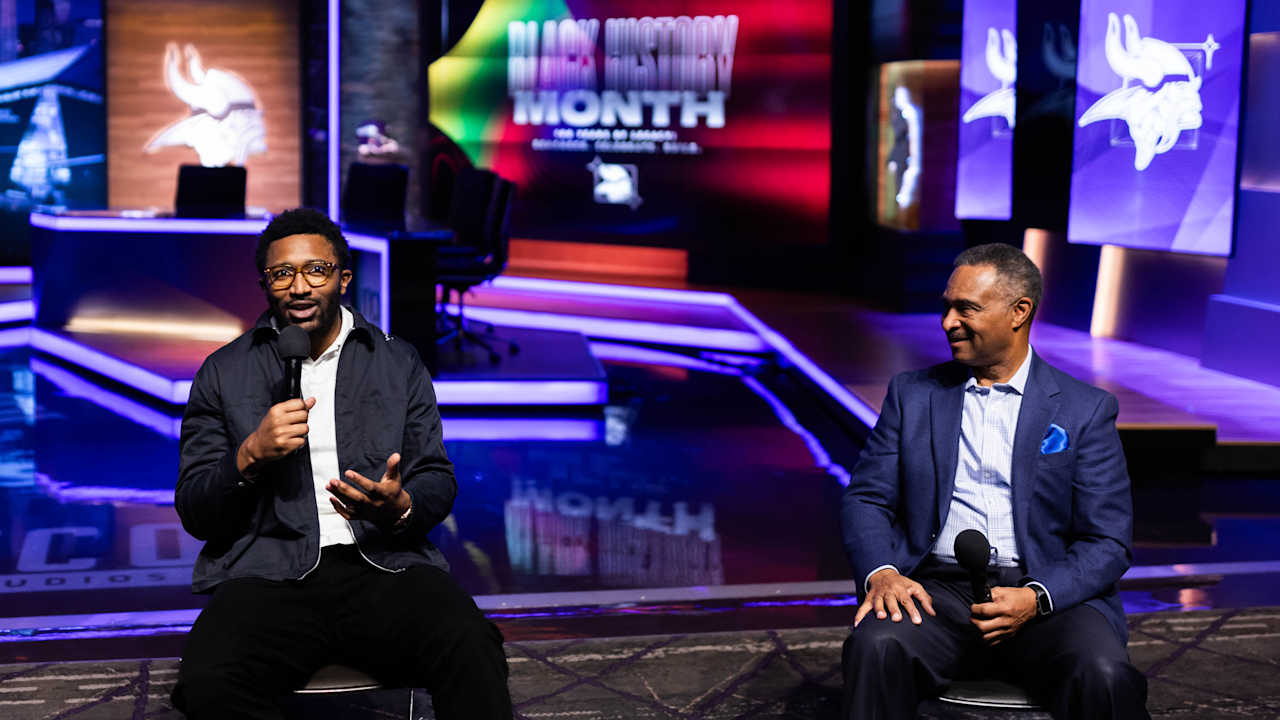
Lewis echoed Greenard’s sentiments on studying and understanding American — which includes Black — history.
“Sport and professional football run concomitant with our nation’s history in terms of access, civil rights,” Lewis said. “Who’s being hired, who isn’t being hired, and for what reason? The NFL runs very parallel to our country’s history.”
Many may not know that in 1933, NFL owners informally agreed to ban black players; that decision didn’t waver until 1946, when the Rams moved from Cleveland to Los Angeles and announced an intent to integrate as a condition of their leasing of Los Angeles Memorial Coliseum. The Rams signed Kenny Washington, a talented Black player who had starred at UCLA, and shortly after Woody Strode. By 1959, Black players still only accounted for about 12 percent of NFL rosters.
Though Lewis’ NFL journey started two decades after the league’s reintegration, he understood the impact of racial disparity through stories and lessons from his parents, both educators and — to this day — his biggest mentors.
“I’m a product of segregation,” Lewis told the audience. “I went to segregated schools. It hasn’t been that long since individuals in this country were legally mandated to attend segregated schools. It was brief [for me], certainly, but I have that as a basis.
“My mother lived a mile-and-a-half from the University of Missouri, but she couldn’t go to the University of Missouri in the early 1950s,” Lewis added. “She had to go to Lincoln University, which was 30 miles south, a Historically Black College. Thank goodness she had somewhere close she could attend.”
Lewis’ father, Leo Lewis, Jr., starred as a running back at Lincoln and then was drafted by the Baltimore Colts in the 1955 NFL Draft. He instead opted for the Canadian Football League, however, going on to play 12 seasons for the Winnipeg Blue Bombers — where he teamed with and then was coached by Bud Grant.