
INDIANAPOLIS
It’s the word no one wants to say.
The optics aren’t great. The fans won’t like it. And once it’s said, it can’t be taken back.
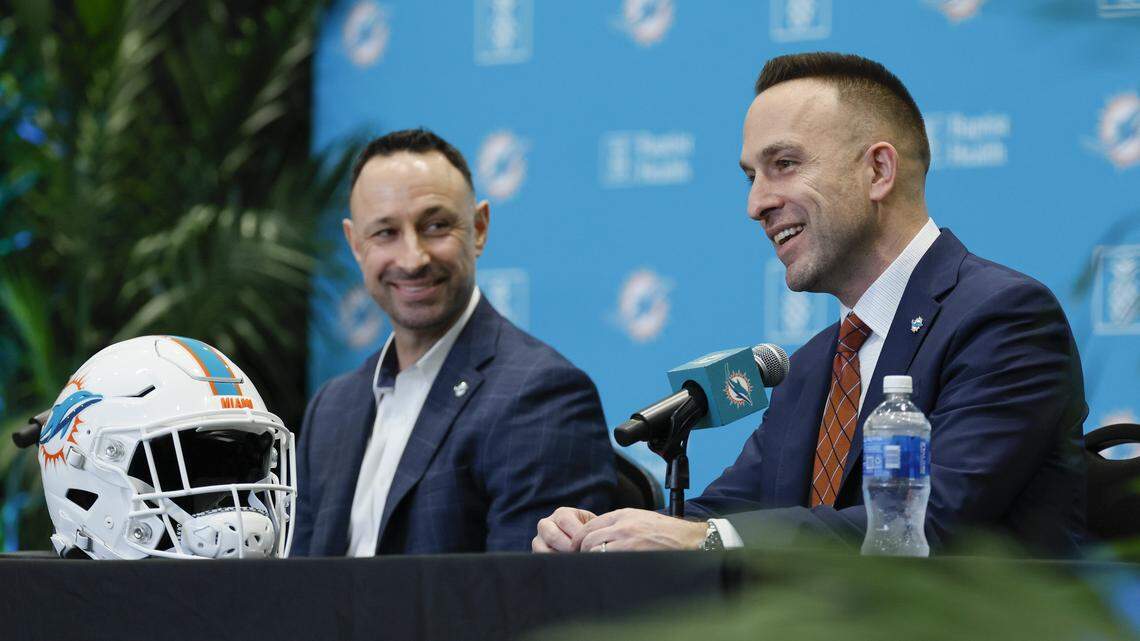
As the Miami Dolphins prepare for the 2026 season, there’s one word that’s seemingly off limits: rebuild. Neither general manager Jon-Eric Sullivan nor Jeff Hafley elected to say the in any of their interviews. Most fans know, however, that 2026 will unfortunately fall right in that category.
“What I want to do is build a foundation,” Sullivan said. “That’s my responsibility. Something that’s sustainable over time. We’re not looking for quick fixes here.”
Added Sullivan: “All the r words – retool, rebuild, refocus – I don’t like that because that gives the connotation of like ‘Hey, we’re mailing it in this year.’ That’s 100% no what’s going on. We’re here to compete, play our ass off, try to win football games as we build this thing out. That’s the culture we want to be. We want people that embrace that underdog mentality.”
It’s clear, however, that Sullivan and Hafley have chosen another phrase – build a foundation – to suffice.
“Between free agency, the draft and the good pieces that we have right now, the whole goal is to build a really strong foundation, and we have a shared vision for that,” Hafley said. “I have kind of noted that. It’s one of the reasons that I wanted to come here with the relationship that I have with him and us talking really over the last two years of what it will look like.”
There are several reasons why the outlook of the 2026 season looks bleak. For one, the Dolphins remain married to quarterback in Tua Tagovailoa who they would love to move on from. What makes that complicated, however, is the huge cap hit that his release will trigger. That, in turn, makes a bad situation even worse as the Dolphins already have very limited cap space to begin with due a slew of bad contracts.
“We’ve had conversations with Tua and his representation,” Sullivan said. “Everything’s on the table, including the potential of a trade. We don’t know which way that’s going to go. There are a lot of different factors at play, a lot of conversations being had.”
The lack of cap space becomes an even bigger issue upon the realization that the Dolphins have more than 30 unrestricted and restricted free agents.
“We have a bit of an uphill climb,” Sullivan said. “We’ll do it the right way.”
A positive: despite the uncertainty surrounding Tagovailoa’s situation, the Dolphins do have a quarterback on the roster in Quinn Ewers who looked serviceable during his three-game stint as a starter to end the year. Sullivan, for one, appears somewhat enthusiastic about the former Texas standout’s future.
“The ball was coming out gross – clean, tight spiral, had a little more juice on it,” Sullivan said of Ewers’ three-game stint as QB1. “I like what he did. He’s a little bit like Tua in the sense that he’s accurate, very good short to intermediate thrower. Quinn would be the first to tell you there were a couple of decisions he wishes he had back, but I thought he did a nice job in a limited window that he had. Certainly gives you some excitement moving forward about what he could potentially be.”
So with a question mark at quarterback, limited resources and significant roster holes, the 2026 season could certainly be one to forget. Or, as both Sullivan and Hafley will strive to do, it could be one later deemed as the catalyst to the future.
Think about what has happened across the league in the last few seasons. The Denver Broncos, for example, cut quarterback Russell Wilson in 2024, suffering the largest cap hit in NFL history, yet have been able to make postseason over the last two years. A 4-13 New England Patriots team went 14-3 a year later and even made it to the most recent Super Bowl due to a huge cultural shift.
The bottom line: sometimes a step back becomes necessary to take a few steps forward. And while it might seem like the Dolphins have been here before considering the “Tank for Tua” era, one big difference remains: for the first time in a while, the general manager and coach weren’t just forced together. Instead, the two individuals chose one another, a move that allowed them to build Miami in their image.
“‘Sully’ and I have had a lot of really good conversations about that,” Hafley said of how they plan to build out the Dolphins, later adding “some could look at it in certain ways— I look at it as really exciting.”
This story was originally published February 28, 2026 at 4:14 PM.
Miami Herald
C. Isaiah Smalls II is a sports and culture writer who covers the Miami Dolphins. In his previous capacity at the Miami Herald, he was the race and culture reporter who created The 44 Percent, a newsletter dedicated to the Black men who voted to incorporate the city of Miami. A graduate of both Morehouse College and Columbia Graduate School of Journalism, Smalls previously worked for ESPN’s Andscape.